Quick Facts
Payment
Paid directly to hospital
Consultation
In-person at the hospital
Advance booking
1–2 weeks recommended
Language
English coordination + bilingual escort
Type
Public 3A · Maternal-Child
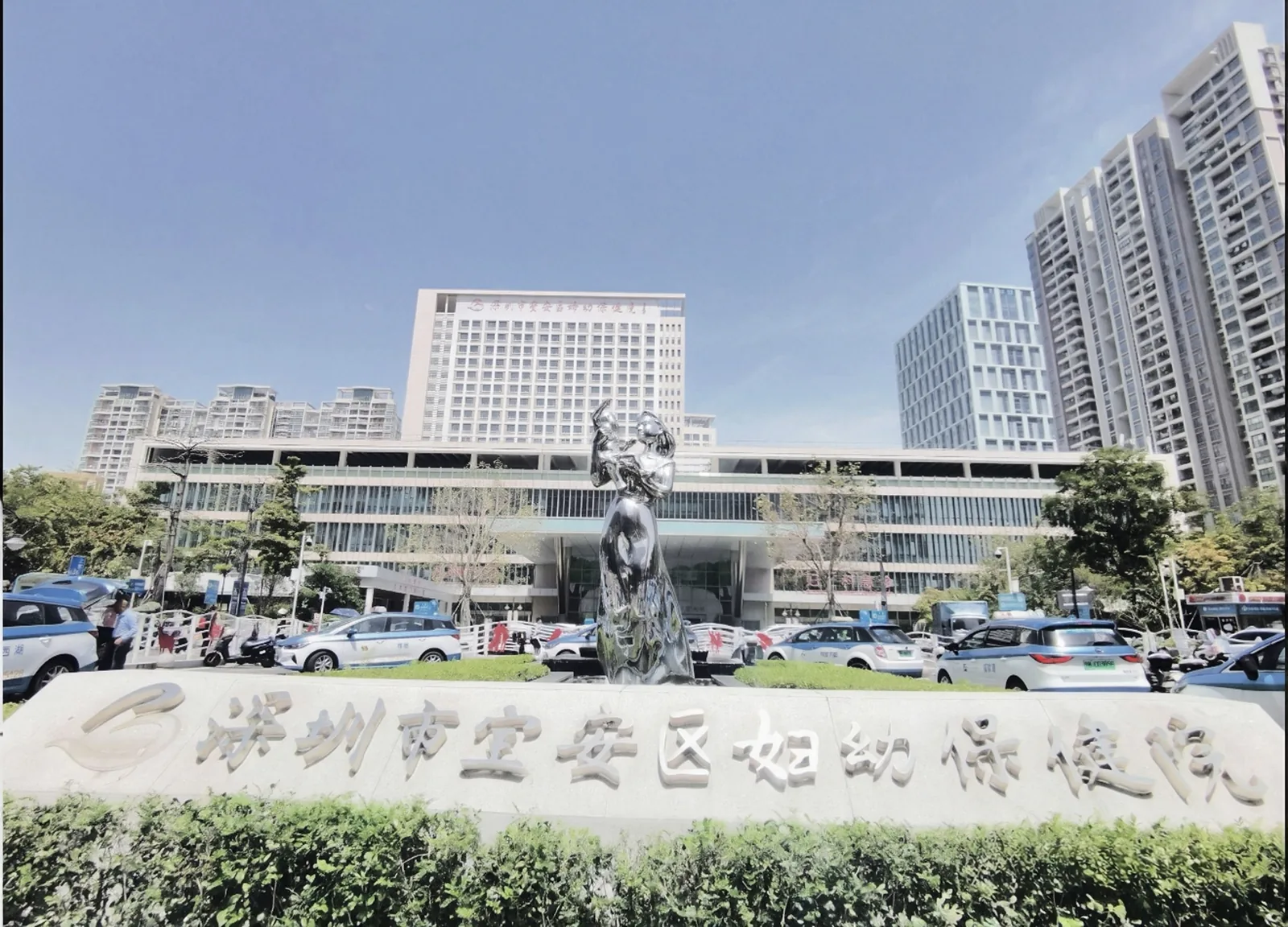
Shenzhen Bao'an Women's and Children's Hospital (深圳市宝安区妇幼保健院) is a public Grade-3A maternal and child health hospital in the Qianhai-Bao'an centre of Shenzhen, founded in 1986 and in its current campus since 2016. It records among the highest delivery volumes in Shenzhen, hosts a maternal-fetal medicine institute built with the Chinese University of Hong Kong, and is recognised for mother–infant safety and birth-defect prevention.
Shenzhen Bao'an Women's and Children's Hospital was founded in 1986 and has operated from its current campus in the Qianhai-Bao'an centre since 2016. It handles roughly two million outpatient visits a year and has ranked first in Shenzhen for delivery volume for several consecutive years — with more than 180,000 babies delivered since the new campus opened.
Beyond volume, the hospital runs a maternal-fetal medicine institute established with the Chinese University of Hong Kong, holds a national preconception health speciality, and was named one of China's first 'smart maternal-child digital hospital' demonstration units. It is also a designated institution for Hong Kong-Macao drugs and devices under the Greater Bay Area scheme — relevant context for families considering cross-border care.
First in Shenzhen for delivery volume for several consecutive years, with neonatal, obstetric and high-risk maternity teams scaled to that volume — practical experience in high-risk and emergency obstetric care.
A maternal-fetal medicine institute built with the Chinese University of Hong Kong brings research and specialist fetal medicine to the hospital, including prenatal diagnosis and fetal therapy.
Named among China's first smart maternal-child digital hospital demonstration units — paperless records, online results and streamlined workflows reduce waiting times.
Finding a hospital's name is easy. Knowing whether it's the right one for your situation — and what to prepare before you travel — is harder. That's where China Care helps.
The departments most commonly accessed by international patients coordinated through China Care.
Finding a hospital is the easy part. Understanding whether it's the right one for your situation is harder — China Care guides you through that, from initial guidance through to on-the-ground support.
Send your medical records and questions to China Care. We review your situation, prepare a bilingual case summary, and help you compare this hospital with other options in Shenzhen.
records review · 1–2 daysChina Care registers your case, translates your records, and confirms your appointment date, department and specialist before you arrange your travel. For complex cases, an initial consultation may be arranged to scope the plan.
appointment confirmed · fixed feeWith your appointment confirmed, you travel for your in-person consultation. The specialist reviews your case, confirms the plan, and provides a formal cost estimate. China Care's bilingual coordinator accompanies you.
in-person consultation · cost estimate issuedOnce you agree to proceed, admission is arranged. China Care's coordinator remains on hand throughout your stay. Ward and administration operate primarily in Mandarin, so on-site escort is strongly recommended for non-Chinese speakers.
payment direct to hospitalBilingual discharge documentation is issued on completion of care. For ongoing treatment or follow-up, remote consultation may be possible depending on the individual physician — China Care can enquire on your behalf after you return home.
bilingual documents · follow-up coordinationWhichever stage you're at, China Care's role is the same: help you make an informed decision, not just a booking.
We'll help you understand whether Bao'an Women's & Children's Hospital — or another hospital in China — may be a better option for your situation.
China Care coordinates your case with the hospital's international team. Treatment costs are quoted directly by the hospital. We never add to or mark up the hospital's quoted treatment cost.
Hospital profile note: This profile is general reference information. China Care does not endorse or guarantee a particular hospital, treatment, appointment, clinical decision, or outcome. Current services, requirements, language support, availability, and clinical suitability should be confirmed directly with the hospital.