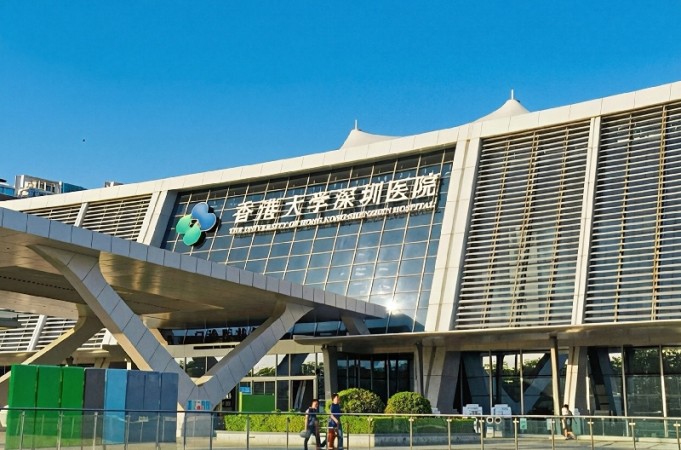
HKU Faculty-LedEnglish-Speaking SpecialistsPublic · Grade 3AEstablished 201220 min from HK border
HKU-Shenzhen Hospital Hong Kong Medical Standards, Mainland China
A hospital operated and clinically led by the University of Hong Kong. HKU faculty lead every major department, all clinical processes follow Western informed consent protocols, and billing is itemised and transparent (subject to confirmation by the hospital's International Medical Center). For the right case, it can offer Hong Kong-standard care at a more accessible cost point — but whether it's the appropriate option for your situation depends on your diagnosis and objectives. China Care helps you work that out before you travel.
1 Haiyuan 1st Road, Futian District, Shenzhen — shuttle from Lok Ma Chau MTR (~20 min from HK border)
Quick Facts
Payment
WeChat Pay, Alipay, cash, or card — direct to hospital
Consultation
In-person required for treatment planning
Advance booking
1–2 weeks minimum
Language
Chinese, with English-speaking specialists
Type
Public hospital · Grade 3A · HKU affiliated
2,000+
Inpatient beds
129+
Countries served (cumulative)
20 min
From HK border by MTR shuttle
HKU
Faculty-led departments
About the Hospital
A Mainland Hospital Operated to University of Hong Kong Clinical Standards
The University of Hong Kong-Shenzhen Hospital (港大深圳医院) opened in 2012. It is a public hospital in mainland China, wholly invested by the Shenzhen Municipal Government and operated with the University of Hong Kong's management model (co-management), where clinical departments are led by University of Hong Kong faculty on permanent rotation — meaning patients see physicians trained and credentialled to the same standard as Hong Kong's Queen Mary Hospital.
The hospital follows an appointment-based outpatient model, Western-style informed consent protocols, and itemised transparent billing — practices designed to feel familiar to patients accustomed to healthcare systems in Hong Kong and other international settings. Its oncology center treats a full range of solid tumours and haematological malignancies, while cardiology, orthopaedics, and health screening are equally prominent services.
For international patients arriving from Hong Kong, HKU-Shenzhen is uniquely convenient: the hospital is served by a direct shuttle from Lok Ma Chau MTR station, placing it approximately 20–30 minutes from the Hong Kong border (Futian Port / Lok Ma Chau). Inpatient rooms in the international wing have private bathrooms. Clinical documentation is in Chinese as standard; some specialists and nursing staff in the international wing speak English, and China Care arranges interpretation for consultations and key documents.
"Bridging Hong Kong's clinical governance with the scale and capability of mainland China — so patients receive the best of both worlds without compromise."
Why Patients Choose HKU-Shenzhen
Three reasons international patients choose HKU-Shenzhen Hospital
Hong Kong Clinical Standards, Contractually Enforced
HKU-Shenzhen is contractually required to deploy HKU faculty to lead departments. Clinical governance, infection control, and patient safety procedures are audited by HKU Medical School on an ongoing basis. For patients who need independently verifiable evidence of clinical standards, this structural guarantee provides a clear basis for confidence.
English-Speaking Specialists Available
Appointment booking, consultation, informed consent, and discharge documentation are conducted in Chinese as standard, as at any mainland hospital. Some HKU-trained specialists and nursing staff in the international wing speak English, and China Care arranges interpretation for consultations, key documents, and day-to-day communication throughout your stay.
Transparent Billing, Mainland Costs
The hospital uses Western-style itemised billing (subject to confirmation by the hospital's International Medical Center) — patients receive a full cost breakdown before procedures, not a single lump sum. Treatment costs are quoted directly by the hospital. For many procedures, treatment costs at HKU-Shenzhen may be lower than comparable care in Hong Kong private hospitals. Contact the hospital's International Medical Center for a personalised cost estimate.
Beyond the Hospital
Why Patients Work With China Care
Finding a hospital's name is easy. Knowing whether it's actually the right one for your situation is much harder — that's where China Care helps.
Most international patients researching HKU-Shenzhen are unsure whether it's genuinely the right fit for their case, or whether another hospital might serve them better. China Care helps you answer questions like:
The departments most commonly accessed by international patients coordinated through China Care at HKU-Shenzhen Hospital.
Primary Focus
Oncology
Comprehensive cancer center treating solid tumours and haematological malignancies. Multidisciplinary tumour boards follow international guidelines. Surgical oncology, medical oncology, radiation, and targeted therapy within a single integrated team.
Full interventional cardiology including coronary angiography, PCI, electrophysiology, and echocardiography. Cardiac surgery capabilities on site. HKU cardiologists oversee complex multi-vessel disease management.
Joint replacement (hip, knee, shoulder), sports injury, spine surgery, and trauma. HKU orthopaedic surgeons use implant systems and post-operative rehabilitation protocols standard in Hong Kong. Wait times significantly shorter than public hospitals in Hong Kong.
Joint ReplacementSpine SurgerySports Injury
Also Available
General Surgery
Minimally invasive laparoscopic and robotic-assisted surgery for hepatobiliary, colorectal, and upper GI conditions. Day surgery and short-stay surgical protocols reduce hospitalisation duration.
Laparoscopic SurgeryRobotic SurgeryColorectal
Also Available
Health Screening
Comprehensive executive health screening including full blood panel, cardiac stress testing, abdominal ultrasound, colonoscopy, chest CT, and cancer marker screening. Popular with executives based in Hong Kong or the Greater Bay Area.
Hospital Access reviews your records, identifies the right HKU specialist team, and books and confirms your appointment before you commit to travelling.
How China Care Helps You Reach HKU-Shenzhen — If It's Right for You
Finding a hospital is the easy part. Understanding whether it's the right one for your situation is harder — China Care guides you through that, from initial guidance through to on-the-ground support in Shenzhen.
Step 1 · Tell Us What You Need
Tell Us About Your Situation
Send your medical records, imaging reports, and a brief description of your condition and treatment goals. For oncology cases, include pathology reports and prior treatment history. This step is free and helps us understand whether HKU-Shenzhen — or another hospital — may be worth exploring for your case.
1–2 days
Step 2 · Hospital Access
China Care Arranges and Confirms Your Appointment
China Care registers your case with HKU-Shenzhen's international coordination team, translates your medical records and referral documents, and confirms your appointment date, department, and specialist before you arrange your travel — all coordinated in English on your behalf. This is a fixed-fee service, agreed with you upfront. Already in China? Skip this step — China Care can arrange direct escort and interpretation for your own visit instead.
Travel to Shenzhen for Your In-Person Consultation
With your appointment confirmed, you travel to Shenzhen for your own in-person consultation. The specialist reviews your case in person, confirms the treatment plan, and provides a formal cost estimate — this step cannot be completed remotely at a public hospital. China Care's bilingual coordinator accompanies you throughout. From Hong Kong, the hospital is reachable in under 30 minutes via the Lok Ma Chau MTR shuttle.
in-person consultation · treatment plan & cost estimate issued
Step 4 · Medical Journey
Admission & Treatment
Admissions paperwork and informed consent documentation are in Chinese as standard at HKU-Shenzhen. China Care's coordinator remains available throughout your stay for translation and logistical needs. Treatment fees are paid directly to the hospital via WeChat Pay, Alipay, cash, or card. For surgical admissions, a deposit is required before the procedure; the balance is settled before discharge.
payment direct to hospital · WeChat Pay / Alipay / cash / card
Step 5 · Medical Journey
Discharge and Follow-Up
Discharge documentation is issued in Chinese on the day of discharge, including imaging and laboratory results in digital format. China Care arranges translation for sharing with your home physician. For ongoing conditions, the hospital's telemedicine service allows follow-up consultations via video with your HKU specialist without returning to Shenzhen. China Care coordinates post-discharge communication and translation as needed.
First ConversationHKU faculty physiciansEnglish-speaking specialists availableItemised transparent billingIn-person escort & interpretation20 min from HK border by MTRWeChat Pay / Alipay / cash / card direct to hospitalDischarge documents translated by China Care
Before You Travel
What international patients need to know
Payment
WeChat Pay, Alipay, cash, or card
All fees paid directly to the hospital. WeChat Pay, Alipay, cash, and credit cards are accepted. A deposit is required for surgical admissions.
Advance booking
1–2 weeks minimum
Walk-in not available for international patients. All appointments booked through China Care before you travel.
Consultation type
In-person required
Specialist consultations and treatment planning require in-person attendance. China Care's Hospital Access service books and confirms your appointment before you travel.
Language
Chinese, with English-speaking specialists
Clinical operations are conducted in Chinese as standard. Some HKU faculty physicians and international-wing staff speak English. China Care provides interpretation for Arabic, Russian, Korean, Portuguese, Spanish, and other language speakers.
From Hong Kong
~20 min by MTR shuttle
Direct shuttle bus from Lok Ma Chau MTR station. Family members can stay in HK and commute daily. From Shenzhen Bao'an Airport: ~40 min.
Hospital type
Public · Grade 3A
Wholly invested by the Shenzhen Municipal Government, operated with the University of Hong Kong's management model (co-management). China's highest hospital classification. Treatment costs quoted directly by the hospital — zero markup from China Care.
Your Next Step
How China Care Can Help
Whichever stage you're at, China Care's role is the same: help you make an informed decision, not just a booking.
Are the standards at HKU-Shenzhen really equivalent to Hong Kong hospitals?
Yes, in the clinical governance sense. HKU faculty lead department heads under a contract requiring adherence to the same clinical protocols used at HKU's Queen Mary Hospital in Hong Kong. This is structurally different from a hospital that has merely hired some international consultants or received a JCI accreditation. Informed consent processes, patient safety reporting, and infection control all follow HKU standards. Support infrastructure (ward facilities, food service) reflects Shenzhen public hospital norms rather than private Hong Kong hospital norms, which is the main practical difference.
How close is HKU-Shenzhen to Hong Kong, and can family commute daily?
The hospital is served by a direct shuttle bus from the Lok Ma Chau MTR station, placing it approximately 20 minutes from the border crossing. Family members accompanying a patient can stay in Hong Kong and commute daily. For outpatient treatment (chemotherapy, cardiology check-ups), many Greater Bay Area patients commute from Hong Kong on treatment days rather than staying overnight. Inpatients requiring continuous monitoring cannot commute but can typically keep family visitors nearby at much lower accommodation cost compared to Hong Kong.
Is English service available throughout the entire stay?
Clinical operations at HKU-Shenzhen are conducted in Chinese as standard, as at any mainland hospital. Some HKU faculty physicians and nursing staff in the international wing speak English, though this varies by individual and is not guaranteed for every consultation. For non-clinical interactions (canteen, general admin desks), Mandarin or Cantonese is typically needed. China Care's coordinator is available throughout your stay to interpret and assist with any situation where language becomes a barrier.
What conditions are treated most frequently by international patients?
The most common reasons international patients access HKU-Shenzhen through China Care are: executive health screening (particularly for Greater Bay Area executives), orthopaedic joint replacement (hip and knee), oncology second opinions and treatment, cardiology evaluation and intervention, and obstetrics for non-residents. The hospital's accessible location relative to Hong Kong makes it especially popular for procedures where patients want to stay close to their home base. (Obstetrics & Gynaecology is a full hospital department, though it is not part of the international-wing specialty set highlighted above.)
How does payment work at HKU-Shenzhen Hospital?
All treatment fees are paid directly to HKU-Shenzhen Hospital. The hospital accepts WeChat Pay, Alipay, cash, and credit cards. For surgical admissions, a deposit is typically required before the procedure; the remaining balance is settled before discharge. Non-surgical outpatient treatment is generally paid as services are rendered. Payment is made directly to the hospital. China Care does not collect or process medical payments on your behalf; the China Care coordination fee is paid to China Care separately and in advance.
What visa do I need to receive treatment at HKU-Shenzhen?
Hong Kong residents holding a Home Return Permit (回乡证) can enter Shenzhen directly without a visa. Foreign nationals from 77+ exempt countries can typically enter visa-free for treatment stays up to 30 days (visa-free policy is subject to change — confirm current eligibility before travel). For treatment exceeding 30 days, an S2 medical visa is required. The hospital's International Medical Center can issue the official invitation letter needed to support the S2 application (subject to IMC confirmation) — China Care coordinates this process but cannot issue the letter itself. See our complete guide: Medical Visa for China 2026.
Disclaimer: The information on this page is provided for general reference purposes only and may be subject to change. Patients should confirm service availability, pricing, and clinical details directly with the hospital. China Care does not provide medical advice or guarantee clinical outcomes.
Still Deciding?
Not every hospital is the right fit for every patient
We'll help you understand whether HKU-Shenzhen — or another hospital in China — may be a better option for your situation.
China Care coordinates your case with HKU-Shenzhen Hospital's international patient team. Treatment costs are quoted directly by the hospital. We never add to or mark up the hospital's quoted treatment cost.
Hospital profile note: This profile is general reference information. China Care does not endorse or guarantee a particular hospital, treatment, appointment, clinical decision, or outcome. Current services, requirements, language support, availability, and clinical suitability should be confirmed directly with the hospital.
We use essential cookies to make this site work. With your permission, we also use analytics cookies to improve it. See our Cookie Policy for details.