
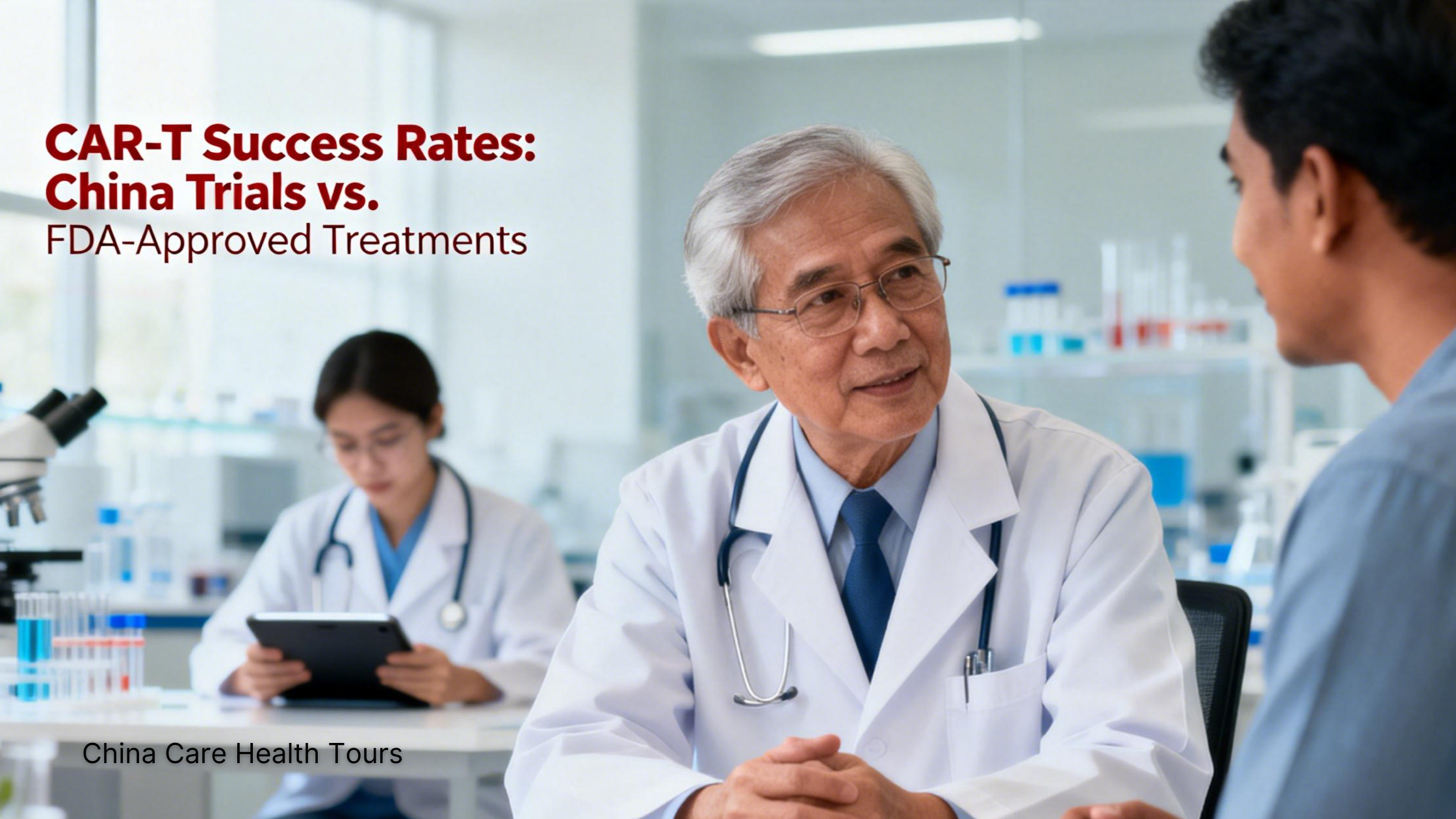
In 2026, Chinese CAR-T therapies such as Fucaso (Equecabtagene Autoleucel) have demonstrated overall response rates (ORR) of 96–98% in Multiple Myeloma, rivaling or exceeding FDA-approved benchmarks like Carvykti. When evaluating CAR-T success rates in China vs the USA, the data for blood cancers is particularly compelling — and China is now also leading the charge in solid tumor applications.
For the full context of cancer treatment options in China where CAR-T fits, see Cancer Treatment in China.
Key Facts
- Fucaso (Equecabtagene Autoleucel), China’s NMPA-approved CAR-T for Multiple Myeloma, showed a 96.3% ORR and 88.4% complete remission (CR) rate in CAR-T-naïve patients at Shanghai Ruijin Hospital.
- FDA-approved therapies Abecma and Carvykti show CR rates of approximately 70–80% in comparable patient populations.
- Chinese dual-target CAR-T (CD19 + CD22) reduces antigen-escape relapse rates by up to 30% compared to single-target Western protocols.
- Chinese GPC3- and Claudin 18.2-targeting solid tumor trials report ORR of 56.5% in advanced solid tumors — a milestone still largely elusive for Western CAR-T development.
- Chinese labs achieve “vein-to-vein” manufacturing in 10–14 days vs 4–6 weeks in the USA, with less than 2% severe (Grade 3+) neurotoxicity rates reported.
Table of Contents
Hematological Success: Head-to-Head Data
When evaluating CAR-T success rates China vs USA, the data for blood cancers is particularly compelling.
Multiple Myeloma (BCMA Target)
Studies from leading institutions like Shanghai Ruijin Hospital, which completed over 100 commercial CAR-T discharges by late 2025, show a 96.3% ORR and an 88.4% complete remission (CR) rate in CAR-T-naïve patients with relapsed/refractory Multiple Myeloma.
FDA-approved therapies like Abecma (idecabtagene vicleucel), whose landmark KarMMa trial reported a 73% ORR, and Carvykti (ciltacabtagene autoleucel), whose CARTITUDE-1 trial reported a 97.9% ORR but in a heavily pre-treated population, have shown CR rates of around 70–80% in similar patient populations. NCCN guidelines for Multiple Myeloma now list anti-BCMA CAR-T as a recommended option for relapsed/refractory disease.
Leukemia (B-ALL)
Chinese hospitals, particularly those collaborating with companies like Gracell Biotechnologies, are pioneers in dual-target CAR-T (e.g., targeting both CD19 and CD22). Data from trials published on PubMed indicate that this approach significantly reduces the “Antigen Escape” relapse rate by up to 30% compared to traditional single-target FDA treatments — such as FDA-approved Kymriah (tisagenlecleucel), the first CAR-T therapy to receive regulatory clearance for B-cell ALL.
The “Solid Tumor” Frontier (2026 Update)
While CAR-T for solid tumors remains a challenge globally, China is making significant strides.
Liver & Gastric Cancers
Leading Chinese institutions are conducting cutting-edge GPC3-targeting (glypican-3) trials for hepatocellular carcinoma (liver cancer) and Claudin 18.2-targeting trials for gastric cancer. Published data from these trials show promising overall response rates (ORR) of 56.5% in advanced solid tumors — a milestone still largely elusive for Western CAR-T development. For context on the broader landscape of novel CAR-T targets, researchers have also reported encouraging data in a 2022 New England Journal of Medicine study on GPRC5D-targeting CAR-T in myeloma, illustrating the pace of antigen diversification in the field.
The Boao Lecheng Factor
The Hainan Boao Lecheng International Medical Tourism Pilot Zone acts as a special zone allowing faster access to innovative, combined therapies (CAR-T + PD-1 inhibitors) and rapid data collection, accelerating the development of solid tumor CAR-T solutions.
Why are the Rates Different? (Expert Insights)
Manufacturing Speed
Chinese labs often achieve a “Vein-to-Vein” time (from cell collection to infusion) of 10–14 days, significantly faster than the 4–6 weeks often seen in the US. This speed reduces the risk of disease progression during the manufacturing window. Mayo Clinic’s overview of CAR-T cell therapy notes that the manufacturing wait is one of the key practical challenges patients face globally.
Trial Volume & Innovation
China’s immense patient population and government support for biotechnology have led to more active CAR-T clinical trials than the rest of the world combined. This volume accelerates learning and protocol refinement. You can search active trials at ClinicalTrials.gov.
For a detailed breakdown of what leading institutions offer, see our guide to the Best CAR-T Cell Therapy Hospitals in China.
Safety & Side Effect Comparison
CRS Management
Chinese hospitals have developed highly efficient and proactive protocols for managing Cytokine Release Syndrome (CRS), with published trials indicating a less than 2% incidence of severe (Grade 3+) neurotoxicity. For comparison, the pivotal ZUMA-1 trial of axicabtagene ciloleucel for large B-cell lymphoma reported Grade 3+ neurological events in 28% of patients — underscoring the significance of China’s refined post-infusion monitoring protocols.
In-Patient Observation
Most Chinese hospitals require a comprehensive 14-day or longer in-patient observation period post-infusion, ensuring vigilant monitoring for side effects — a more conservative and safer standard than the outpatient infusion common in the US.
Conclusion: Is China Right for You?
For international patients, the CAR-T success rates China vs USA present a compelling case. With ORR of 90–98% for hematological cancers, groundbreaking solid tumor trials, faster manufacturing, and costs of $40,000–$100,000 USD versus $400,000+ in the USA, China’s leading hospitals offer a genuine alternative for patients who face waitlists or cost barriers in the West.
To understand the step-by-step process of receiving treatment, see our CAR-T Treatment Timeline in China: 2026 Step-by-Step Guide.
Frequently asked questions about CAR-T success rates China vs USA
1. What are the CAR-T cell therapy success rates in China vs USA for 2026?
In 2026, Chinese CAR-T trials for Multiple Myeloma and Leukemia report overall response rates (ORR) of 90–98%, which are comparable to or higher than FDA-approved standards. For example, the Chinese-approved Fucaso has shown an 88.4% complete remission rate in clinical settings.
2. How much does CAR-T therapy cost in China compared to the United States?
The cost of CAR-T therapy in China typically ranges from $40,000 to $100,000 USD, whereas FDA-approved treatments in the USA often exceed $400,000. This 70-80% cost reduction includes high-quality care at JCI-accredited hospitals in Shanghai and Beijing.
3. Is dual-target CAR-T therapy available in China for international patients?
Yes, China is a leader in dual-target CAR-T therapy (e.g., CD19 + CD22). Many hospitals, such as GoBroad and Ruijin, offer these advanced protocols to foreigners, which can reduce relapse rates by up to 30% compared to single-target Western treatments.
4. Can I get a medical visa for China to receive CAR-T treatment?
Foreign patients can apply for an S2 Medical Visa for China. To qualify in 2026, you must provide an official medical invitation letter from an accredited Chinese hospital. Professional medical tourism facilitators can assist with this documentation.