
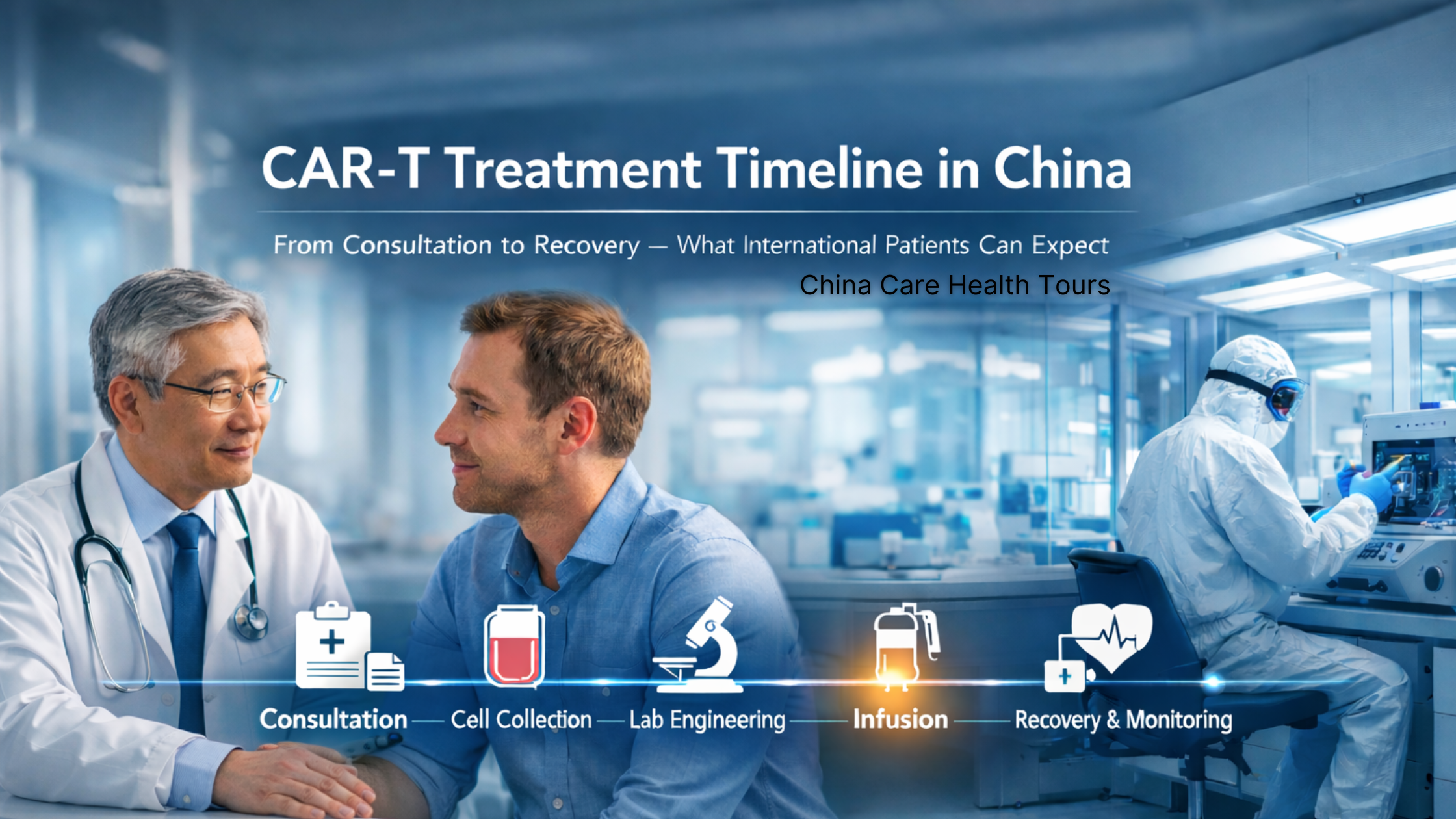
The typical CAR-T treatment timeline in China spans 4 to 8 weeks from initial screening to discharge. This includes a 1-week evaluation, a 2-week manufacturing phase, and a 14-to-28-day inpatient monitoring period. Patients seeking rapid care can often access “Next-Day CAR-T” platforms in Shanghai, which reduce the car t cell therapy cost in china and manufacturing time significantly. Mayo Clinic describes CAR-T cell therapy as a process that involves collecting and modifying a patient’s own T-cells before reinfusing them — a multi-step journey that requires careful coordination at every phase.
Key Facts
- Total CAR-T treatment stay in China: 4–8 weeks from initial screening to discharge.
- Standard manufacturing time (vein-to-vein): 10–14 days in China vs 4–6 weeks in the USA.
- FasTCAR (Gracell): next-day manufacturing — cell engineering completed within 24 hours vs. 1–6 weeks (global standard); total treatment stay including monitoring remains 4–6 weeks.
- China mandates 14–28 days inpatient observation post-infusion; the USA commonly uses outpatient infusion.
- S2 Medical Visa approval typically takes 4–10 days once the hospital invitation is issued.
Table of Contents
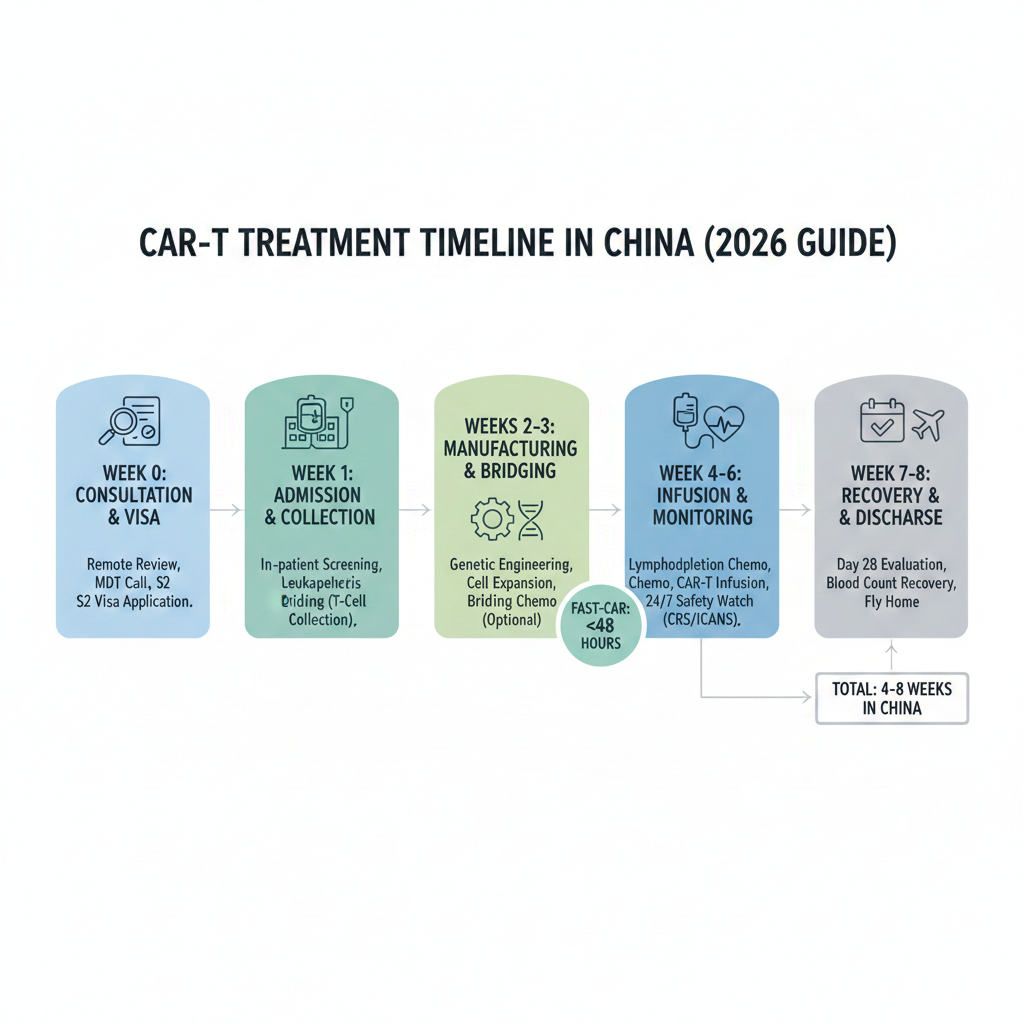
Phase 1: Remote Evaluation & Visa (Week 0)
Before booking your flight, you must clear the “Digital Gateway.” 2026 protocols emphasize remote verification to ensure international patients are fit for travel.
- Document Submission: You will provide PET-CT scans, IHC pathology reports, and recent blood work via secure channels (or WhatsApp).
- Virtual MDT: A Multidisciplinary Team at hospitals like Shanghai Ruijin or Beijing GoBroad reviews your eligibility.
- Visa Issuance: Once approved, the hospital sends a formal invitation. You then apply for an S2 Medical Visa, which typically takes 4–10 days.
Phase 2: Admission & Cell Collection (Week 1)
Upon arrival in China, you are admitted to the hematology ward for the “Vein-to-Vein” starting point.
- Day 1–3: Baseline Tests: In-person screening to confirm organ function (Heart/Lung/Kidney).
- Day 4–5: Leukapheresis: This is the cell collection process. A machine filters T-cells from your blood and returns the rest. It takes about 3–5 hours and is generally painless. This step is the same procedure used in all FDA-approved CAR-T therapies and forms the biological foundation of the entire treatment.
Phase 3: Manufacturing & Bridging (Weeks 2–3)
While your T-cells are in the lab being “armed” with cancer-fighting receptors, you enter the waiting phase.
- Lab Engineering: In 2026, Gracell’s FasTCAR platform achieves next-day manufacturing — compressing the cell engineering step to within 24 hours, compared to the global standard of 1–6 weeks. The total treatment stay (leukapheresis through post-infusion monitoring) remains 4–6 weeks. China’s manufacturing speed advantage is visible in the active trial pipeline at ClinicalTrials.gov, where dozens of Chinese studies specifically investigate accelerated vector and cell engineering platforms.
- Bridging Therapy: If your tumor burden is high, doctors may administer low-dose chemotherapy to keep the cancer stable while the CAR-T cells are being manufactured.
For more on which hospitals offer the fastest manufacturing, see our guide to the Best CAR-T Cell Therapy Hospitals in China.
Phase 4: Infusion & Critical Monitoring (Weeks 4–6)
This is the most sensitive part of the car-t cell therapy treatment journey, as it requires intensive 24/7 nursing care.
- Conditioning (Days −3 to −1): You receive “lymphodepletion” chemotherapy to clear space for the new cells. NCCN guidelines for B-cell lymphomas specify lymphodepleting conditioning as a mandatory preparatory step before CAR-T infusion.
- The Infusion (Day 0): The modified CAR-T cells are infused back into your bloodstream.
- Inpatient Watch: Unlike the US, where outpatient infusion is common, China requires a 14-to-28-day hospital stay. Doctors monitor for Cytokine Release Syndrome (CRS) and neurological side effects (ICANS). MD Anderson Cancer Center identifies CRS and neurotoxicity as the two primary safety concerns requiring close inpatient observation after any CAR-T infusion.
Phase 5: Recovery & Discharge (Weeks 7–8)
Once your white blood cell counts recover and side effects are managed, you move toward the finish line.
- Evaluation: A day-28 PET-CT or bone marrow biopsy is performed to assess the initial response.
- Discharge: You receive a comprehensive English medical report and a 3-month follow-up plan before flying home.
Summary Timeline Table
| Phase | Duration | Primary Activity |
| Pre-Travel | 7–10 Days | Medical review & S2 Visa approval |
| Collection | 3–5 Days | Hospital admission & Leukapheresis |
| Manufacturing | 2–14 Days | Genetic cell modification in GMP lab |
| Recovery | 14–28 Days | Inpatient monitoring for CRS/safety |