
CAR-T cell therapy has shown durable remission in certain blood cancers, but the cost in the US remains a major barrier — commonly $400,000–$500,000 for an approved product alone. As of July 2026, China has nine NMPA-approved CAR-T products, including the world’s first approved CAR-T for a solid tumour. Official manufacturer list prices in China run roughly $125,000–$215,000 depending on the product and current exchange rate — a real but more modest saving than some older estimates suggest, and one grounded in official RMB pricing rather than a single US-dollar figure.
Key Facts
- Nine CAR-T products are NMPA-approved in China as of July 2026, spanning CD19, BCMA, and (for the first time globally) CLDN18.2 targets.
- Official list prices in China run roughly $125,000–$215,000 per product, versus $400,000–$500,000 for equivalent approved products in the US.
- Manufacturing time (“vein-to-vein”) for commercial CAR-T products is 7–21 days, not a same-day or 24–36 hour process.
- Commercial CAR-T — not a clinical trial — is the realistic, predictable pathway for most international patients.
- Clinical trial access exists in China and includes investigational approaches such as dual-target CD19/CD20 constructs, but enrollment for first-time overseas patients is selective and should not be assumed.
Table of Contents
Why China for CAR-T Therapy?

Is CAR-T cell therapy accessible for international patients? This form of immunotherapy has shown durable remission in certain blood cancers previously considered untreatable, but the cost of an approved CAR-T product in the US commonly runs $400,000–$500,000 — a figure reflected in the FDA-approved list price for Kymriah (tisagenlecleucel) and Yescarta (axicabtagene ciloleucel). By July 2026, China’s National Medical Products Administration (NMPA) had approved nine CAR-T products, including licensed equivalents to Yescarta, Kymriah, Abecma, and Carvykti, plus satricabtagene autoleucel (satri-cel) — approved 22 June 2026 as the world’s first commercially approved CAR-T product for a solid tumour (CLDN18.2-positive gastric and gastroesophageal junction adenocarcinoma).
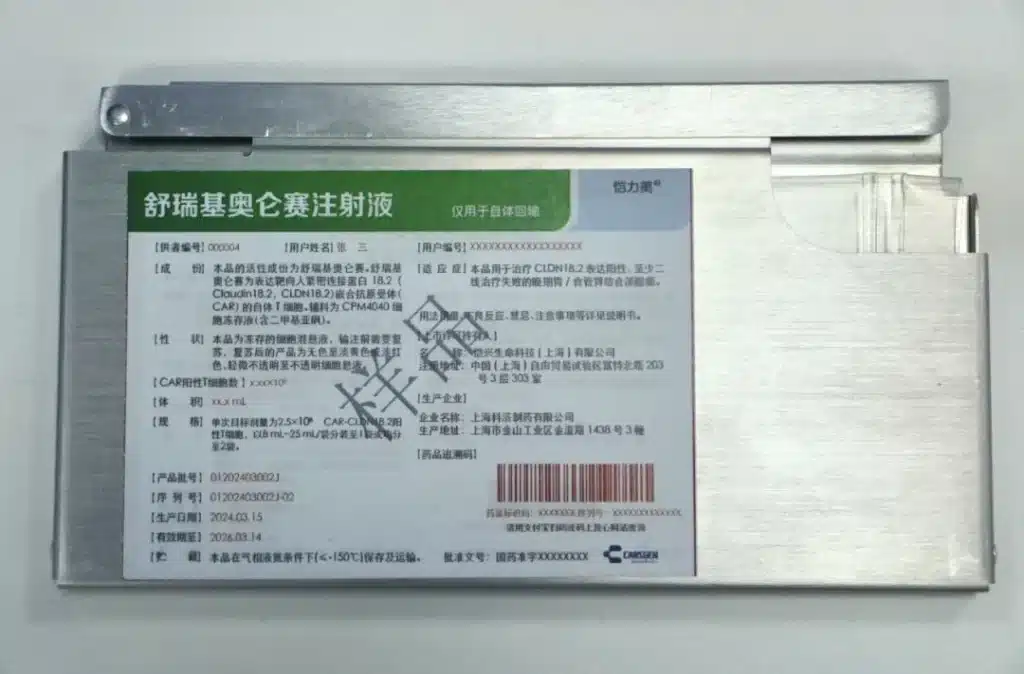
commercial CAR-T product for a solid tumour. (Source: thepaper.cn)
China also hosts more registered clinical trials for CAR-T therapy than any other country, including trials exploring solid tumours, autoimmune disease, and dual-target constructs for patients who have relapsed after single-target CAR-T. For international patients, the realistic picture looks like this:
- Affordability: Official list prices for approved products are roughly 50–70% lower than equivalent approved products in the US.
- A commercial pathway that does not depend on trial enrollment: most patients who contact us are matched to an already-approved product, not a research protocol.
- An active trial landscape for harder-to-treat cases — genuinely valuable, but access for first-time overseas patients is selective, not guaranteed.
For a deeper look at clinical outcomes, see our guide to CAR-T success rates: China trials vs FDA-approved treatments.
2026 Cost Comparison Table
RMB prices below are official manufacturer list prices as of July 2026 and do not change with the market. USD figures are approximate reference ranges only, since the RMB–USD exchange rate fluctuates — always confirm the current rate for an exact conversion. Actual invoiced cost is quoted directly by the treating hospital.
| Product | Target | Indication | Approved | List Price (China) | Equivalent Product Cost (US) |
|---|---|---|---|---|---|
| Axi-cel (奕凯达®) | CD19 | DLBCL, FL, MCL | Jun 2021 | ¥1.20M (~$165K–$185K) | $400K+ (Yescarta) |
| Relma-cel (倍诺达®) | CD19 | DLBCL, B-ALL | Sep 2021 | ¥1.29M (~$175K–$200K) | $400K–$500K |
| Equecab-cel (福可苏®) | BCMA | Multiple Myeloma | Jun 2023 | ¥1.166M (~$160K–$180K) | $450K+ |
| Zevor-cel (赛恺泽®) | BCMA | Multiple Myeloma | Mar 2024 | ¥1.15M (~$155K–$180K) | $450K+ |
| Cilta-cel (卡卫荻®) | BCMA | Multiple Myeloma (3L+) | Aug 2024 | ¥1.15M (~$155K–$180K) | $500K+ (Carvykti) |
| Satri-cel (恺力美®) | CLDN18.2 | Gastric / GEJ adenocarcinoma | Jun 2026 | ¥0.99M (~$135K–$155K) | No approved equivalent yet |
For clinical trial participants — where a trial pathway genuinely applies to your case — costs can be lower still, typically $15,000–$40,000, and some trials are subsidised. This is not the default pathway for most patients; see the next section for why.
According to the WHO global cancer statistics, blood cancers collectively represent millions of new diagnoses annually, and access to affordable, proven therapies like CAR-T has become a critical global health priority. MD Anderson Cancer Center describes CAR-T as one of the most significant advances in oncology.
For the full range of cancer treatment options and costs beyond CAR-T, see Cancer Treatment in China. For context on how China compares in other advanced therapies, see our Proton Therapy Cost in China vs USA: 2026 Comparison Guide.
Commercial Products vs Clinical Trials: Set Realistic Expectations
Since May 2026, China’s CAR-T landscape has split into two clearly distinct pathways, and confusing them leads to unrealistic expectations.
Commercial CAR-T means receiving one of the nine NMPA-approved products listed above at a qualified hospital. This is standard clinical care, not a trial, and it is not subject to a research team’s recruitment decisions. For the large majority of international patients whose diagnosis matches an approved indication (DLBCL, follicular lymphoma, mantle cell lymphoma, multiple myeloma, B-ALL, or CLDN18.2-positive gastric cancer), this is the realistic and recommended pathway.
Clinical trial CAR-T is available only through hospitals conducting registered trials, and only if your diagnosis does not fit an approved product. This includes genuinely promising investigational approaches — for example, researchers at Shenzhen University General Hospital, working with Shenzhen Haoshi Biotechnology, have reported early results for an investigational CD19/CD20 dual-target CAR-T in relapsed or refractory B-cell non-Hodgkin lymphoma: in a cohort of 32 evaluable patients, the overall response rate was 74% and the complete response rate was 58%. This is a real and encouraging signal for a dual-target approach in patients who have exhausted single-target options, but it is an investigational construct, not an NMPA-approved commercial product, and no head-to-head relapse-rate comparison against single-target Western protocols has been published.
Recruitment into trials like this is managed by the research team, and places are typically offered first to patients already established within that hospital’s domestic referral network. First-time overseas enrollment is uncommon — even when a patient appears medically eligible on paper, admission is decided by the investigators and the study protocol, not guaranteed by eligibility alone. Treat trial access as a possibility worth exploring if your case genuinely warrants it, not a plan to rely on before you have an honest read on your odds.
The Process for International Patients
Accessing CAR-T treatment in China generally involves a three-step process:
- Remote File Review: Specialists evaluate your current medical reports and identify whether an approved commercial product fits your diagnosis, or whether a trial pathway is genuinely relevant to your case.
- S2 Medical Visa: Full assistance with the necessary health travel documentation.
- Treatment & Recovery: Plan for a minimum of 4–6 weeks in China, covering hospital assessment, leukapheresis, the 7–21 day manufacturing wait, conditioning chemotherapy, infusion, and post-infusion monitoring.
For visa guidance, see the complete China Medical Visa guide (2026).
Additional context on what leading hospitals offer can be found in our guide to the Best CAR-T Cell Therapy Hospitals in China for Foreigners (2026 Guide).
Get a Free, Confidential Medical File Evaluation
Feeling uncertain about where to start, or whether you are even a candidate for CAR-T cell therapy in China? The sheer amount of information online can be paralyzing. Often, the most practical first step is to get a professional, clinical perspective on your specific situation.
We offer a free, preliminary medical file review to help bring clarity to your options. This is not a sales pitch, but a confidential assessment conducted in partnership with our medical network in China.
Here’s how it works:
- You share your details securely.
- A preliminary clinical review is conducted.
- You receive feedback including:
- Whether your diagnosis fits an NMPA-approved commercial product — the realistic pathway for most patients.
- An honest read on whether a clinical trial is genuinely relevant to your case, and how likely enrollment is.
- What the next steps would be if you chose to proceed.
- A realistic cost range based on official list pricing for your specific case.
This process is designed to translate your medical documents into actionable information, helping you make a more informed decision about whether to pursue this path further. There is no obligation whatsoever.
Submit your diagnosis and treatment history. We review your case and respond within 24 hours — no cost, no obligation.
References
- Shenzhen University General Hospital / Shenzhen Haoshi Biotechnology — reported clinical data on an investigational CD19/CD20 dual-target CAR-T in relapsed/refractory B-cell non-Hodgkin lymphoma (co-first authors Prof. Wang Lixin and Dr. Fang Chuling; corresponding investigators Prof. Yu Li and Dr. Li Yisheng).
- China Care Health Tours: CAR-T Success Rates — China Trials vs FDA-Approved Treatments (2026 Comparison) — https://chinacarehealthtours.com/car-t-success-rates-china-trials-vs-fda-approved-treatments-2026-comparison/
- China Care Health Tours: Best CAR-T Cell Therapy Hospitals in China for Foreigners (2026 Guide) — https://chinacarehealthtours.com/best-car-t-cell-therapy-hospitals-in-china/
- China Care Health Tours: How to Get a Medical Visa for China — A Complete 2026 Guide — https://chinacarehealthtours.com/how-to-get-a-medical-visa-for-china-a-complete-2026-guide/
- China Care Health Tours: Proton Therapy Cost in China vs USA: 2026 Comparison Guide — https://chinacarehealthtours.com/proton-therapy-cost-in-china-vs-usa-2026-comparison-guide/