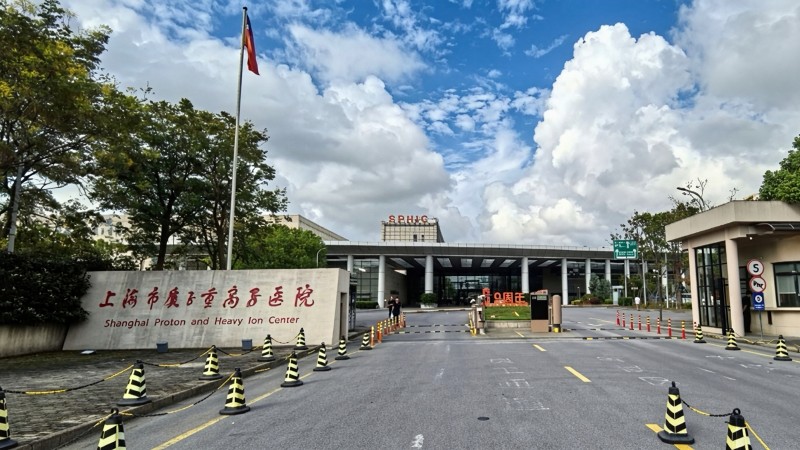
Proton TherapyCarbon Ion TherapySpecialised 3A HospitalPudong · Opened 2014Skull Base & Head/Neck
Shanghai Proton and Heavy Ion Center SPHIC, Pudong, Shanghai
China’s dedicated precision radiation oncology center — one of fewer than 15 facilities globally offering carbon ion (heavy ion) therapy. Carbon ion treatment at SPHIC costs approximately USD 45,000–60,000, compared to USD 100,000–120,000 in Germany or Japan. Not every tumour type qualifies for particle therapy — China Care helps you work out whether SPHIC may be a suitable option for your case, and coordinates the eligibility review and full travel logistics before you commit to travelling.
4365 Kangxin Road, Pudong New Area, Shanghai — ~15 min from Pudong International Airport
Quick Facts
Payment
Paid directly to hospital
Eligibility
Remote review before travel; simulation after confirmation
Advance booking
1–2 weeks minimum
Treatment duration
3–7 weeks total (simulation + fractions)
Type
Specialised public 3A hospital · Opened 2014
2014
Year opened
2–3×
Carbon ion radiobiological effectiveness vs X-ray
~$50K
Average treatment cost vs $150K+ in US
<15
Centers globally offering carbon ion therapy
About the Center
China’s Only Dedicated Particle Therapy Center — Proton and Carbon Ion Under One Roof
Shanghai Proton and Heavy Ion Center (上海市质子重离子医院, SPHIC) is China’s first and most specialised facility for particle radiation therapy. Opened in 2014 in Pudong and jointly established by the Shanghai Municipal Government together with leading academic institutions, SPHIC operates as a dedicated 3A specialty hospital focused exclusively on proton beam therapy and carbon ion (heavy ion) therapy.
Carbon ion therapy is the most biologically effective form of radiation currently available for solid tumours. Carbon ions deposit energy precisely at the tumour site (the Bragg peak effect), deliver 2–3 times higher radiobiological effectiveness than conventional photon radiation, and cause significantly less damage to surrounding healthy tissue than X-ray or even proton-based treatment. SPHIC is one of only a small number of centers in the world that can offer carbon ion therapy, alongside facilities in Germany, Japan, Austria, and Italy — fewer than 15 globally.
Proton therapy at SPHIC is particularly valuable for tumours adjacent to critical structures — skull base, brainstem, optic nerve, spinal cord, and paediatric tumours where radiation dose to developing tissue must be minimised. SPHIC uses the pencil beam scanning technique, the most precise proton delivery method currently available, allowing three-dimensional dose shaping around irregular tumour volumes.
For international patients, SPHIC offers a cost-effective treatment option. Carbon ion therapy in Germany or Japan costs USD 100,000–120,000 for a full course. At SPHIC, equivalent treatment is available at approximately USD 45,000–60,000. China Care coordinates the full eligibility assessment and in-Shanghai logistics for patients travelling for treatment.
Particle Therapy: Cost Comparison (2026)
Location
Proton Therapy
Carbon Ion Therapy
United States
USD 150,000–250,000
Not widely available
Germany / Japan
USD 80,000–120,000
USD 100,000–120,000
SPHIC Shanghai
USD 30,000–45,000
USD 45,000–60,000
Treatment costs quoted directly by the hospital. Estimates vary by tumour type, fractions, and complexity. China Care provides a case-specific cost estimate before travel.
“Carbon ion therapy delivers 2–3 times higher tumour-killing effectiveness than conventional X-ray radiation — SPHIC’s equipment and clinical protocols are equivalent to centers in Germany and Japan, at roughly half the cost.”
Why Patients Choose SPHIC
Three reasons international patients choose SPHIC
Carbon Ion: The Most Precise Radiation Available
Carbon ion therapy delivers 2–3 times higher tumour-killing effectiveness than conventional X-ray radiation while sparing surrounding healthy tissue. It is the treatment of choice for radio-resistant tumours, skull base tumours, chordomas, chondrosarcomas, and selected head and neck cancers. With fewer than 15 centers globally offering this modality, SPHIC is one of the most accessible options for patients outside Europe and Japan.
World-Class Technology at Half the Western Cost
Carbon ion therapy at SPHIC costs approximately USD 45,000–60,000 for a full treatment course. The same treatment in Germany or Japan costs USD 100,000–120,000. Proton therapy at SPHIC runs approximately USD 30,000–45,000, compared to USD 150,000–250,000 in the United States. The technology and clinical protocols are equivalent — the cost difference reflects healthcare system economics, not quality.
Optimal for Paediatric & Neurological Tumours
For brain tumours, skull base lesions, spinal tumours in children, and cancers near the optic pathway, minimising radiation dose to healthy developing tissue is critical. SPHIC’s pencil beam scanning proton therapy and carbon ion programme are specifically suited to these cases, offering dose precision that conventional IMRT or VMAT cannot achieve. Proton therapy is standard of care for many paediatric CNS tumours.
Beyond the Hospital
Why Patients Work With China Care
Finding a treatment center’s name is easy. Knowing whether it’s actually the right one for your situation is much harder — that’s where China Care helps.
Most international patients researching SPHIC are unsure whether proton or carbon-ion therapy is genuinely appropriate for their case, or whether another treatment approach might serve them better. China Care helps you answer questions like:
Is my cancer type eligible for proton or carbon-ion therapy?
Are there better treatment options for my condition?
Can my case be reviewed before I travel?
What documents and imaging should I prepare?
How does this compare with conventional radiotherapy for my case?
Chordomas and chondrosarcomas of the skull base and cervical spine — the primary global indication for carbon ion therapy, where no other modality achieves equivalent local control rates.
ChordomaChondrosarcomaCervical Spine
Also Indicated
Brain Tumours
Gliomas, meningiomas, pituitary adenomas, and acoustic neuromas. Proton therapy reduces integral dose to the normal brain, reducing long-term cognitive effects vs conventional radiotherapy.
GliomaMeningiomaPituitary Adenoma
Also Indicated
Paediatric Oncology
Medulloblastoma, ependymoma, rhabdomyosarcoma, and paediatric brain tumours. Proton therapy is standard of care for many paediatric CNS tumours precisely because it spares developing neural tissue.
MedulloblastomaCNS TumoursEpendymoma
Also Indicated
Prostate Cancer
Proton therapy for localised and locally advanced prostate cancer, reducing rectal and bladder dose compared to conventional IMRT. Fewer gastrointestinal side effects with equivalent oncological outcomes.
LocalisedLocally Advanced
Explore your options
Not sure if proton or carbon-ion therapy is right for your case?
Hospital Access reviews your records and imaging, checks your eligibility against SPHIC’s treatment criteria, and books and confirms your appointment before you commit to travelling.
How China Care Helps You Reach SPHIC — If It’s Right for You
Finding a treatment center is the easy part. Understanding whether it’s the right one for your situation is harder — China Care guides you through that, from initial guidance through to on-the-ground support in Shanghai.
China Care coordinates the full pathway from initial eligibility review through to on-the-ground support during your treatment course in Shanghai.
Step 1 · Tell Us What You Need
Submit Your Records to China Care
Send your pathology reports, staging scans, and prior treatment history. For re-irradiation cases, include all prior radiotherapy records and dose maps. We review your records and prepare a bilingual case summary within 1–2 working days. Not all tumour types are suitable for particle therapy — we confirm clinical fit before you travel.
records review · 1–2 days
Step 2 · Hospital Access
China Care Arranges and Confirms Your Appointment
China Care registers your case with SPHIC, translates your medical records, imaging, and referral documents, and confirms your appointment date and eligibility assessment against SPHIC’s treatment criteria before you arrange your travel — all coordinated in English on your behalf. The radiation oncology team reviews your case in advance and confirms whether proton or carbon ion therapy is indicated, with an initial treatment timeline reported back to you. This is a fixed-fee service, agreed with you upfront. Already in China? Skip this step. After your appointment is confirmed, you will travel for a planning CT and treatment simulation before fractions begin.
With your appointment confirmed, you travel to Shanghai. The first week at SPHIC typically includes planning CT/MRI, immobilisation mask or mould fitting, and treatment planning review. The formal treatment plan and cost estimate are confirmed at this stage. China Care’s coordinator accompanies you throughout the simulation process.
planning simulation · treatment plan & cost confirmed
Step 4 · Medical Journey
Treatment Course
Daily treatment fractions are delivered Monday–Friday for 3–6 weeks depending on the protocol. All treatment fees are paid directly to SPHIC — accepted payment methods vary; your China Care coordinator will confirm before you travel. China Care remains your point of contact for translation, clinical questions, and logistics support throughout. Bilingual escort strongly recommended as clinical communications on the ward are in Mandarin.
daily fractions · payment direct to hospital
Step 5 · Medical Journey
Completion & Follow-Up
Full treatment summary, dosimetry records, and response assessment imaging are delivered digitally at the end of the treatment course. China Care provides guidance for continuing oncology management at home and can arrange remote follow-up scheduling with SPHIC radiation oncologists for post-treatment queries.
treatment records · post-treatment support
Hospital Access (fixed fee)Eligibility pre-screeningBilingual case coordinationPlanning simulation supportIn-person escort & translationRMB payment direct to hospitalBilingual treatment recordsPost-treatment coordination
Before You Travel
What international patients need to know
Payment
Direct to hospital
Payment is made directly to the hospital. Accepted payment methods vary by hospital — your China Care coordinator will confirm before you travel.
Advance booking
1–2 weeks minimum
Eligibility must be confirmed before travel. All coordination through China Care before you book flights.
Treatment duration
3–7 weeks total
Includes simulation week and treatment fractions. Exact timeline depends on tumour type and protocol. China Care provides a case-specific estimate.
Language
Limited English on-site
Clinical communications at SPHIC are primarily in Mandarin. Bilingual escort from China Care is strongly recommended throughout treatment.
From airport
~15 min from Pudong
~15 min taxi from Pudong International Airport. Pudong New Area. Convenient for patients arriving on international flights.
Hospital type
Specialised public 3A
Dedicated particle therapy center. Treatment costs quoted directly by the hospital — zero markup from China Care.
Your Next Step
How China Care Can Help
Whichever stage you’re at, China Care’s role is the same: help you make an informed decision, not just a booking.
What is the difference between proton therapy and carbon ion (heavy ion) therapy?
Both proton and carbon ion therapies exploit the Bragg peak: they deposit the majority of their energy at a precise depth within the tumour, with minimal exit dose beyond it. Carbon ions are heavier than protons and carry a higher linear energy transfer (LET), making them 2–3 times more biologically effective at killing tumour cells per unit of physical dose. Carbon ion therapy is particularly effective against radio-resistant tumour histologies (chordoma, salivary gland tumours, hypoxic tumours) where dose escalation with protons alone is insufficient. Proton therapy is the preferred modality for most paediatric tumours, brain tumours, and prostate cancer, where the primary goal is reducing healthy tissue dose rather than overcoming radio-resistance.
Which cancers are best treated at SPHIC?
SPHIC’s strongest indications are skull base chordomas and chondrosarcomas (where carbon ion therapy achieves local control rates of 70–85% at 5 years, surpassing any other modality), nasopharyngeal carcinoma, head and neck cancers with proximity to critical structures, paediatric brain and spinal tumours, and localised prostate cancer. SPHIC is generally not the primary treatment center for haematological malignancies, cancers requiring surgery, or systemic therapy — for those, China Care coordinates with Fudan University Cancer Center or Ruijin Hospital.
How long does a full treatment course at SPHIC take?
Treatment fractions are typically delivered Monday–Friday. The total number of fractions varies by tumour type and modality: proton therapy for prostate cancer is commonly 20–28 fractions (4–6 weeks); carbon ion therapy for skull base tumours typically runs 16–24 fractions (3–5 weeks). The first week includes simulation and treatment planning, so patients should plan for a total stay of 4–7 weeks depending on the protocol. China Care provides a specific timeline estimate based on your case before travel.
Can SPHIC treat patients who have already had conventional radiotherapy?
Re-irradiation after prior conventional radiotherapy is one of the more technically demanding indications, but it is a recognised application of carbon ion and proton therapy at SPHIC. Carbon ion’s sharper dose distribution reduces overlap with previously irradiated tissue, making re-treatment feasible in selected cases where conventional re-irradiation would carry unacceptable toxicity. Each case is reviewed individually by SPHIC’s multidisciplinary team. China Care coordinates the submission of all prior RT records and dose maps as part of the eligibility review.
Does SPHIC coordinate with other Shanghai hospitals for multi-modality treatment?
Yes. SPHIC functions as a specialist referral center within Shanghai’s broader oncology ecosystem. Patients who need surgery before radiation, or systemic therapy concurrent with or following radiation, are coordinated across institutions. China Care manages this multi-hospital pathway, liaising with SPHIC, Fudan University Cancer Center, or Zhongshan Hospital as the clinical picture requires.
What does China Care’s coordination fee cover for SPHIC treatment?
China Care charges a fixed USD 2,000 coordination fee for cancer treatment cases. This covers eligibility pre-screening, proxy consultation at SPHIC, appointment and simulation scheduling, arrival logistics, in-treatment communication and translation, and discharge documentation. Treatment costs — including all SPHIC facility and radiation therapy fees — are quoted directly by the hospital and are separate from the coordination fee. China Care does not add to, inflate, or mark up the hospital’s quoted treatment cost.
How do treatment costs at SPHIC compare to similar centers in Germany and Japan?
Carbon ion therapy at SPHIC costs approximately USD 45,000–60,000 for a full course, compared to USD 100,000–120,000 at centers in Germany (Heidelberg Ion-Beam Therapy Center) or Japan (HIMAC, SAGA-HIMAT). Proton therapy at SPHIC costs approximately USD 30,000–45,000, compared to USD 80,000–120,000 in Germany and USD 150,000–250,000 in the United States. The equipment used at SPHIC is technically comparable to these centers. The cost difference is a function of healthcare system economics in China rather than a difference in technology or clinical protocol quality.
Still Deciding?
Not every treatment center is the right fit for every patient
We’ll help you understand whether SPHIC — or another treatment approach in China — may be a better option for your situation.
China Care coordinates your case with SPHIC’s clinical team. Treatment costs are quoted directly by the hospital. We never add to or mark up the hospital’s quoted treatment cost.
Hospital profile note: This profile is general reference information. China Care does not endorse or guarantee a particular hospital, treatment, appointment, clinical decision, or outcome. Current services, requirements, language support, availability, and clinical suitability should be confirmed directly with the hospital.
We use essential cookies to make this site work. With your permission, we also use analytics cookies to improve it. See our Cookie Policy for details.