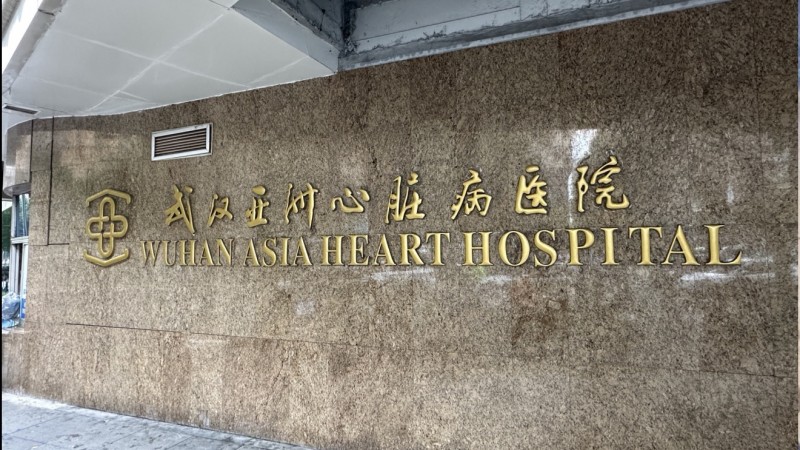
Wuhan Asia Heart Hospital Asia’s Leading Dedicated Private Cardiac Center
Wuhan Asia Heart Hospital is a dedicated cardiac center, performing over 10,000 cardiac procedures annually in a facility built and staffed for one purpose only: treating the heart. Every surgeon, every protocol, and every piece of equipment is optimised for cardiovascular medicine. Private rooms are standard, and the surgical teams are among the highest-volume cardiac surgeons in China. For international patients who need cardiac surgery, it may be a suitable option. China Care helps you work out whether it's the right one for your situation before you travel.
753 Jintai 1st Road, Jianghan District, Wuhan — ~25–35 min from Wuhan Tianhe International Airport
Quick Facts
Payment
International bank transfer — direct to hospital
Consultation
Remote assessment within 24–48 hours
Advance booking
1–2 weeks minimum
Language
Mandarin + bilingual coordination via China Care
Type
Private · Dedicated cardiac · Jianghan District
10,000+
Cardiac surgeries per year
100%
Cardiac-only dedicated
Private
Rooms as standard
<1 wk
Typical admission timeline
About the Hospital
The Only Thing Asia Heart Does Is Hearts
Wuhan Asia Heart Hospital (武汉亚洲心脏病医院) was established as a dedicated private cardiac hospital and has grown to become one of the most recognised cardiac centers in Asia by volume and outcomes. With over 10,000 cardiac procedures performed annually — from CABG and valve surgery to complex congenital heart disease and device implantation — the hospital's surgeons operate at a frequency that is associated with strong technical outcomes for high-risk cases.
As a private institution, Asia Heart offers a fundamentally different patient experience to Wuhan's large public hospitals. Private rooms are the standard, not a premium upgrade. Pre-admission assessment appointments are typically available within one week. Surgical scheduling is not subject to the delays common in high-demand public hospital operating lists. For international patients who need cardiac surgery but cannot tolerate a long wait, Asia Heart provides the right combination of excellent surgical skill and private-sector efficiency.
The hospital's interventional cardiology team is equally strong, managing coronary disease, structural heart conditions (TAVI, MitraClip), and complex electrophysiology cases including ablation for atrial fibrillation. China Care coordinates all referrals to Asia Heart's patient liaison team, which is experienced with international case management.
"Every surgeon, every nurse, every piece of equipment at Asia Heart exists for one purpose — and that single focus produces outcomes that generalist hospitals rarely match for cardiac cases."
Why Patients Choose Asia Heart
Three reasons international patients choose Wuhan Asia Heart Hospital
Dedicated Cardiac Focus
100% of Asia Heart's resources — its operating theatres, ICUs, nursing staff, imaging equipment, and specialist teams — are dedicated to cardiovascular medicine. There are no competing surgical lists, no allocation conflicts, no generalist care diluting specialist focus. For a patient who needs cardiac surgery, this environment produces better decision-making, faster peri-operative response, and nursing care that understands cardiac-specific recovery deeply.
Private Speed & Service
No public hospital queues. Pre-admission assessment appointments are typically available within one week of case submission. Private rooms are standard on all wards. Treatment costs are quoted directly by the hospital before you confirm any procedure. For international patients who need cardiac surgery on a defined timeline rather than an unpredictable public waiting list, Asia Heart's private structure makes planning straightforward.
High-Volume Surgical Expertise
With over 10,000 cardiac procedures annually, Asia Heart's surgeons operate at a frequency that exceeds most cardiac programmes in Asia. High-volume cardiac surgery is strongly associated with lower mortality and complication rates, particularly for complex valve surgery, multi-vessel CABG, and congenital heart correction — cases where technical repetition genuinely matters. For patients requiring high-level cardiac surgical expertise, this may be a suitable option depending on your situation — China Care's Hospital Access service can help confirm whether it's the right fit.
Beyond the Hospital
Why Patients Work With China Care
Finding a hospital's name is easy. Knowing whether it's actually the right one for your situation is much harder — that's where China Care helps.
Most international patients researching Wuhan Asia Heart Hospital are unsure whether it's genuinely the right fit for their case, or whether another hospital might serve them better. China Care helps you answer questions like:
Is Wuhan Asia Heart Hospital suitable for my diagnosis?
Cardiac Procedures Available at Asia Heart Hospital
Every procedure at Wuhan Asia Heart Hospital is cardiac. The following are most commonly accessed by international patients coordinated through China Care.
Primary Focus
Coronary Artery Bypass (CABG)
On-pump and off-pump CABG for multi-vessel coronary artery disease. Minimally invasive bypass available for suitable cases. High-volume surgeons with strong outcomes for complex and redo CABG. The most common procedure at Asia Heart.
Mitral and aortic valve repair and replacement. Transcatheter aortic valve implantation (TAVI) for high-risk surgical patients. MitraClip for mitral regurgitation. Minimally invasive valve surgery via small incisions. Experience in complex re-operative valve procedures.
Valve RepairTAVIMitraClipMinimally Invasive
Also Available
Congenital Heart Disease
Correction of congenital heart defects in adults: ASD, VSD, PDA, tetralogy of Fallot, and complex single-ventricle conditions. Catheter-based closure of septal defects. Experience with re-operative congenital cases and adults with uncorrected defects from childhood.
Radiofrequency and cryoablation for atrial fibrillation, atrial flutter, SVT, and ventricular arrhythmias. 3D electroanatomical mapping. Pacemaker and ICD implantation. Complex device cases including CRT for heart failure with dyssynchrony.
AF AblationPacemaker / ICDCRT
Also Available
Heart Failure Management
Advanced heart failure center. LVAD implantation as bridge to transplant or destination therapy. Optimised medical management and cardiac resynchronisation therapy. Multidisciplinary heart failure team review for complex cases.
LVADAdvanced Heart FailureCRT
Explore your options
Not sure which treatment approach fits your case?
Hospital Access reviews your cardiac records, identifies whether a surgical or interventional approach is more appropriate, and books and confirms your appointment before you commit to travelling.
How China Care Helps You Reach Wuhan Asia Heart Hospital — If It's Right for You
Finding a hospital is the easy part. Understanding whether it's the right one for your situation is harder — China Care guides you through that, from initial guidance through to on-the-ground support in Wuhan.
Step 1 · Tell Us What You Need
Submit Your Cardiac Records to China Care
Share your cardiac records: echocardiogram report, ECG, coronary angiography or CT coronary angiogram (if available), any existing cardiology assessment, and a brief description of your symptoms and current medications. This step is free and helps us understand whether Asia Heart — or another hospital — may be worth exploring for your case. China Care prepares a bilingual cardiac case summary within 1–2 working days.
1–2 days
Step 2 · Hospital Access
China Care Arranges and Confirms Your Appointment
China Care registers your case with Wuhan Asia Heart Hospital's international coordination team, translates your cardiac records and referral documents, and confirms your appointment date, treatment approach (surgical vs. interventional), and specialist team before you arrange your travel — all coordinated in English on your behalf. This includes identifying the likely approach — typically CABG vs. PCI for coronary disease, surgical vs. transcatheter approach for valve disease, or ablation strategy for arrhythmia. This is a fixed-fee service, agreed with you upfront. Most cases receive an initial response within 3–5 days.
Hospital Access · fixed fee · 3–5 days
Step 3 · In-Person Consultation
Travel to Wuhan for Your In-Person Consultation
With your appointment confirmed, you travel to Wuhan for your own in-person consultation with the cardiac surgical or interventional team. The specialist confirms the treatment plan and provides a formal cost estimate — this step is required before admission is confirmed. A pre-operative assessment appointment is typically available within one week of confirming your intention to proceed. China Care's bilingual coordinator supports you throughout.
in-person consultation · treatment plan & cost estimate issued
Step 4 · Medical Journey
Admission & Treatment
You are admitted to a private room. China Care coordinates your arrival and admission with Asia Heart's patient liaison team. Post-operative cardiac ICU monitoring follows all major surgical procedures, with step-down to a private ward room as recovery progresses. Nursing staff in the private wards are experienced in cardiac post-operative care.
All treatment fees are paid directly to the hospital via international bank transfer or by the method confirmed before admission. China Care does not collect or handle medical payments.
private room · cardiac ICU available · payment direct to hospital
Step 5 · Medical Journey
Discharge, Cardiac Rehabilitation Plan & Follow-Up
A cardiac rehabilitation plan is provided before discharge, including activity guidelines, medication management, and follow-up monitoring schedule. Full bilingual discharge documentation — including operative report, imaging, and laboratory results — is issued in a format accessible to your home cardiologist. China Care ensures documentation is complete before your departure.
cardiac rehab plan · bilingual documentation · post-discharge support
Dedicated cardiac-only hospitalPrivate rooms as standardRemote eligibility assessmentBilingual case coordinationIn-person escort & interpretationPayment direct to hospitalCardiac rehabilitation planBilingual discharge documentsPost-discharge coordination
Before You Travel
What international patients need to know
Payment
International bank transfer
All fees paid directly to hospital. Payment method confirmed before admission. China Care does not handle medical payments.
Advance booking
1–2 weeks minimum
Pre-admission assessment typically available within 1 week. All appointments arranged through China Care before you travel.
Consultation
Remote assessment available
Private hospital. Remote eligibility assessment within 3–5 days. Treatment plan confirmed at in-person visit.
Language
Mandarin + bilingual coordination
Hospital staff operate in Mandarin. China Care provides bilingual coordination for Arabic, Russian, English, and other languages.
From airport
~25–35 min taxi
From Wuhan Tianhe International Airport. Direct flights from Southeast Asia, Middle East, Hong Kong, and major Chinese cities.
Hospital type
Private · Dedicated cardiac
Asia's leading dedicated cardiac hospital by surgical volume. Treatment costs quoted directly by the hospital — zero markup from China Care.
Your Next Step
How China Care Can Help
Whichever stage you're at, China Care's role is the same: help you make an informed decision, not just a booking.
Should I choose Asia Heart or Wuhan Union Hospital for cardiac surgery?
Both are viable options for cardiac surgery, depending on your situation. Wuhan Union Hospital is a top-10 public hospital with strong cardiac surgery outcomes and the advantage of being affiliated with a major medical university, which may be relevant for complex cases involving other organ systems. Asia Heart may be a more suitable option when private accommodation, shorter wait times, and dedicated cardiac focus are priorities. For patients where cardiac surgery is the only issue and who want a faster, more streamlined private experience, Asia Heart can be a suitable option. China Care's Hospital Access service helps you decide based on your specific case.
What is the difference between valve repair and valve replacement?
Valve repair preserves your natural valve tissue and is generally preferred when technically feasible, as it avoids the need for lifelong anticoagulation that comes with mechanical valve replacement. Asia Heart's surgeons are experienced in complex mitral valve repair. When repair is not possible due to extensive valve damage or calcification, replacement with either a mechanical valve (durable, requires blood thinners) or a biological valve (no anticoagulation, but may need re-operation after 15–20 years) is performed. The surgical team recommends the most appropriate option for your anatomy and lifestyle.
Is TAVI (transcatheter aortic valve implantation) available at Asia Heart?
Yes — Asia Heart performs TAVI for patients with severe aortic stenosis at high or intermediate surgical risk. TAVI involves inserting a new valve through a catheter via the femoral artery, avoiding open-chest surgery. The procedure requires a heart team assessment including CT angiography for valve sizing and a multidisciplinary discussion between the interventional cardiologist and cardiac surgeon. Recovery time is typically 3–5 days in hospital versus 5–7 days for surgical valve replacement. China Care can arrange a pre-travel TAVI eligibility assessment based on your imaging.
How long will I need to stay in Wuhan after cardiac surgery?
For CABG and open valve surgery, the typical hospital stay is 7–10 days, followed by a recommended 2–3 week recovery period in Wuhan before long-distance travel is safe. TAVI patients typically stay 3–5 days in hospital and may be able to fly within 2 weeks of the procedure. Ablation for atrial fibrillation usually requires 2–3 days in hospital. China Care assists with planning your post-procedure accommodation and arranging follow-up appointments before your departure.
How do cardiac surgery costs at Asia Heart compare to Western countries?
As a private hospital, Asia Heart's costs are higher than Wuhan's public hospitals but remain substantially lower than equivalent procedures in Western countries or the Middle East. Treatment costs are quoted directly by the hospital before you confirm any procedure. China Care provides a full itemised cost estimate as part of the pre-travel assessment. We never add to or mark up the hospital's quoted treatment cost.
Does Asia Heart have experience treating adults with congenital heart disease?
Yes. Asia Heart's cardiac surgery and interventional cardiology teams are experienced with congenital heart disease in adults — including patients who had repairs in childhood and now require re-operation, and adults with defects not corrected in childhood. Common procedures include percutaneous closure of atrial septal defects (ASD) and patent foramen ovale (PFO), surgical repair of ventricular septal defects, and complex congenital re-operations. The pre-operative workup includes detailed cardiac imaging to plan the safest approach for re-operative cases.
Still Deciding?
Not every hospital is the right fit for every patient
We'll help you understand whether Wuhan Asia Heart Hospital — or another hospital in China — may be a better option for your situation.
China Care coordinates your case with Wuhan Asia Heart Hospital's patient liaison team. Treatment costs are quoted directly by the hospital. We never add to or mark up the hospital's quoted treatment cost.
Hospital profile note: This profile is general reference information. China Care does not endorse or guarantee a particular hospital, treatment, appointment, clinical decision, or outcome. Current services, requirements, language support, availability, and clinical suitability should be confirmed directly with the hospital.
We use essential cookies to make this site work. With your permission, we also use analytics cookies to improve it. See our Cookie Policy for details.