Most concerns about Chinese hospitals come from real incidents — but they apply to a specific segment of the market, not to major academic cancer centres. This guide separates legitimate caution from unfounded fear, so you can make an informed decision about whether China belongs on your shortlist.
Key Facts
- NMPA-approved CAR-T therapy carries official list prices of roughly USD 125,000—215,000 in China, compared to USD 400,000—500,000 in the United States; advanced cancer surgery and proton therapy in China are typically 60—80% less than equivalent care in the US or Western Europe.
- As of July 2026, China has nine NMPA-approved CAR-T products, including satricabtagene autoleucel — the world’s first commercially approved CAR-T for a solid tumour; India and Thailand have no approved CAR-T products.
- China has approximately 198,000 registered medical institutions; SYSUCC handles approximately 120,000 inpatients annually — a volume that creates specialist experience levels unmatched at most Western cancer centres.
- Public hospital deposit requirements are typically RMB 30,000—100,000 (approximately USD 4,000—14,000) depending on the procedure; written cost estimates from a reputable facilitator before travel are the primary protection against mid-treatment payment disputes.
- China Care charges a fixed facilitation fee — USD 2,000 for cancer treatment, USD 3,500 for CAR-T or bone marrow transplant — shown as a separate line item from the hospital’s treatment cost, which is quoted directly by the hospital.
Table of Contents
Where the Fear Comes From
Search Reddit, Quora, or any expat forum for “hospital in China” and you will find a consistent set of warnings: scam clinics that target foreigners, hospitals that stop treatment mid-surgery until you top up a deposit, doctors who don’t speak English, and a general sense that the system is opaque.
These warnings are not invented. They reflect real experiences — but they describe a specific segment of China’s healthcare market, not its top academic medical centres.
China has approximately 198,000 registered medical institutions, ranging from village clinics to facilities treating more oncology cases annually than most countries treat in a decade. When someone warns you about “hospitals in China,” the quality of that warning depends entirely on which tier of that system they encountered.
This article addresses the concerns patients and families actually raise — and gives you honest answers, not reassurance.
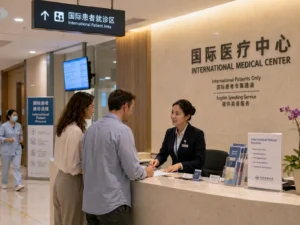
International patient departments at major Chinese cancer centres operate separately from general outpatient queues, with dedicated English-speaking coordinators.
The Wei Zexi Case: What Actually Happened
In 2016, a 21-year-old Chinese computer science student named Wei Zexi died of synovial sarcoma after receiving an experimental treatment at the Second Hospital of the Beijing Armed Police Corps. He had found the hospital through a Baidu search — the results were paid advertisements, not medical recommendations.
The treatment he received — a form of experimental immunotherapy — had been marketed as a breakthrough. It was not. The hospital had contracted its oncology department to a private company that was billing patients for treatments with no evidence base.
Wei Zexi’s death became a national story in China because he documented his experience on video before he died, explicitly describing how the Baidu search results had misled him. The Chinese government subsequently changed Baidu’s advertising rules, and the contracted company was shut down.
What this case actually tells you:
- It happened at a second-tier military hospital whose oncology department had been outsourced to a private operator
- The failure was in paid search advertising, not in China’s top academic hospitals
- Sun Yat-sen University Cancer Center, Fudan University Shanghai Cancer Center, Peking University Cancer Hospital — none of these operate this way
- NMPA-approved CAR-T therapy at a major cancer centre is categorically different from experimental treatments sold through online advertising
The Wei Zexi case is a legitimate warning about how to find a hospital in China. It is not a warning about Chinese hospitals in general.
The Wei Zexi case involved a second-tier military hospital whose oncology department had been contracted to a private commercial operator — not any of China’s top-ranked academic cancer centres, which are government-funded, university-affiliated institutions subject to national oversight.
Private Hospital vs Public Hospital vs International Department
This distinction causes more confusion than almost anything else in Chinese healthcare. Here is what each category actually means.
Public Hospitals
China’s top academic cancer hospitals — SYSUCC, Nanfang Hospital, Tongji Hospital, Fudan University Shanghai Cancer Center — are public institutions. They are funded by the state, affiliated with universities, and subject to government oversight. Their oncologists are government-employed physicians. China’s top public academic cancer hospitals — including SYSUCC, Tongji Hospital, and Fudan University Shanghai Cancer Center — are categorically different from the private facility involved in the Wei Zexi case.
These hospitals treat enormous patient volumes. SYSUCC, for example, handles approximately 120,000 inpatients annually. That volume creates specialist experience that private facilities cannot replicate. The oncologists at these hospitals have seen more cases of any given cancer subtype than most Western cancer centres will see in years.
The trade-off: public hospitals are not designed for international patients. General outpatient queues are long, paperwork is in Chinese, and non-Chinese speakers navigating the system without a guide will struggle.
Most top public hospitals have an international patient department that addresses this. International departments offer English-speaking coordinators, streamlined registration, consolidated billing, and, in most cases, English discharge summaries.
Private Hospitals
Private hospitals in China range from excellent specialist facilities to, frankly, profit-driven operations that target patients who don’t know better. The reputation for money-extraction machines that appears in Chinese forums refers specifically to this category.
GoBroad Hospital in Beijing is a private specialist oncology hospital with a genuine clinical track record in CAR-T therapy. Its Lymphoma and Myeloma Department, led by Dr. Kai Hu, has treated over 1,000 CAR-T cases and accepts international patients across seven countries. This is not representative of all private hospitals — it is an outlier built around a specific clinical programme.
The test for any private hospital is simple: Can they show you outcome data? Do their physicians have published research? Are their treatment protocols based on approved products or experimental claims?
International Hospitals
International hospitals — United Family, Raffles Beijing, Parkway Pantai — are licensed foreign or joint-venture facilities. They operate to Western service standards, with near-universal English, and are used primarily by expatriates and wealthy Chinese patients.
They are very expensive by Chinese standards and do not offer the specialist oncology depth of top public hospitals. For a foreigner needing a GP, a straightforward procedure, or occupational health services, they are the right choice. For complex oncology or CAR-T therapy, they are not.
| Type | Best For | Limitations |
|---|---|---|
| Public hospital (international dept.) | Complex oncology, CAR-T, high-volume specialties | Navigation requires support |
| Private specialist (e.g. GoBroad) | CAR-T, BMT, specific clinical programmes | Quality varies widely — must verify |
| International hospital | GP care, routine procedures, expat health | Expensive; limited oncology depth |
The Deposit System: What to Expect
Chinese public hospitals operate on a prepayment system. Before any significant procedure, patients are required to deposit funds into a hospital account. As treatment proceeds, the hospital draws down against the deposit. If the balance runs low, the patient or their family is asked to top it up.
This is not a scam. It is how China’s hospital billing system works — a consequence of a national health insurance framework that was not designed for international patients paying out of pocket.
What this means practically:
- You will be asked to pay a substantial deposit before admission — typically RMB 30,000–100,000 (approximately USD 4,000–14,000) depending on the procedure
- Your coordinator or facilitator should explain the expected total cost before you arrive, so the deposit figure is not a surprise
- In rare cases, if an unexpected complication significantly increases treatment cost, the hospital may pause non-emergency care while the family arranges additional funds — the scenario Reddit describes is real, but it applies to situations where costs have run well beyond what was discussed upfront
How to protect yourself: Get a written cost estimate — broken into hospital treatment fees and facilitation fees as separate line items — before you travel. Any reputable coordinator provides this. If a hospital cannot give you an estimate, do not proceed.
Can You Be Denied Treatment If You Can’t Pay?
In a life-threatening emergency at any Chinese hospital, treatment will not be refused. Emergency departments are legally required to stabilise patients regardless of payment.
For elective or planned oncology treatment, the answer is more nuanced. If a patient cannot demonstrate the financial capacity to fund treatment, the hospital may decline to admit them for that treatment. This is not unique to China — it applies in every healthcare system where upfront payment is required.
The practical implication: Before committing to treatment in China, have a clear picture of the total expected cost and ensure you have the funds — or insurance coverage — to cover it. Do not arrive hoping to negotiate payment terms at the hospital gate.
A reliable facilitator will not accept a case where the patient cannot fund treatment. This is not cruelty — it prevents a situation where a patient travels to China, begins treatment, and then cannot continue because funds run out mid-protocol. In CAR-T therapy specifically, interrupting the treatment sequence can be medically harmful.
Language Barrier: How Serious Is It?
Honest answer: it depends entirely on where you are and how you are going.
At the international department of SYSUCC or the GoBroad Hospital patient services team, you will have English-speaking coordinators. Key consultations will be interpreted. Your discharge summary will be translated. For practical purposes, the language barrier is managed.
At a general outpatient clinic in a Chinese public hospital, you will encounter very limited English. Triage nurses, registration staff, pharmacy windows — most will not speak English. Translation apps help but have obvious limits for medical terminology.
What AI translation cannot replace:
- Interpreting a doctor’s explanation of a treatment plan, including risks and alternatives
- Understanding what a consent form means in the context of your specific case
- Navigating a conversation about a complication or a change in prognosis
- Knowing whether what the doctor said matches what the discharge summary says
English-speaking physicians at Chinese cancer centres are more common than they were a decade ago, particularly at department head level. Many were trained or did fellowships abroad. But “the doctor speaks some English” is different from “everything about your care will be communicated clearly in English.” For a high-stakes decision — whether to proceed with a specific CAR-T protocol, whether a clinical trial is appropriate for your case — you need more than functional English. You need someone who can advocate for you in both languages.
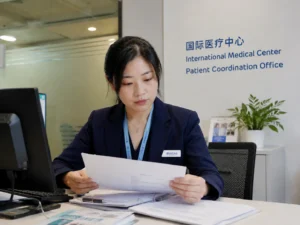
The difference between a translation app and a clinical coordinator is most visible at the moments that matter: consultations about treatment options, informed consent, and discharge planning.
How to Tell If a Hospital Is Legitimate
Five checks that take less than 30 minutes:
1. National hospital ranking
The National Health Commission publishes annual rankings of Chinese hospitals by specialty. Top cancer hospitals appear consistently. Search “[hospital name] 全国排名” or check the Chinese Hospital Association rankings.
2. Published research
Oncologists at legitimate hospitals have published in peer-reviewed journals. Search the department head’s name on PubMed. Absence of publications in a claimed specialist is a warning sign.
3. NMPA registration for treatments
If a hospital is recommending a specific drug or cell therapy, verify it is approved by the NMPA (China’s FDA equivalent). As of July 2026, China has nine NMPA-approved CAR-T products, spanning CD19, BCMA, and CLDN18.2 targets. India and Thailand have no approved CAR-T products. If a hospital claims to offer a CAR-T “treatment” not on this list as an approved therapy, be sceptical.
4. International patient references
Any hospital or facilitator that has genuinely treated international patients should be able to connect you with a previous patient — even anonymously, with their consent. Ask for this. If it is not available, that is a data point.
5. Separate cost line items
A legitimate facilitator shows treatment cost and facilitation fee as separate figures. If the two are bundled together and you cannot verify what the hospital actually charges, you do not have full information.
What Changes When You Use a Coordinator
The questions in this article — which hospital tier, how the deposit works, how to verify legitimacy, how language barriers are handled — are exactly what a coordinator answers before you travel.
A coordinator’s job is not translation. It is:
- Reviewing your pathology and advising whether China has a genuine clinical advantage for your specific diagnosis
- Identifying which hospital and which physician has the most relevant experience — not the highest referral fee
- Obtaining a written cost estimate before you commit
- Managing the international department relationship so your admission is expected and prepared for
- Being present or reachable when consultations happen, so nothing is lost in translation
- Producing an English discharge summary your home physician can act on
What a coordinator does not do: fabricate options. If your diagnosis does not match any treatment where China holds a genuine advantage, a reputable coordinator tells you. That willingness to decline a case is the most reliable signal of integrity.
China Care charges a fixed facilitation fee — USD 2,000 for cancer treatment, USD 3,500 for CAR-T or bone marrow transplant — shown as a separate line item from the hospital’s treatment cost, which is quoted directly by the hospital. We do not mark up treatment costs.
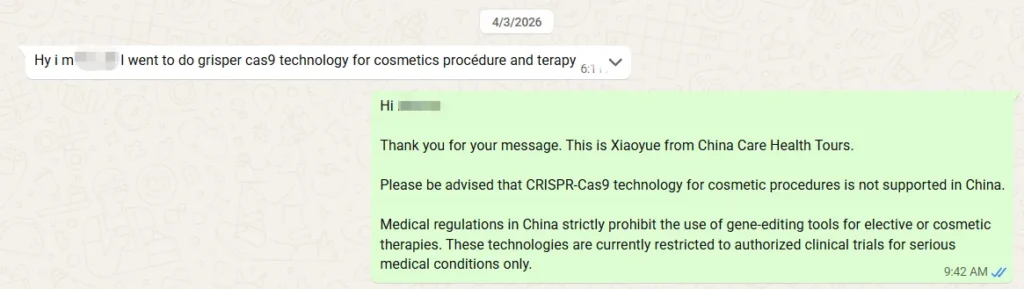
China Care provides a free initial case assessment within 24 hours. If China is not the right option for your diagnosis, we will tell you.
FAQs
-
Is it safe to get cancer treatment in China as a foreigner?
At a major academic cancer hospital — SYSUCC, Nanfang Hospital, GoBroad, Tongji Hospital — the clinical care is genuine and, for specific oncology indications, among the best available globally. The risks are around navigation, payment logistics, and communication — not the medicine itself. Those risks are manageable with proper coordination.
-
What happened with Wei Zexi and why does it matter?
Wei Zexi was treated at a second-tier military hospital whose oncology department had been contracted to a private operator. He found the hospital through paid Baidu search results he could not distinguish from medical recommendations. His case is a legitimate warning about Baidu advertising and unverified clinics — not about NMPA-approved treatments at China’s top cancer centres.
-
Do Chinese hospitals really stop surgery if you run out of deposit funds?
In genuine emergencies, treatment is not withheld. For planned oncology treatment, if costs significantly exceed what was agreed upfront, the hospital may pause non-emergency care while additional funds are arranged. The protection is a written cost estimate before you travel, which any reputable facilitator provides.
-
What is the difference between a private hospital and an international department?
An international department is a dedicated wing within a public hospital, staffed by the same physicians, with English-speaking coordinators added. A private hospital is a separately licensed facility. International departments at top public hospitals are generally the better choice for complex oncology — you get the clinical depth of a major academic centre with the navigation support of a patient-facing service.
-
Can doctors in Chinese hospitals speak English?
Senior oncologists at top Chinese cancer centres frequently have international training and functional to fluent English. General staff — nurses, registration, pharmacy — usually do not. For a high-stakes clinical conversation, functional English from a physician is not a substitute for having a bilingual coordinator present.
-
How do I know if a CAR-T treatment offered in China is legitimate?
Verify that the product is NMPA-approved. As of 2026, China has four approved CAR-T products: Relma-cel (JW Therapeutics), Axi-cel (Fosun Kite), Equecabtagene autoleucel (IASO Bio), and Inaticabtagene autoleucel (Gracell/AZ). Any hospital offering CAR-T therapy outside of these approved products or an active clinical trial registered on ClinicalTrials.gov should be treated with scepticism.
-
How much does treatment in China cost compared to elsewhere?
Verify that the product is NMPA-approved. As of 2026, China has four approved CAR-T products: Relma-cel (JW Therapeutics), Axi-cel (Fosun Kite), Equecabtagene autoleucel (IASO Bio), and Inaticabtagene autoleucel (Gracell/AZ). Any hospital offering CAR-T therapy outside of these approved products or an active clinical trial registered on ClinicalTrials.gov should be treated with scepticism.
-
Is China Care a medical provider?
No. China Care Health Tours (Hong Kong Huayou Care Consulting Limited) is a facilitation service. We coordinate access to hospitals and physicians; we do not provide medical advice, diagnose conditions, or recommend treatments. All medical decisions are made by your treating physician. Our role is to ensure you reach the right physician, with the right information, without unnecessary friction.
Next Step
If you are considering treatment in China and want an honest assessment of whether it is appropriate for your specific diagnosis, submit your case to China Care. We review pathology reports and treatment history within 24 hours and tell you whether China has a genuine clinical advantage — or whether it does not.
There is no fee for the initial assessment.
Submit Your Case | Explore CAR-T Therapy in China | View Partner Hospitals
References
- World Health Organization (WHO). China’s approximately 198,000 registered medical institutions. Referenced for scale of China’s healthcare system. https://www.who.int/
- Sun Yat-sen University Cancer Center (SYSUCC). Official hospital website; referenced for SYSUCC’s approximately 120,000 inpatients annually and institutional background. https://www.sysucc.org.cn/
- Chinese Hospital Association (CHA). Annual rankings of Chinese hospitals by specialty; referenced for guidance on verifying hospital legitimacy. http://www.cha.org.cn/
- PubMed / National Center for Biotechnology Information. Database for verifying published oncology research by hospital physicians. Referenced in the “How to Tell If a Hospital Is Legitimate” section. https://pubmed.ncbi.nlm.nih.gov/
- National Medical Products Administration (NMPA). NMPA-approved CAR-T products as of 2026: Relma-cel (JW Therapeutics), Axi-cel (Fosun Kite), Equecabtagene autoleucel (IASO Bio), and Inaticabtagene autoleucel (Gracell/AZ). https://www.nmpa.gov.cn/
- ClinicalTrials.gov. Registry for verifying active clinical trials; referenced as the standard for confirming whether a CAR-T treatment at a Chinese hospital is within an approved trial. https://clinicaltrials.gov/
- China Care Health Tours. CAR-T cost comparison data: USD 60,000—90,000 in China vs. USD 400,000—500,000 in the United States. Referenced in FAQ cost comparison section.