
Summary: A health screening in China runs from around RMB 1,399 (~USD 196) for a solid annual check to RMB 16,000+ (~USD 2,240) for the most comprehensive executive programme with MRI, cardiac imaging, and genetic risk panels — a fraction of what comparable checks cost in Singapore, the UK, or the USA. This guide breaks down real 2026 package prices, what drives the difference between tiers, and how to avoid paying for tests you don’t need.
Key Facts
- A solid annual health check at a foreigner-ready centre in China starts at RMB 1,399 (~USD 196), covering 29+ tests including full blood count, liver/kidney panel, thyroid, ECG, and chest CT.
- A comprehensive executive programme with brain MRI, echocardiography, and expanded tumour markers runs RMB 7,700–16,000 (~USD 1,075–2,240) — roughly one-quarter to one-eighth the cost of an equivalent programme in Singapore or the UK.
- Meinian Onehealth’s nationwide package lineup (RMB 1,199–2,999) is available in over 200 Chinese cities, making it the most geographically accessible option for a routine annual check.
- JD Health’s Beijing and Shenzhen centres offer a fully digital, app-based screening workflow with results delivered within 3–7 working days, English translation included on request.
- China Care confirms the current centre, package/version, preferred date, availability, published rate and booking details before payment. Advance payment is required to secure the confirmed partner package, and China Care collects the payment directly.
Table of Contents
- Introduction
- Average Prices
- What Determines the Price?
- Price by Screening Type
- China vs Singapore vs Japan vs South Korea vs UK vs USA
- Is It Worth It?
- How to Save Money
- FAQs
- Book Your Screening
Introduction
If you search health screening cost in China, you will mostly find two kinds of answers: suspiciously cheap numbers copied from domestic Chinese platforms that don’t apply to foreign visitors, or vague reassurance that it’s “much cheaper than home” with no actual figures. Neither is useful when you’re trying to budget for a trip.
Here is what China Care’s partner centres actually charge in 2026, using real, currently published package rates — not estimates.
A basic annual health check at a foreigner-ready centre in China starts around RMB 1,399 (~USD 196). A genuinely comprehensive executive programme with brain MRI, cardiac imaging, and an expanded cancer marker panel runs RMB 7,700–16,000 (~USD 1,075–2,240). That compares to USD 2,500–8,000 for an equivalent executive screen in Singapore, or GBP 2,000–7,000 at a private clinic in London.
The honest caveat: “cheap” depends entirely on which centre you choose and what is actually included. A 27-item blood-and-imaging panel is not the same product as a 77-item platinum screen with MRI and genetic risk markers, even if both get called “comprehensive” in marketing copy. This guide focuses on the tier of facility actually suitable for a YMYL health decision: established chains with English-language coordination, transparent published pricing, and a track record with international patients — Meinian Onehealth, JD Health, and Ruici Health.
Average Prices
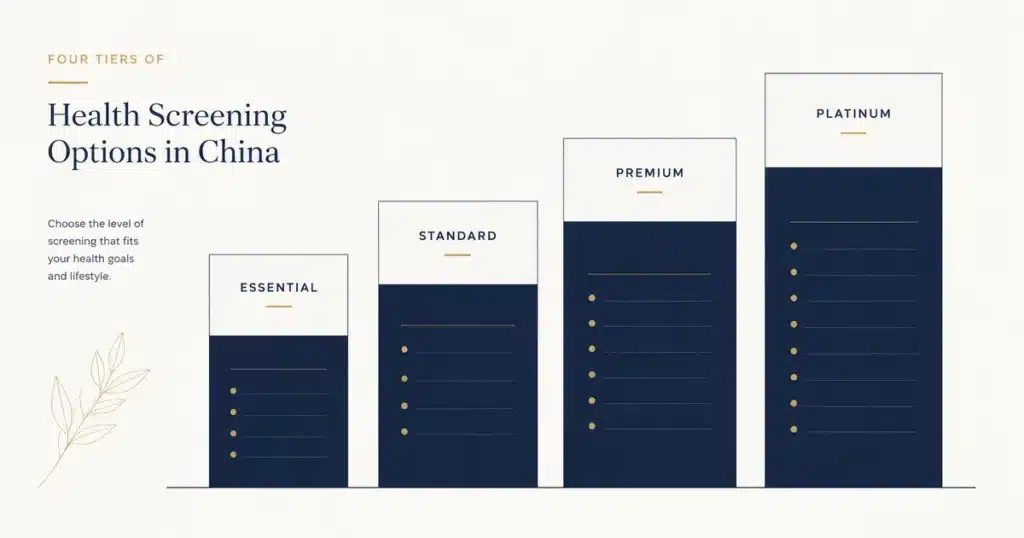
The table below shows four representative tiers with real, currently published package rates. Before payment, China Care confirms the selected centre, package/version, preferred date, availability, published package rate, and booking requirements. Once confirmed, an advance payment of the published package rate is required to secure the booking. You pay China Care directly when booking, and China Care settles the payment with the screening centre on your behalf — so you don’t need a Chinese bank card or cash on the day.
| Tier | Package | What You Get | Price (RMB) | Approx USD |
|---|---|---|---|---|
| Essential | Office Wellness Check (Meinian, nationwide) | 29+ tests: full blood count, liver/kidney panel, thyroid, ECG, chest CT, abdominal ultrasound | RMB 1,399 | ~USD 196 |
| Standard | Heart & Vascular Screening (Meinian, nationwide) | 27+ tests: Essential + echocardiography, carotid ultrasound, head CT, tumour marker screening | RMB 1,499 | ~USD 210 |
| Premium | Advanced Executive (JD Health, Beijing/Shenzhen) | 61+ tests: Brain MRI, echocardiography, carotid Doppler, expanded tumour marker panel | RMB 7,700 | ~USD 1,075 |
| Platinum | Signature Executive (JD Health, Beijing/Shenzhen) | 77+ tests: full imaging suite, genetic risk panels, cardiologist-grade cardiac work-up | RMB 16,000 | ~USD 2,240 |
Why these four tiers? They represent the real spread available through China Care’s partner centres — not a rounded-off estimate. The gap between RMB 999 and RMB 7,700 is intentional: it reflects the jump from a solid nationwide annual check to a full imaging-inclusive executive programme, which is where most of the meaningful clinical depth (MRI, advanced cardiac imaging) gets added. USD figures use approximate mid-2026 exchange rates.
For the full catalogue of available programmes, see executive health screening in China.
What Determines the Price?
Four variables account for most of the price spread between tiers and centres.
Imaging Technology
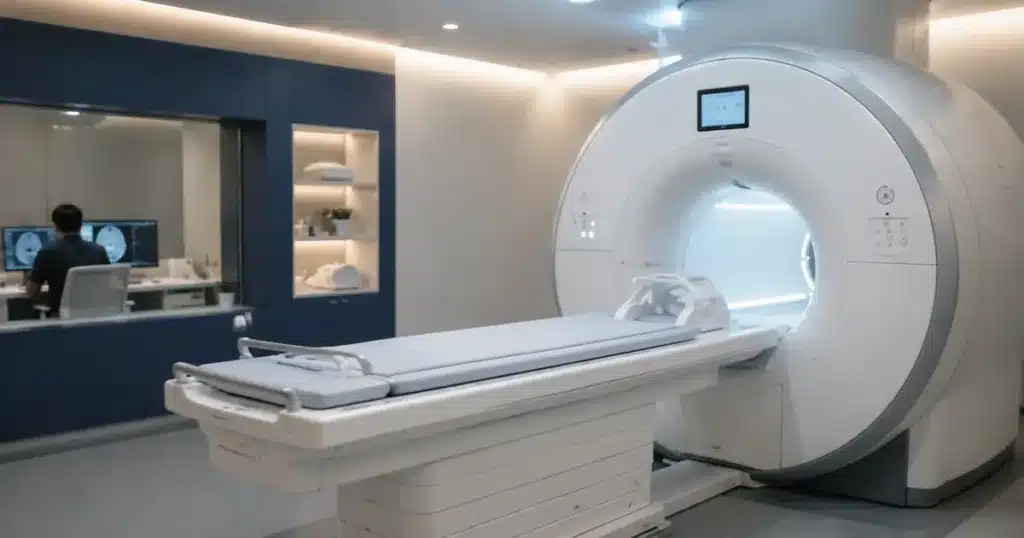
A low-dose CT lung scan on a modern scanner costs more than a chest X-ray for good reason — it is a categorically more sensitive detection method. A brain MRI adds real cost on top of that. Packages under RMB 1,000 (like the Essential and Standard tiers above) typically use CT and ultrasound rather than MRI; MRI-inclusive programmes start around RMB 2,000 and above, and dedicated brain/vascular MRI combinations run higher still.
Scope of the Panel
A 27-item panel (blood work, ECG, core imaging) is a routine annual check. A 60+ item panel that adds inflammatory markers, expanded tumour markers, and cardiac-specific testing is a materially different product. When comparing two packages that both call themselves “comprehensive,” check the actual test count — it’s listed on every China Care partner package page.
Facility and City
JD Health operates dedicated, purpose-built screening centres in Beijing and Shenzhen only, with a fully digital app-based workflow — this positions it at the premium end of the market. Meinian Onehealth runs a nationwide network with over 200 cities covered, which is why its entry and mid tiers are priced lower and available almost anywhere in China. Ruici Health sits in between, with a nationwide family-card lineup that scales from RMB 1,988 to RMB 5,988 depending on whether brain MRI is included.
Provider Line, Not Just City
Some cities have more than one product line from the same provider at overlapping price points with different contents. Meinian, for example, runs its standard nationwide lineup alongside city-exclusive tiers in Beijing and a separate premium line in Shenzhen — a RMB 999 package in one line is not necessarily the same tests as a RMB 999 package in another. Always confirm which specific package you’re being quoted, not just the price point.
Price by Screening Type
Basic Annual Check
Suitable for: Healthy adults, routine annual maintenance, pre-employment checks.
Real example: Office Wellness Check — RMB 1,399, 29+ tests covering full blood count, liver/kidney function, chest CT, and abdominal ultrasound.
Overseas anchor: A comparable check at a private GP in the UK costs GBP 400–800; in Singapore, SGD 600–1,200 (~USD 440–880).
Cardiovascular-Focused Screening
Suitable for: Adults with family history of heart disease, smokers, high-pressure executives.
Real example: Heart & Vascular Screening — RMB 1,499, includes echocardiography, carotid ultrasound, head CT, and tumour marker screening.
Overseas anchor: A dedicated cardiac risk screen at Raffles Medical Group in Singapore costs SGD 2,500–4,500 (~USD 1,840–3,310).
Comprehensive Executive Programme (MRI-Inclusive)
Suitable for: Adults 40+, anyone wanting a full-body imaging work-up rather than a routine annual check.
Real example: Advanced Executive — RMB 7,700, 61+ tests including brain MRI, echocardiography, and carotid Doppler.
Overseas anchor: USD 5,000–12,000 at US concierge practices; GBP 3,500–9,000 at London private hospitals.
Platinum / Genetic Risk Programme
Suitable for: Patients wanting the deepest available clinical picture in a single visit, including hereditary risk assessment.
Real example: Signature Executive — RMB 16,000, 77+ tests spanning full imaging, genetic risk panels, and cardiologist-grade cardiac work-up.
Important clinical note: Tumour markers and genetic risk panels are screening tools, not diagnoses. A flagged result requires follow-up imaging and specialist review — ask before you book how abnormal results are handled for international patients.
Family / Multi-Person Screening
Suitable for: Couples, families, or small groups wanting to book together at one centre.
Real example: Family Executive Health Check (Ruici, nationwide) — RMB 5,988, 52+ tests including brain MRI and MRA.
Note: Ruici’s family-card lineup scales from RMB 1,988 to RMB 5,988 depending on whether brain MRI/MRA is included and how many biomarker panels are added — ask your coordinator which tier matches your priorities.
China vs Singapore vs Japan vs South Korea vs UK vs USA
The table below compares a comprehensive executive health screening programme (full-day, imaging included) across six markets. China figures reflect the Premium tier above (RMB 7,700, ~USD 1,075); other markets are 2026 indicative estimates in USD equivalent.
| Country | Indicative Price (USD) | Typical Wait Time | English Support | Results Turnaround |
|---|---|---|---|---|
| China | ~USD 1,075 (Advanced Executive, RMB 7,700) | Same day or next day | Available at partner centres | 3–7 working days |
| Singapore | USD 2,500–8,000 | 1–3 days | Excellent | 3–7 working days |
| Japan | USD 3,000–10,000 | 2–6 weeks (private clinics) | Limited | 2–4 weeks |
| South Korea | USD 1,800–5,000 | 1–5 days | Variable | 1–2 weeks |
| UK (private) | GBP 2,000–7,000 (~USD 2,500–8,800) | 1–4 weeks | Excellent | 1–3 weeks |
| USA (concierge) | USD 4,000–15,000+ | 1–3 weeks | Excellent | 1–2 weeks |
Key takeaway: A comprehensive executive screen in China costs roughly one-quarter to one-eighth of an equivalent programme in Singapore or the UK, and a fraction of a US concierge health programme. For international patients who can spend a few days in Beijing or Shenzhen, the arithmetic is compelling.
According to the World Health Organization’s World Health Statistics, China has continued to expand its diagnostic imaging infrastructure significantly over the past decade, with high-field MRI and multi-slice CT density in Tier 1 cities now comparable to OECD averages — part of why comprehensive imaging-inclusive packages are available at these price points without a quality trade-off.
Is It Worth It?
For a single blood panel: probably not worth a dedicated trip. For a comprehensive executive screen that combines advanced imaging, cardiovascular risk profiling, and cancer markers — for many international patients, yes.
The case for it: You save real money — often USD 1,500–10,000+ versus an equivalent private-pay check in Singapore, the UK, or the USA. The check itself takes a single morning rather than weeks of separate GP referrals. JD Health’s app-based, fully digital workflow is strikingly efficient compared to a typical London private hospital booking process.
The honest caveats: If your results flag something that needs follow-up, you’ll need either a longer stay or a plan for remote consultation. Reports are issued in Chinese; English translation is arranged through China Care but isn’t instant. Travel costs are real on top of the package price — budget for flights and two to three nights in a hotel if you’re not already in China.
The sweet spot: Patients based in Hong Kong, Southeast Asia, or already travelling in China who want to combine a health check with other plans. The cost and time savings are most compelling for this group.
A research letter published in BMJ Open in 2022 noted that medical tourism for elective diagnostics is growing fastest among self-paying patients, precisely because price transparency in destination markets has improved. China’s established private screening chains publish fixed package rates, which reduces the guesswork that used to make cross-border health purchasing risky.
How to Save Money
Book Through a Coordinator Who Knows the Centres
China’s health screening market has a real information gap for international patients. Booking direct on Chinese consumer apps can look cheap but often means no English support and no one to call if results need clarification. A coordinator who works directly with specific centres can also confirm whether the exact package you’re seeing online is actually available at the branch nearest you — large chains often run different product lines in different cities at overlapping price points.
Match the Package to What You Actually Need
A RMB 16,000 platinum programme with genetic risk panels is not the right choice for a healthy 30-year-old who wants a routine annual check — the RMB 1,399–1,499 tier covers the core indicators that matter for most people under 40. Save the imaging-heavy, higher-priced tiers for when family history, age, or specific symptoms actually warrant them.
Avoid Unnecessary Add-Ons
Upselling during the check itself happens — a technician may suggest additional imaging after an initial scan. Some suggestions are clinically appropriate; others are revenue-driven. Confirm exactly what’s included in writing before you travel, so you’re in a position to evaluate any on-the-day suggestion rather than agreeing under time pressure.
Time Your Visit
Peak domestic health-check season in China is Q1 (January–March, post-Lunar New Year) and late Q4 (October–November). Mid-year slots (May–August) tend to have shorter waits and can be booked at shorter notice.
Use Published Package Rates
At China Care’s partner centres — Meinian, JD Health, and Ruici — an advance payment of the published package rate is required to secure the booking. You pay China Care directly when booking, and China Care settles the payment with the screening centre on your behalf — so you don’t need a Chinese bank card or cash on the day. See executive health screening in China for how this works.
FAQs
For current questions about this topic, contact China Care or consult the relevant official provider or authority for up-to-date information.

How do I get my results if I’ve already left China?
Results are delivered digitally within 3–7 working days. Most centres offer a remote English consultation for international patients who need results explained after returning home.
Do I need a separate appointment for each test?
No. The screening package model in China consolidates all tests into a single half-day or full-day appointment — a genuine efficiency advantage over piecemeal GP referrals in the UK or USA.
Is there a minimum age for these programmes?
Most comprehensive executive programmes are designed for adults 18 and above; cardiovascular-focused panels are most clinically useful from age 40. Paediatric health assessments are a different product — contact us if you need one.
Are Chinese health screening results accepted by overseas insurers or employers?
This depends on your insurer or employer. Results from accredited centres are generally accepted for insurance underwriting purposes. For employment medicals, check whether your employer specifies particular accreditation requirements before booking.
Book Your Full Body Health Checkup in China
Ready to find out which tier and centre fits your situation? China Care works with Meinian Onehealth, JD Health, and Ruici Health — three of China’s most established foreigner-ready screening chains. China Care confirms the current centre, package/version, preferred date, availability, published rate and booking details before payment. Advance payment is required to secure the confirmed partner package, and China Care collects the payment directly.