
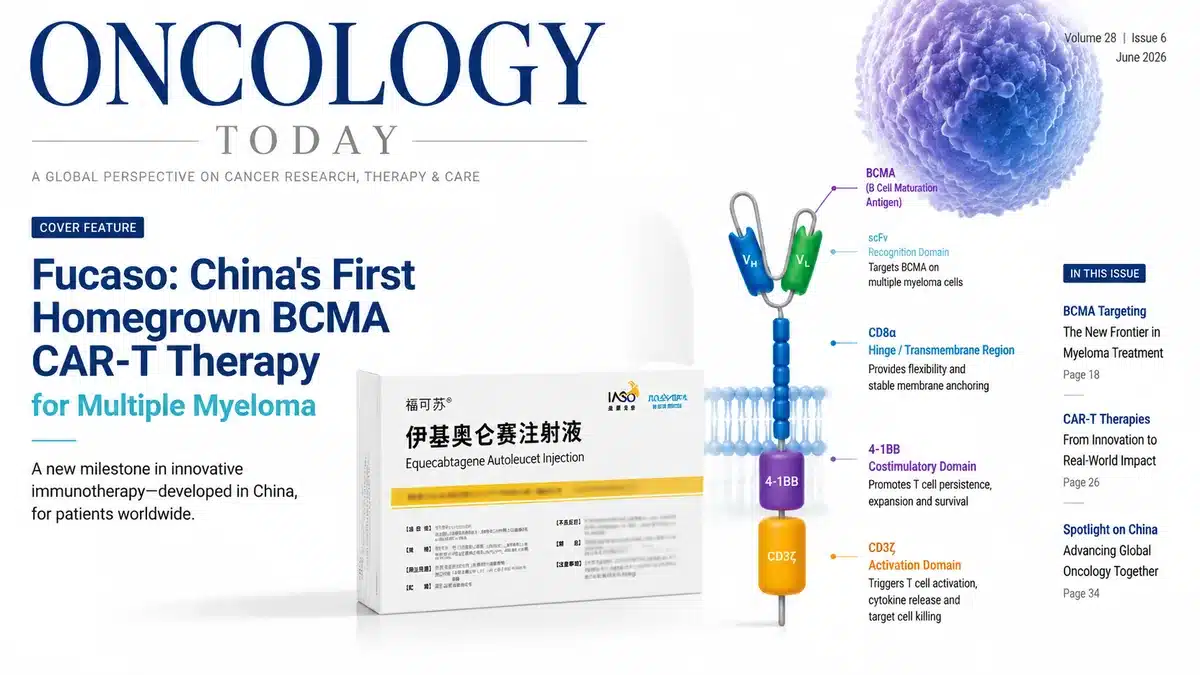
Summary: Fucaso (equecabtagene autoleucel, CT103A/IBI326) is China’s first homegrown BCMA-directed CAR-T and the world’s first fully-human BCMA CAR-T, NMPA-approved for relapsed/refractory multiple myeloma. It reports a 96% overall response rate and costs roughly $160,000–$180,000 in China versus $465,000 for Carvykti in the US.
Key Facts
- Fucaso (equecabtagene autoleucel) is China’s first homegrown BCMA-directed CAR-T and the world’s first fully-human BCMA CAR-T, approved by the NMPA on 30 June 2023 (registration 福可苏®, S20230040).
- In the FUMANBA-1 pivotal trial, Fucaso achieved a 96.0% overall response rate (ORR) and a 74.3% stringent complete response/complete response (sCR/CR) rate at first readout, deepening to 83.2% CR/sCR at three-year follow-up.
- Fucaso’s official NMPA list price is ¥1.166 million (roughly $160,000–$180,000 USD), compared with $465,000 for Carvykti and $419,500 for Abecma in the United States — both of which use non-human (murine or camelid) recognition domains.
- China now has three NMPA-approved BCMA CAR-T products — Fucaso (2023), Zevorcabtagene autoleucel/Zevo-cel (2024), and Ciltacabtagene autoleucel/Cilta-cel, the domestic-market version of Carvykti (2024) — part of a broader portfolio of 9 NMPA-approved CAR-T products as of July 2026.
- Any-grade cytokine release syndrome (CRS) occurred in 93.2% of patients, but 92.2% was Grade 1–2 and only one Grade 4 event was reported; ICANS (neurotoxicity) occurred in just 1.9% of patients.
- Some engineered CAR-T cells have persisted in patients for over 1,000 days, consistent with the lower immunogenicity expected from a fully-human construct.
Table of Contents
What Is Fucaso? China’s Milestone in Cell Therapy

In late June 2023, China’s National Medical Products Administration (NMPA) granted conditional approval to equecabtagene autoleucel — brand name Fucaso (福可苏), development codes CT103A (IASO Bio) and IBI326 (Innovent Biologics). It is a BCMA-directed chimeric antigen receptor T-cell (CAR-T) therapy built from a patient’s own immune cells, and it is the world’s first fully-human BCMA CAR-T and China’s first homegrown BCMA-directed CAR-T cell therapy.
It is worth being precise about that distinction: Fucaso is not China’s first CAR-T therapy overall — that belongs to the CD19-targeted Axi-cel (奇凝达®), approved in June 2021. Fucaso is specifically China’s first approved BCMA CAR-T, developed and manufactured across a fully domestic pipeline by IASO Bio (南京驯鹿生物医药) and Innovent Biologics (信达生物).
The approval (registration S20230040, granted 30 June 2023 under priority review) covers adult patients with relapsed or refractory multiple myeloma (r/r MM) who have progressed after at least three prior lines of therapy, including at least one proteasome inhibitor and one immunomodulatory drug. For a full overview of how Fucaso fits into China’s broader myeloma CAR-T landscape — including the GPRC5D-targeting programs China pioneered — see our companion guide, CAR-T Therapy for Multiple Myeloma in China.
Why Multiple Myeloma Needed a New Weapon
Multiple myeloma is a cancer of plasma cells — the antibody-producing white blood cells that normally help fight infection. A single clone of plasma cells multiplies uncontrollably, crowds out healthy blood cells, erodes bone, and disrupts kidney and immune function. It remains, at present, essentially incurable for most patients.
The central clinical problem is relapse and resistance. Patients typically respond to combinations of proteasome inhibitors, immunomodulatory drugs, and monoclonal antibodies, but the disease almost invariably returns — and each relapse is harder to treat than the last. By the time a patient has received three or more prior lines of therapy, effective options become scarce and responses are typically short-lived.
This is exactly the gap Fucaso was designed to fill. Its pivotal trial enrolled patients whose disease had resisted a median of four prior lines of treatment — a population for whom conventional drugs offered little hope. A targeted, “living” cell therapy represents a fundamentally different kind of weapon: one that does not merely suppress the cancer temporarily but is engineered to seek it out and persist in the body. For the full mechanics of how CAR-T reprograms a patient’s immune cells, see CAR-T cell therapy in China.
Inside Fucaso: How Equecabtagene Autoleucel Works
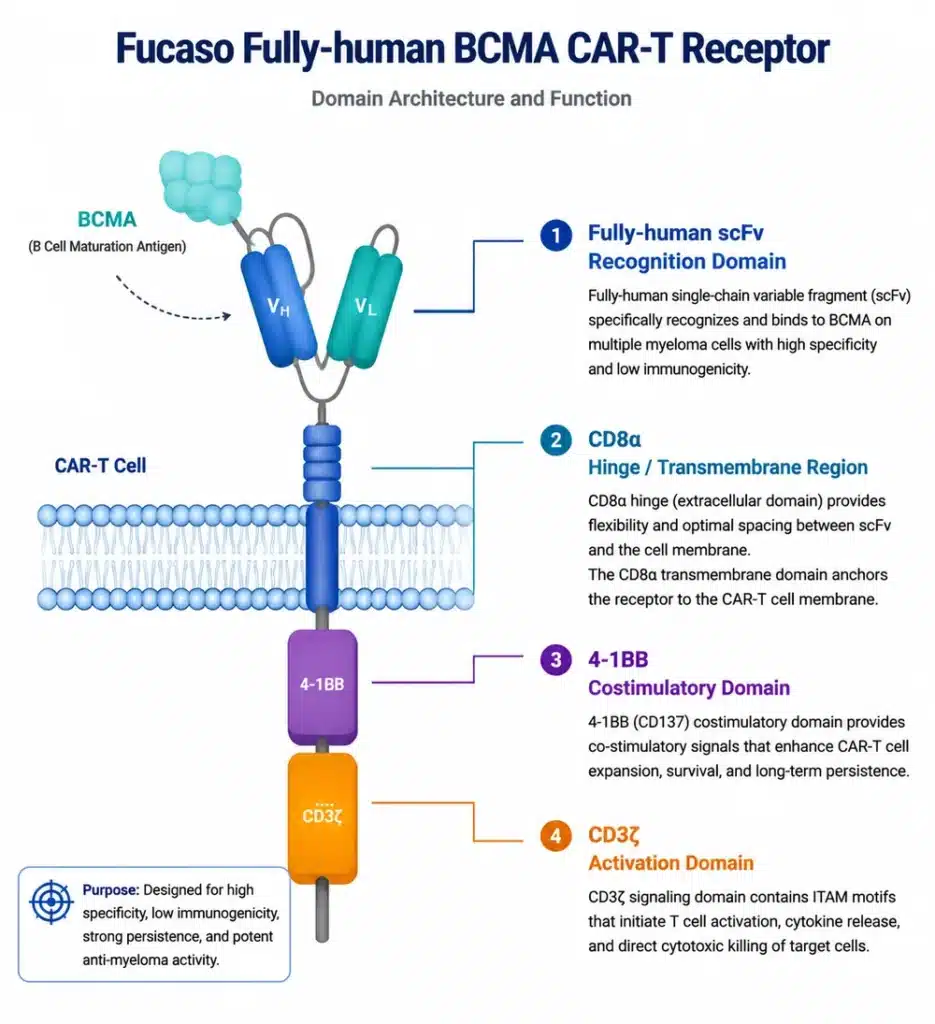
Fucaso targets BCMA (B-cell maturation antigen), a protein expressed at low levels in healthy tissue but almost exclusively and abundantly on malignant plasma cells — making it an ideal “Achilles’ heel” for immunotherapy. Fucaso’s CAR is built like a modular tool:
- Fully-human scFv (single-chain variable fragment) — the “recognition head” that binds BCMA, derived entirely from human antibody sequences.
- CD8α hinge and transmembrane region — anchors the receptor in the T cell’s membrane and gives it flexibility.
- 4-1BB (CD137) costimulatory domain — an internal “booster” that helps the engineered cell survive and expand after infusion.
- CD3ζ activation domain — the switch that tells the T cell to kill once it has engaged its target.
The CAR gene is delivered into the patient’s own autologous CD3⁺ T cells using a lentiviral vector, then the cells are expanded and cryopreserved.
Why “fully-human” matters. Two rival BCMA CAR-Ts use non-human recognition domains: Abecma uses a murine (mouse-derived) scFv, and Carvykti uses two camelid (llama-derived) VHH nanobodies. Fucaso’s fully-human design is intended to lower immunogenicity — the chance the patient’s body rejects the therapy as foreign. Lower immunogenicity helps the cells persist longer: in Fucaso’s data, some CAR-T cells survived beyond 700 days, with the longest persistence around 1,013 days, while anti-drug antibody (ADA) rates rose only to about 19.4% over follow-up.
Manufacturing. Production begins with apheresis of the patient’s T cells, followed by lentiviral transduction, ex vivo activation and expansion, quality-control release, and cryopreservation. Before infusion, patients receive lymphodepleting chemotherapy (cyclophosphamide 500 mg/m² plus fludarabine 30 mg/m² for three days) to make room for the engineered cells. The target dose is 1.0 × 10⁶ CAR-T cells per kilogram of body weight, given as a single infusion, with a typical vein-to-vein manufacturing window of 7–21 days — in line with standard commercial CAR-T timelines in China.
From Lab to Clinic: The Development Journey
Fucaso was jointly developed by IASO Bio and Innovent Biologics, receiving China’s Breakthrough Therapy Designation as well as US FDA orphan-drug, Regenerative Medicine Advanced Therapy (RMAT), and Fast Track designations during development. The NMPA’s conditional approval on 30 June 2023 made it the world’s first fully-human BCMA CAR-T and China’s first homegrown BCMA CAR-T.
In 2024, the partnership evolved: IASO Bio acquired Innovent’s rights to Fucaso, with Innovent taking an 18% equity stake in IASO in exchange, and IASO assuming global commercialization rights. IASO has since established certified treatment centers in China and begun serving overseas patients traveling to China for treatment, with planned expansion toward Singapore, Hong Kong, and Macau.
The Evidence: FUMANBA-1 Efficacy and Durability
The backbone of Fucaso’s approval is FUMANBA-1, a single-arm, open-label Phase I/II study conducted across 14 centers in China (registered as NCT05066646 on ClinicalTrials.gov). It enrolled heavily pretreated r/r MM patients — including some previously exposed to another BCMA CAR-T — treated at the recommended Phase 2 dose. The main peer-reviewed results were published in JAMA Oncology in 2024.
First readout (data cutoff 9 September 2022, 101 evaluable patients, median follow-up 13.8 months):
| Endpoint | Result |
|---|---|
| Overall response rate (ORR) | 96.0% (97/101) |
| Stringent complete response/complete response (sCR/CR) | 74.3% |
| ≥Very good partial response (VGPR) | 91.1% |
| Median time to response | 16 days |
| 12-month progression-free survival (PFS) | 78.8% |
| 12-month overall survival (OS) | 92.2% |
| MRD-negative rate | 95.0% |
Three-year follow-up (data cutoff 31 December 2024, 107 evaluable patients, median four prior lines):
| Endpoint | Result |
|---|---|
| ORR | 96.3%; CR/sCR 83.2% |
| Median PFS | 30.5 months (35.9 months in CAR-T-naïve patients) |
| Median OS | Not reached; ~66.3% estimated 3-year survival |
| MRD-negative rate | 95.3%, median duration 36.5 months |
Patients who had never received a prior CAR-T did even better — ORR 98.9% and CR/sCR 88.4%. Notably, 12 patients previously exposed to another BCMA CAR-T still responded (ORR 75%, CR/sCR 42%), suggesting Fucaso can offer a second chance even after prior BCMA-targeted cell therapy — a meaningful finding given how limited options are in that setting.
Safety: Managing CRS and Other Risks
Cytokine release syndrome (CRS). Any-grade CRS occurred in 93.2% of patients, almost all mild: Grade 1–2 in 92.2%, with only a single Grade 4 event and no Grade 3. CRS typically began around day 6 and lasted about 5 days, resolving with tocilizumab and/or steroids.
Immune effector cell-associated neurotoxicity syndrome (ICANS). Rare, at just 1.9% of patients, all Grade 1–2.
Blood and infection effects. Grade ≥3 hematologic toxicity affected about 93.7% of patients (mainly neutropenia, thrombocytopenia, and anemia) but was controllable; infection-related serious adverse events occurred in 31.1%, linked to secondary low immunoglobulin levels.
Monitoring. Patients are monitored in hospital for at least 14 days after infusion and are asked to remain near the treatment center for at least 4 weeks, consistent with standard CAR-T monitoring protocols at Chinese hematology centers described in our CAR-T therapy for multiple myeloma guide.
Fucaso vs. Abecma vs. Carvykti vs. Zevo-cel
Fucaso’s defining technical distinction is its fully-human recognition domain, contrasted with the non-human designs of its overseas rivals:
| Product | Recognition Domain | Trial (ORR / CR) | List Price |
|---|---|---|---|
| Fucaso (equecabtagene autoleucel, China) | Fully-human scFv | FUMANBA-1: 96–96.3% / 74.3–83.2% | ¥1.166M (~$160K–$180K) |
| Abecma (idecabtagene vicleucel, US) | Murine scFv | KarMMa: 72–73% / 28–39% | $419,500 |
| Carvykti (ciltacabtagene autoleucel, US) | Camelid VHH nanobodies (×2) | CARTITUDE-1: 97–98% / ~80–82.5% | $465,000 |
| Zevo-cel (zevorcabtagene autoleucel, China) | — | — | ~¥1.15M |
A 2025 head-to-head review in the Journal of Translational Medicine summarized ORR/CR across products as: ide-cel 72%/39%, cilta-cel 97.9%/82.5%, eque-cel (Fucaso) 98.9%/82.4%, and zevor-cel 92.2%/71.6%.
An important correction for anyone comparing products: Fucaso is China’s first approved BCMA CAR-T, but not the only one available today. Zevo-cel (赛恺泽®, by CARsgen) was approved 23 February 2024 as China’s second BCMA CAR-T. And in August 2024, cilta-cel — the same molecule as Carvykti, marketed in China as 卡卫荻® — also received NMPA approval for relapsed/refractory multiple myeloma after three or more prior lines, at an official list price of roughly ¥1.15 million. That means China now has three NMPA-approved BCMA CAR-T products, sitting alongside six CD19- and CLDN18.2-targeted products for a total of 9 NMPA-approved CAR-T therapies as of July 2026. For the full current roster and pricing across all nine, see CAR-T Cell Therapy Cost in China vs USA: 2026 Comparison Guide.
Within China, choosing between Fucaso, Zevo-cel, and Cilta-cel is a clinical decision made by the treating hematologist based on prior treatment history, disease characteristics, and hospital protocol — not something a patient selects independently before a case review.
Who Qualifies for Fucaso Treatment
| Criterion | Standard Requirement |
|---|---|
| Prior lines of therapy | ≥3 prior lines, including a proteasome inhibitor and an immunomodulatory drug |
| Performance status | ECOG 0–2 |
| Cardiac function | LVEF ≥45–50% |
| Renal function | Creatinine clearance ≥40–45 mL/min |
| Hepatic function | AST/ALT ≤3× ULN; bilirubin ≤2× ULN |
| Active CNS myeloma | Typically excludes standard protocols; discuss with treating team |
| Prior BCMA-directed therapy | Does not automatically disqualify — FUMANBA-1 included patients previously exposed to another BCMA CAR-T |
| Active infection | Must be treated/controlled before infusion |
Patients who do not meet every criterion should not self-exclude — Chinese centers evaluate borderline cases individually, and the first step is always a full record review by the treating hematology team. For international patients specifically, it is worth setting realistic expectations about clinical trial access versus commercial treatment: Fucaso is a commercially approved product, not a trial enrollment, so accessing it does not depend on a research team’s recruitment priorities the way an investigational construct would.
Cost, Access, and Hospitals in China
Fucaso’s listed price in China is about ¥1.166 million per infusion (roughly $160,000–$180,000 USD), set as the unified national maximum sale price at public medical institutions. For context, other Chinese BCMA CAR-T products are priced similarly — Zevo-cel about ¥1.15 million, cilta-cel about ¥1.15 million — while US list prices run far higher: Abecma $419,500 and Carvykti $465,000.
Insurance and payment innovation. In December 2025, Fucaso entered the first edition of China’s Commercial Health Insurance Innovative Drug Catalog, one of five CAR-T products selected that round, and is also covered by several city-level “Huiminbao” benefit insurance plans, such as Nanjing’s Ninghui Bao. Innovative payment models — including outcomes-based (pay-for-performance) schemes and installment plans — are being explored to improve affordability. Whether Fucaso has separately entered China’s national basic medical insurance scheme (NRDL) should be verified against the latest official catalog at time of inquiry.
Where it’s administered. Fucaso is available at major academic hematology centers with established CAR-T programs, including the Institute of Hematology and Blood Diseases Hospital (IHBDH), CAMS in Tianjin, Peking Union Medical College Hospital (PUMCH) in Beijing, Ruijin Hospital in Shanghai, and Nanfang Hospital and Sun Yat-sen University Cancer Center (SYSUCC) in Guangzhou. These are the same five centers profiled in depth in our CAR-T therapy for multiple myeloma guide, which also covers GPRC5D-targeting programs for patients who have already failed BCMA-directed therapy. You can browse the complete hospital directory for additional certified centers.
How International Patients Access Fucaso Through China Care
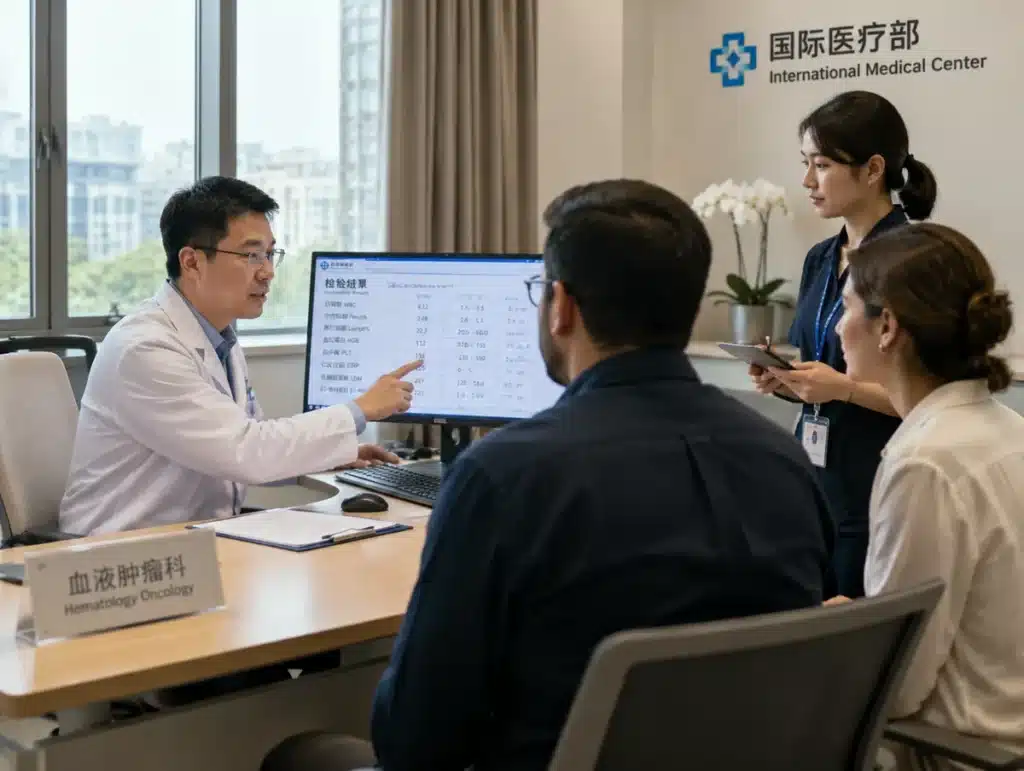
Step 1: Submit your medical records. Send pathology and bone marrow biopsy results, treatment history (prior regimens, dates, responses), recent labs (SPEP/UPEP, free light chains, LDH), and imaging through our contact form. China Care reviews documentation and provides a preliminary eligibility assessment within 5–7 business days.
Step 2: Hospital matching and remote consultation. Based on your clinical profile and prior treatment history, China Care identifies the most appropriate hospital and can often arrange a remote pre-consultation with the treating hematologist before you book travel.
Step 3: Visa application. International patients traveling to China for treatment typically require an S2 medical visa; the official invitation letter is issued by the licensed treating hospital. Our China medical visa guide covers documentation requirements and processing timelines.
Step 4: Travel and treatment. China Care coordinates airport transfer, hospital registration, interpreter services, and accommodation recommendations, with a dedicated case coordinator from arrival through discharge and the post-infusion monitoring period.
Step 5: Discharge and follow-up. At discharge, China Care provides a comprehensive English-language treatment summary for handover to your home oncologist, with follow-up remote consultations available at months 3, 6, and 12 post-infusion.
To begin, contact China Care today. Initial record reviews are provided at no charge.
FAQ
1. Is Fucaso the only BCMA CAR-T available in China?
No. Fucaso was China’s first approved BCMA CAR-T (June 2023), but two more have since been approved: Zevo-cel (February 2024) and cilta-cel — the domestic version of Carvykti (August 2024). China now has three NMPA-approved BCMA CAR-T products. Which one is appropriate for a given patient is a clinical decision made by the treating hematologist based on prior treatment history and disease characteristics.
2. How is Fucaso different from Carvykti or Abecma?
The core technical difference is the recognition domain. Fucaso uses a fully-human scFv, while Abecma uses a murine (mouse-derived) scFv and Carvykti uses camelid (llama-derived) nanobodies. Fucaso’s fully-human design is intended to reduce immunogenicity, which may support longer CAR-T cell persistence — some patients in the FUMANBA-1 trial had detectable CAR-T cells beyond 1,000 days post-infusion. In terms of response rates, FUMANBA-1’s ORR (96%) and Carvykti’s CARTITUDE-1 ORR (97.9%) are broadly comparable; Abecma’s KarMMa trial reported a lower ORR (72–73%).
3. What does Fucaso treatment cost compared to the US products?
Fucaso’s official NMPA list price is ¥1.166 million, roughly $160,000–$180,000 USD depending on the exchange rate. Carvykti lists at $465,000 and Abecma at $419,500 in the United States, before hospitalization, monitoring, and bridging therapy are added. RMB prices in China are fixed manufacturer list prices; USD conversions will move with the exchange rate.
4. Can I receive Fucaso if I already tried a BCMA CAR-T abroad and relapsed?
Possibly. The FUMANBA-1 trial included 12 patients previously exposed to another BCMA CAR-T, and 9 of them (75%) still responded to Fucaso. Prior BCMA-directed therapy does not automatically disqualify a patient, though eligibility depends on current disease status, organ function, and time since the prior treatment. A full case review by the treating hematology team is the first step.
5. Is Fucaso available through a clinical trial, or is it a standard commercial treatment?
Fucaso is a commercially approved product, not a clinical trial. This matters for international patients: accessing Fucaso does not depend on a research team’s recruitment priorities the way an investigational construct (such as some GPRC5D or bispecific CAR-T programs) would. For patients who have already failed BCMA-directed therapy and are exploring next-generation targets, our multiple myeloma CAR-T guide covers the trial landscape and realistic expectations for enrollment.
6. What are the main risks of Fucaso treatment?
The two primary toxicities are cytokine release syndrome (CRS) and neurotoxicity (ICANS). In the FUMANBA-1 trial, 93.2% of patients experienced some-grade CRS, but 92.2% was Grade 1–2 and only one Grade 4 event occurred. ICANS was rare, at 1.9% of patients, all Grade 1–2. Grade ≥3 hematologic toxicity (low blood counts) affected about 93.7% of patients and required monitoring. All patients are hospitalized for at least 14 days post-infusion for safety monitoring.
7. How long does the whole process take, from consultation to discharge?
Plan for a total in-country stay of roughly 6–9 weeks, covering pre-treatment evaluation, leukapheresis, the 7–21 day manufacturing period, lymphodepletion chemotherapy, infusion, and the mandatory 14-day-minimum post-infusion monitoring period, plus a further 2–4 weeks of outpatient follow-up before travel clearance.
8. Is Fucaso covered by insurance for international patients?
Most international patients pay out of pocket, since travel health insurance and most home-country insurers do not cover elective overseas treatment. Within China, Fucaso entered the first edition of the Commercial Health Insurance Innovative Drug Catalog in December 2025 and is covered by several city-level “Huiminbao” plans — but these programs generally apply to domestic policyholders, not international patients. China Care provides an itemized cost estimate during the initial case review.
Start Your Consultation
Fucaso reports a 96% response rate for relapsed multiple myeloma — at roughly a third of the US list price for equivalent BCMA CAR-T products.
China Care Health Tours is a Hong Kong-based medical facilitation service connecting international patients with China’s leading hematology centers for CAR-T therapy. We coordinate every step from record review through post-treatment discharge.
Read Our Full Multiple Myeloma CAR-T Guide →
Disclaimer
China Care Health Tours (Hong Kong Huayou Care Consulting Limited) is a medical facilitation and coordination service. We are not a medical provider, and the information in this article does not constitute medical advice. Treatment eligibility, outcomes, and risks vary by individual patient. All clinical decisions should be made in consultation with a qualified hematologist or oncologist. Clinical data cited in this article reflects published trial results; individual outcomes may differ. China Care does not guarantee specific clinical outcomes.
References
- Li C, Zhou K, Hu Y, et al. Equecabtagene Autoleucel in Patients With Relapsed or Refractory Multiple Myeloma: The FUMANBA-1 Nonrandomized Clinical Trial. JAMA Oncol. 2024. https://doi.org/10.1001/jamaoncol.2024.4879
- National Medical Products Administration (NMPA). Equecabtagene Autoleucel Injection Approved with Conditions by China NMPA. 2023-06-30. https://www.nmpa.gov.cn/
- ClinicalTrials.gov. NCT05066646 — FUMANBA-1 (equecabtagene autoleucel in R/R MM). https://clinicaltrials.gov/study/NCT05066646
- Munshi NC, Anderson LD Jr, Shah N, et al. Idecabtagene Vicleucel in Relapsed and Refractory Multiple Myeloma (KarMMa). N Engl J Med. 2021;385(8):727-738.
- Berdeja JG, Madduri D, Usmani SZ, et al. Ciltacabtagene Autoleucel in Relapsed or Refractory Multiple Myeloma (CARTITUDE-1). Lancet. 2021;398(10297):314-324.
- An N, Li J, Luo P, et al. Key predictors of long-term outcomes in BCMA-targeted CAR-T therapy for relapsed/refractory multiple myeloma. J Transl Med. 2025;23:552.
- U.S. FDA. Abecma (idecabtagene vicleucel) approval, 2021-03-26; Carvykti (ciltacabtagene autoleucel) approval, 2022-02-28. https://www.fda.gov/