
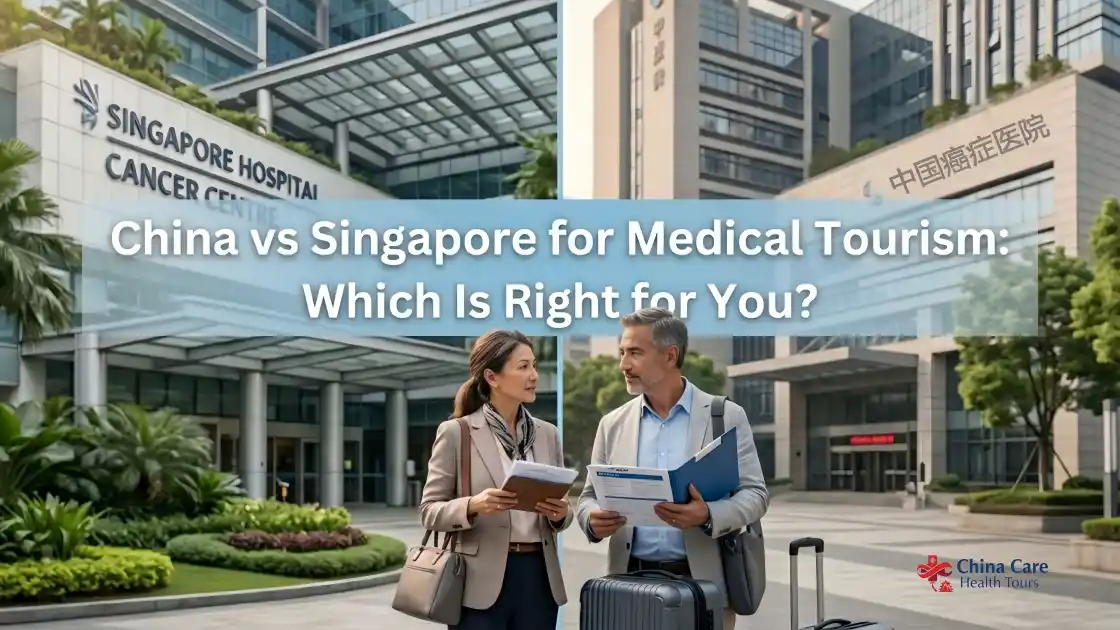
China and Singapore are Asia’s two most sophisticated medical tourism destinations — but they serve very different patients. Singapore offers English-first care in a familiar, low-friction environment. China leads on cost, clinical trial access, and advanced oncology. This guide breaks down the real differences so you can choose with confidence.
Table of Contents
1. Why Compare China and Singapore?
When international patients search for world-class healthcare in Asia, two countries dominate the shortlist: Singapore and China. Both have made deliberate, decade-long investments in attracting medical travelers. Both have top-tier hospitals with internationally trained specialists. And yet they represent fundamentally different propositions.
Singapore is a 734 km² city-state ranked 4th healthiest country globally by Bloomberg’s Global Health Index and 6th in the world by the WHO. It built its medical tourism industry on a simple promise: Western-equivalent care, delivered in English, in one of the world’s most organized cities.
China, home to 198,000 medical institutions and the world’s largest ongoing clinical trial ecosystem, offers something different: scale, specialization, and cost savings that no other country can match. A cancer patient who cannot afford treatment in the US or UK is not choosing between two equally priced alternatives — China is routinely 60–80% cheaper than North American private hospitals.
Google Trends confirms this divergence in audience intent: searches for “medical tourism Singapore” cluster around executive health screening, routine surgery, and second opinions. Searches for “medical tourism China” increasingly feature oncology, CAR-T cell therapy, and treatments unavailable or unaffordable elsewhere.
Understanding that difference is the starting point for every decision in this guide.
2. Hospital Quality & Accreditation
Singapore
Singapore’s private hospital sector is dominated by two major groups:
- Parkway Pantai — Southeast Asia’s largest private healthcare provider, operating Gleneagles, Mount Elizabeth, Mount Elizabeth Novena, and Parkway East hospitals
- Raffles Medical Group — Raffles Hospital specializes in cardiology, oncology, orthopaedics, and obstetrics
Singapore’s hospitals hold international accreditations and routinely appear in regional “best hospital” rankings. The country’s life expectancy of 84.8 years (as of 2019, the world’s longest) reflects systemic, sustained healthcare quality — not just premium facilities for the wealthy.
For international patients, the key advantage is predictability. Appointment systems work, documentation is standardized in English, and billing is transparent.
China
China’s leading hospitals are large by any global standard. Institutions like Wuhan Tongji Hospital, Fudan University Shanghai Cancer Center, Peking University Cancer Hospital, and Sun Yat-sen University Cancer Center (SYSUCC) handle patient volumes that give their specialists experience levels unmatched elsewhere.
China’s flagship hospitals operate international wings with English-speaking doctors, streamlined billing for foreign patients, and dedicated medical liaison teams. Top-tier facilities — particularly in Beijing, Shanghai, Guangzhou, and Shenzhen — meet or exceed global clinical benchmarks for the conditions they specialize in.
The key distinction: Chinese hospitals excel at volume-intensive specialties — oncology, robotic surgery, heavy ion therapy — where procedural experience matters as much as technology. Singapore excels at clinical breadth and patient communication, making it better suited for diagnostic workups and multi-specialty coordination.
| Factor | Singapore | China |
|---|---|---|
| JCI-equivalent accreditation | Widespread | Major hospitals in top cities |
| English-speaking staff | Near-universal | Available in international wings |
| Hospital specialization | Broad, generalist strengths | Deep specialization in oncology |
| Global health ranking | Top 10 (WHO, Bloomberg) | Rapidly rising |
| Patient volume at top centers | High | Very high |
3. Cost Comparison: Key Procedures
Cost is the most searched comparison point — and the most misunderstood.
Singapore is cheaper than the United States or Australia. China is cheaper than Singapore.
The table below uses publicly available 2026 estimates:
| Procedure | USA (Private) | Singapore | China | China vs Singapore |
|---|---|---|---|---|
| Executive Health Screening (Full Body) | $5,000+ | $1,500–$3,500 | $1,000–$1,400 | ~40–60% less |
| Cardiac Bypass Surgery | $123,000 | $25,000–$40,000 | $12,500–$18,000 | ~50% less |
| Robotic Surgery (Da Vinci) | $25,000–$40,000 | $18,000–$28,000 | $12,000–$18,000 | ~35% less |
| Dental Implant (per tooth) | $5,000 | $2,500–$3,500 | $1,100–$1,500 | ~55% less |
| PET-CT Scan | $3,000–$6,000 | $1,500–$2,500 | $1,000–$1,400 | ~40% less |
| Commercial CAR-T Therapy | $1,000,000+ | $350,000–$500,000 | $180,000–$250,000 | ~50% less |
| PD-1 Immunotherapy (annual) | $150,000+ | $60,000–$90,000 | $15,000–$30,000 | ~70% less |
| Heavy Ion Radiotherapy | $150,000+ | Not widely available | $45,000 | Significant |
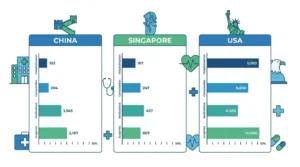
Sources: China Care Health Tours cost database 2026, Singapore Ministry of Health fee benchmarks, published hospital price lists.
Important caveat: Singapore’s costs include near-seamless coordination, English documentation, and post-treatment follow-up infrastructure that is harder to replicate independently in China. Patients managing their own China medical trip without a navigator service may encounter additional logistical costs that partially close the gap.
4. Wait Times & Logistics
Singapore
Singapore’s hospital system is efficient but in high demand. For elective procedures at top private hospitals, booking windows of 2–4 weeks are typical. For urgent oncology assessments, pathways exist that compress timelines. Visa-on-arrival is available for most nationalities, and English is the working language throughout — from airport to discharge.
China
China’s major hospitals offer same-day or next-day imaging for most diagnostic services, including CT, MRI, and PET-CT. CAR-T therapy cell manufacturing timelines have been compressed at leading centers using FasTCAR technology — from the global standard of 4 weeks down to 7–14 days for certain protocols.
The logistical challenge for China is language and navigation. Without a medical coordinator or facilitator, managing appointments, translating records, and communicating with clinical teams across multiple hospital departments is genuinely difficult. This is the primary reason medical navigation services exist for China — they solve a real problem, not a perceived one.
Summary: Singapore wins on frictionless logistics. China wins on speed for diagnostics and cutting-edge oncology protocols, provided you have coordination support.
5. Cancer Treatment & CAR-T Therapy
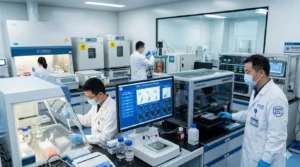
This section deserves special attention because it’s where the China-Singapore gap is widest — and where the right choice can be life-changing.
What Singapore Offers
Singapore’s oncology centers — particularly at Singapore General Hospital, National Cancer Centre Singapore (NCCS), and Mount Elizabeth — provide excellent care aligned with US/European treatment protocols. Access to CAR-T therapy is improving, but commercial availability remains limited compared to China, and costs are substantially higher.
What China Offers
China is currently running more than 1,580 registered cell therapy clinical trials — more than any other country. This is not a talking point; it is a structural advantage. Patients with certain blood cancers, lymphomas, multiple myeloma, and increasingly solid tumors have access in China to therapies that are:
- Approved in China but not yet in the US/EU
- Available at significantly lower cost
- Being administered by teams with higher case volumes
Key statistics for cancer treatment in China (2026):
- CAR-T for Multiple Myeloma: 96–98% overall response rates in Chinese trials, matching or surpassing FDA-approved benchmarks
- Solid Tumor CAR-T (Satri-cel / CT041): World’s first CAR-T therapy targeting gastric and pancreatic cancers — available in China only
- Heavy Ion Therapy: ~3x more precise than conventional radiotherapy; available in Shanghai, cost ~$45,000 vs $150,000+ in the US
- Ivonescimab: Reduces disease progression risk by 50%+ in EGFR-resistant lung cancer; approved in China, in Phase III trials elsewhere
For patients with advanced or treatment-resistant cancers, the clinical gap between the two countries can be decisive.
6. Language & Patient Experience
Singapore
English is an official language of Singapore, and all medical documentation, informed consent, prescriptions, and follow-up communication is in English as standard. There is no language barrier for international patients from English-speaking countries. Patient experience scores at Singapore’s private hospitals are consistently high.
China
Mandarin is the working language of Chinese hospitals. Top-tier hospitals in Beijing, Shanghai, Guangzhou, Shenzhen, and Wuhan have dedicated international patient departments with English-speaking physicians and coordinators — but the experience varies significantly by institution and by ward. Outside the international wings, real-time translation becomes essential.
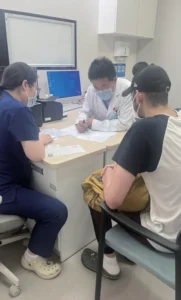
This is the most honest limitation to state plainly: unaccompanied international patients at Chinese hospitals without Mandarin ability will face friction. The solution is not to avoid China — it is to ensure you have professional medical coordination and interpretation support in place before arrival.
7. Visa & Entry Requirements
Singapore
Most nationalities receive visa-free entry for 30–90 days. No special medical visa is required. Medical travel is effectively seamless from an immigration standpoint.
China
China offers multiple entry pathways for medical travelers:
- Medical Visa (S2): For treatment at specific Chinese hospitals; requires financial proof of $10,000–$15,000 USD minimum
- 240-Hour Visa-Free Transit: Available in 24 cities including Beijing, Shanghai, Guangzhou, Shenzhen, and Chengdu — sufficient for diagnostic trips and initial consultations
- Hainan Visa-Free: International patients visiting Hainan’s Boao Lecheng Medical Tourism Zone can access experimental therapies under a special regulatory zone framework with simplified entry
For most planned medical trips lasting 1–4 weeks, the medical visa is the correct pathway. For exploratory diagnostic visits, the 240-hour transit provision allows significant flexibility.
8. Who Should Choose Singapore?
Singapore is the right choice if:
- Language is a priority. You want all communication in English with no translator dependency
- Your treatment is routine and well-defined. Elective surgery, executive health screening, orthopaedic procedures, or second opinions on existing diagnoses
- You value a seamless logistics experience and are willing to pay a premium for it
- You are coming from Southeast Asia and want a short-haul, low-complexity medical trip
- Your insurer covers Singapore but not Chinese hospitals (many international insurance plans recognize Singapore’s private hospitals)
9. Who Should Choose China?
China is the right choice if:
- Cost is a significant factor. You need substantial savings on cancer treatment, robotic surgery, or diagnostics, and cannot afford US/Australian/Singapore prices
- You need CAR-T therapy or advanced immunotherapy. China has more approved therapies, more trial access, and lower costs than anywhere else in the world
- Your cancer is treatment-resistant or rare. China’s trial ecosystem offers pathways that simply do not exist elsewhere
- You want heavy ion therapy. China has the most accessible heavy ion centers globally, at a fraction of Western costs
- You are willing to use a medical navigator. The language barrier is solvable with the right support — and the cost savings more than justify the navigation fee
10. FAQ
Is healthcare in China safe for international patients?
Yes, at China’s top-tier hospitals. Major research hospitals in Beijing, Shanghai, Guangzhou, Shenzhen, and Wuhan maintain clinical standards comparable to leading Western institutions. The key is ensuring you access an international-wing facility with a qualified navigation service, rather than attempting to coordinate complex treatment independently.
Is Singapore more expensive than China for medical care?
Consistently, yes. China is typically 35–70% cheaper than Singapore for equivalent procedures, and 60–80% cheaper than the United States. Singapore offers a premium in English-language service and logistical simplicity that some patients value highly.
Can I get CAR-T therapy in Singapore?
Singapore has improving access to CAR-T therapy, but commercial availability, trial access, and cost are all more favorable in China. Patients specifically seeking CAR-T for blood cancers or solid tumors are better served by Chinese oncology centers.
Do I need a special visa to receive medical treatment in China?
For planned treatment, a Medical Visa (S2) is recommended and requires financial proof. For short diagnostic visits, China’s 240-Hour Visa-Free Transit policy applies in 24 major cities. Hainan’s Boao Lecheng zone offers additional regulatory flexibility for experimental therapies.
Which country has shorter wait times for oncology?
For advanced oncology and CAR-T specifically, China’s leading centers offer faster treatment initiation than Singapore, including same-day diagnostics and compressed CAR-T manufacturing timelines of 7–14 days using FasTCAR technology.
How do I manage the language barrier in Chinese hospitals?
All major international-wing hospitals have English-speaking clinical staff. For complex, multi-appointment treatment journeys, engaging a dedicated medical navigation service — which provides bilingual coordination, document translation, logistics, and in-hospital accompaniment — is strongly recommended.
What types of cancer treatment are available in China that aren’t widely available elsewhere?
China offers: solid tumor CAR-T (targeting gastric and pancreatic cancers), heavy ion therapy at multiple centers, FasTCAR rapid cell manufacturing, and Ivonescimab for EGFR-resistant lung cancer. Several of these therapies are in Phase III trials internationally but already approved and administered in China.
11. Start Your Medical Journey
Considering Treatment in China?
China Care Health Tours specializes in guiding international patients through China’s medical system — from first contact with a hospital to recovery support and follow-up coordination.
We work with verified oncology centers, CAR-T specialists, and surgical teams across Beijing, Shanghai, Guangzhou, Shenzhen, Wuhan, and Hainan.
→ Schedule a Free Consultation via WhatsApp
→ View Our Verified Hospital Directory
→ Read: CAR-T Cell Therapy in China — Full 2026 Guide
No obligation. No upfront fee. We answer your questions first.