
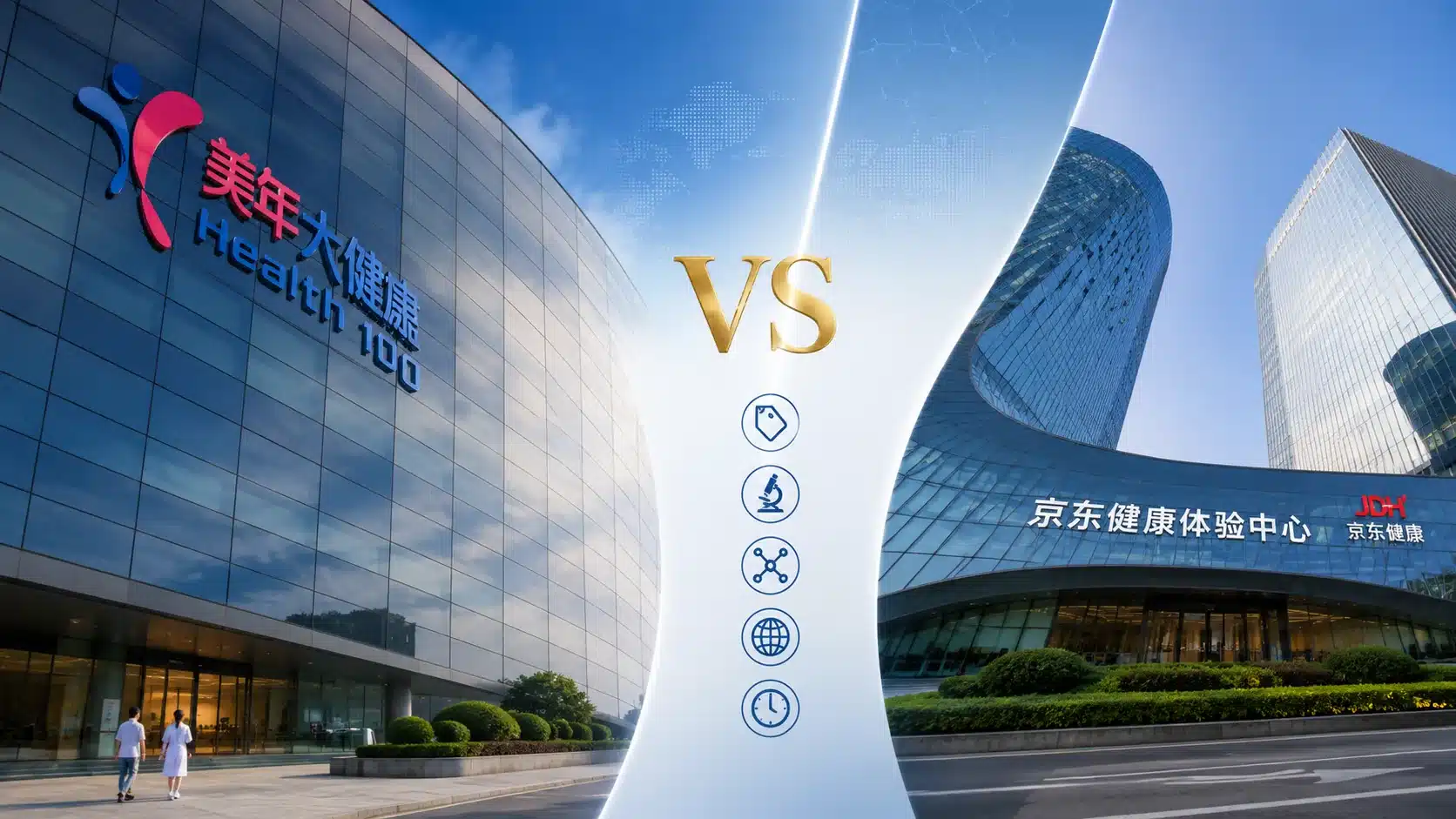
Meinian Onehealth and JD Health are China’s two largest executive health screening networks. Meinian leads on sheer scale — 1,000+ centres nationwide — while JD Health brings tech-first reporting and a stronger digital concierge experience. This guide breaks down locations, packages, English support, and who each provider actually suits in 2026.
Key Facts
- Meinian Onehealth operates 1,000+ screening centres across 300+ Chinese cities; JD Health has ~60 centres concentrated in Tier-1 cities.
- Both providers deliver full results within 3–7 working days; a comprehensive executive programme takes 3–6 hours on-site.
- A comparable executive health check costs USD 3,000–8,000 in Singapore and GBP 2,500–5,000 in the UK; China-based programmes at either provider represent substantial savings at equivalent diagnostic depth.
- JD Health produces structured digital reports with AI-flagged abnormals — the most practical format for sharing with overseas physicians.
- Meinian’s Shenzhen premium centres operate exclusively all-private-suite programmes starting at ¥4,999; standard national pricing does not apply in Shenzhen.
- Neither provider offers same-day comprehensive results; any claim of same-day full-panel results including imaging reads should be treated with scepticism.
Table of Contents
1. Overview: Scale, Background, Ownership
When international patients start researching executive health screening in China, two names come up more than any others: Meinian Onehealth and JD Health. They dominate the market for good reason — but they have arrived at that position through very different routes.
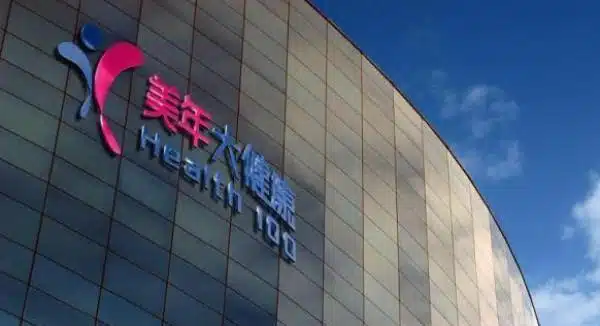
Meinian Onehealth was founded in 2004 and is listed on the Shenzhen Stock Exchange (SZSE: 002044). It is the largest dedicated health screening chain in China by centre count, operating over 1,000 facilities across more than 300 cities. Meinian’s model is physical-first: large, purpose-built screening centres staffed by full-time clinicians, with on-site imaging, laboratory, and specialist consultation rooms. Its growth has been driven by corporate wellness contracts with Chinese employers, but its flagship VIP centres are well suited to the high-value international traveller.
JD Health is a wholly different origin story. It is the healthcare arm of JD.com, China’s second-largest e-commerce platform, and was separately listed on the Hong Kong Stock Exchange (HKEX: 6618) in 2020. JD Health started as an online pharmacy and telemedicine service, then built physical screening centres — currently around 6 locations, concentrated in Beijing and Shenzhen. Its model is digital-first: appointment booking, report delivery, follow-up consultations, and records management all flow through the JD Health app. The physical centres reflect that ethos — quieter, more curated, with a heavier emphasis on post-screening digital care.
Neither is a generalised hospital. Both are dedicated preventive health businesses. The question is which model fits your specific situation.
2. City Presence and International Patient Access
For an international patient, access comes down to two factors: which cities have centres, and whether those centres have the infrastructure to handle non-Mandarin speakers.
Meinian Onehealth 100 operates in virtually every major Chinese city. For international patients, the most relevant locations are its flagship Ruici VIP centres (a premium sub-brand of Meinian) and its standalone premium facilities in Beijing, Shanghai, Guangzhou, Shenzhen, and Hangzhou. If you are already travelling to China for another reason — business, family, or onward treatment — there is almost certainly a Meinian facility in your destination city. You can read more about what Meinian offers through our Meinian Onehealth screening centre profile.
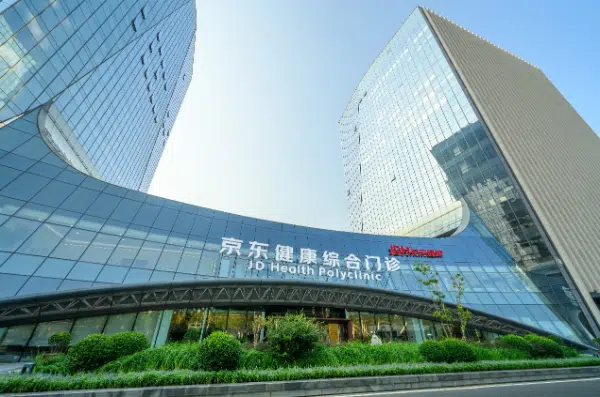
JD Health has a much smaller footprint: roughly 6 centres as of 2026, concentrated in Beijing and Shenzhen. This is not necessarily a disadvantage — the centres that do exist are purpose-designed to a consistent standard — but it does mean fewer options if you are travelling to a second-tier city. Our JD Health Screening Centre profile covers the flagship Beijing and Shenzhen locations in detail.
For patients interested in city-specific guidance:
- Health screening in Shanghai — Shanghai is primarily served by Meinian, as JD Health does not currently operate a screening centre in the city.
- Health screening in Beijing — Beijing offers both providers, with JD Health’s Beijing centre being its most established international-facing facility.
- Health screening in Shenzhen — Shenzhen is one of the few cities where patients can choose between both providers. Meinian offers multiple premium screening programmes, while JD Health operates one of its flagship centres.
- Health screening in Guangzhou — Guangzhou is currently served by Meinian. JD Health does not currently have a health screening centre in Guangzhou.
Bottom line on access: Meinian wins on coverage. JD Health wins on consistency within the cities it operates.
3. Medical Equipment and Technology
Both providers invest heavily in imaging and laboratory infrastructure, but they deploy technology differently.
Meinian’s flagship centres typically house:
- 3.0T MRI (at VIP and premium-tier facilities)
- 64-slice or 128-slice CT scanners
- Full digital mammography and 3D tomosynthesis
- Colour Doppler ultrasound systems (cardiac, abdominal, vascular)
- High-complexity laboratory with same-day processing for most panels
- Gastroscopy and colonoscopy suites with anaesthesia support
The physical footprint of a Meinian premium centre can be several floors of a dedicated building. The clinical depth is genuinely impressive, and for centres that have achieved JCI or CAP laboratory accreditation, the quality benchmarks are internationally comparable.
JD Health’s centres are smaller but technologically curated. They have standardised their equipment list across locations more tightly than Meinian, which has significant variation between its 1,000+ sites. You will find:
- 1.5T or 3.0T MRI (centre-dependent)
- CT with low-dose lung cancer screening protocols
- Digital mammography
- Ultrasound (internal medicine and specialist)
- In-house laboratory with results feeding directly into the JD Health digital platform
JD Health’s differentiating investment is in the digital layer: AI-assisted report interpretation, structured digital output rather than scanned PDFs, and integration with online physician follow-up. For a patient who needs to share results with a doctor overseas, a structured digital report is considerably more useful than a stapled paper booklet.
As the World Health Organization notes in its guidance on patient safety in health services, digital interoperability and structured health records are increasingly recognised as patient safety factors — not just a convenience.
4. Health Check Packages: What Is Included
Meinian Onehealth 100
Meinian’s package architecture has multiple tiers, from entry-level annual checks to comprehensive executive programmes. The entry-level products are popular for domestic employer contracts. International patients are typically looking at mid-to-premium tier programmes, which include:
- Full blood count, metabolic panel, lipid panel, liver and kidney function
- Tumour markers (CEA, AFP, CA125, CA199, CA153, PSA for men)
- Thyroid panel (TSH, FT3, FT4)
- Abdominal ultrasound
- Chest X-ray (or low-dose CT at premium tiers)
- Electrocardiogram
- Blood pressure, BMI, and physical examination
- Bone density (at higher tiers)
- Gastroscopy (optional add-on or included at executive tier)
- Gynaecological check including HPV and cervical cytology (female programmes)
The Shenzhen premium line is worth noting separately: Meinian’s Shenzhen centres operate exclusively premium and ultra-premium programmes — the “Guardian Health” series starting at ¥4,999 and the “First Class” series at ¥10,688 and above, all conducted in private rooms. Standard national pricing does not apply in Shenzhen.
For a detailed breakdown of available programmes, see our screening packages guide.
JD Health Screening
JD Health structures its programmes around four broad health orientations — cardiovascular risk, cancer screening, metabolic health, and comprehensive executive. A typical mid-tier programme covers:
- Core blood panels (haematology, metabolic, lipid, liver, kidney, thyroid)
- Tumour markers (expanded panel at higher tiers)
- Abdominal and pelvic ultrasound
- Low-dose CT (lung screening included as standard at most tiers, not an add-on)
- Cardiac ECG and echocardiogram at premium levels
- Digital report with AI-flagged abnormals
- One follow-up online consultation with a physician included in the package
JD Health’s pricing is competitive with Meinian at equivalent clinical depth. For cost guidance, the clearest benchmark is overseas comparison: a broadly equivalent comprehensive executive check in Singapore runs USD 3,000–8,000; in the United Kingdom, comparable private checks range from GBP 2,500–5,000. China-based packages at either Meinian or JD Health represent substantial savings at equivalent diagnostic depth. For current package pricing at both providers, enquire with us directly — you pay the published package rate with no extra fees added on top.
| Package Tier | What Is Typically Included | Overseas Equivalent Cost |
|---|---|---|
| Entry (domestic focus) | Core bloods, ECG, X-ray, ultrasound | — |
| Mid-tier executive | Full panels + CT + tumour markers + thyroid | USD 3,000–5,000 (SG) |
| Premium/VIP | Above + MRI + gastroscopy + bone density + follow-up | USD 5,000–8,000 (SG) |
| Ultra-premium (Meinian SZ) | Private suite + full imaging + specialist consultation | USD 8,000+ (UK/US) |
China package prices: Enquire for current published rates.
5. Waiting Times and Appointment Process
Meinian appointment lead times vary significantly by city and centre tier. At standard locations, same-week appointments are often available. At flagship premium centres in Shanghai or Beijing during peak periods (Q1 and Q4, when corporate wellness budgets flush), two-to-four weeks lead time is more typical. Walk-ins are technically possible but not advisable for international patients who need interpreter support arranged in advance.
The appointment itself at a full-service Meinian executive centre typically runs four to six hours, covering all imaging, blood draws, physical examination, and specialist consultations in a single visit. Results are delivered within 3–7 working days via the Meinian app or paper report.
JD Health appointment booking runs entirely through the JD Health app or website — or through a concierge like China Care if you want English-language support throughout. Lead times at JD Health flagship centres are broadly comparable to Meinian premium: one to three weeks in major cities. The centre visit itself is typically three to five hours. Results are delivered digitally within 3–7 working days, structured and accessible directly in the app, with AI-flagged abnormals highlighted.
For international patients who need to plan around travel itineraries, both providers can accommodate pre-booked slots with advance notice. China Care handles the booking, language logistics, and appointment confirmation on your behalf — see our full health screening in China for foreigners guide for how this works in practice.
6. International Patient Experience
This is where the two providers diverge most noticeably in 2026, and where the gap matters most to a patient flying in from Lagos, London, or Toronto.
Meinian’s centres are built for the Chinese domestic market. English-language support exists at premium flagship locations in Shanghai and Beijing — but it is inconsistent. Some centres have dedicated international patient coordinators; others rely on in-house bilingual nurses who may be occupied with other patients. If you book directly without a concierge, the risk of a language gap during imaging instructions, consent forms, or results explanations is real.
At the premium tier, Meinian’s physical environment is genuinely impressive: private changing rooms, dedicated waiting areas, premium catering, and a pace that avoids the crowded-clinic feeling of standard domestic health checks. The clinical quality at these facilities is not in question. The coordination layer is what needs reinforcing for international patients.
JD Health has made more deliberate investment in international-facing infrastructure. Its flagship Beijing and Shanghai centres have English-speaking coordinators on site, English-language consent forms, and report templates that can be generated in both Chinese and English. The digital-first model also helps: when your results arrive as a structured PDF with standardised terminology rather than handwritten Chinese annotations on a film printout, sharing with your oncologist or GP back home is straightforward.
Neither provider offers true 24-hour results — any centre that promises same-day comprehensive results for a full panel including imaging reads and laboratory analysis should be treated with scepticism. Realistic expectations: results within 3–7 working days, sometimes faster for blood panels alone.
Ruici — the Meinian VIP sub-brand available in select cities) deserves mention here as a middle path: smaller centres, more curated than standard Meinian, with a stronger service ethos. Our Ruici Health profile covers what makes it distinct.
According to published research in the BMJ on health screening programme design, the quality of the follow-up and explanation process is as clinically important as the screening tests themselves. This is an area where China Care’s coordination adds concrete value regardless of which provider you choose.
7. Pros and Cons
Meinian Onehealth
| Pros | Cons |
|---|---|
| 1,000+ centres — maximum city coverage | Inconsistent English support across locations |
| Deep clinical infrastructure at premium centres | Quality variation between standard and premium sites |
| Ruici VIP sub-brand for curated experience | App and digital report less polished than JD Health |
| Long track record (est. 2004) | Shenzhen premium pricing significantly higher |
| Gastroscopy and colonoscopy on-site | Flagship appointment slots book up in peak periods |
JD Health
| Pros | Cons |
|---|---|
| Consistent centre standard across locations | Smaller network (~60 centres vs 1,000+) |
| Superior digital report and app experience | Fewer cities served |
| Stronger English-language infrastructure at flagships | Newer entrant to physical screening (less long-term track record) |
| AI-flagged abnormals in structured report | Walk-in not practical |
| Included physician follow-up consultation | Some packages lack gastroscopy on-site |
8. Full Comparison Table (8 Criteria)
| Criterion | Meinian Onehealth | JD Health |
|---|---|---|
| Network size | 1,000+ centres, 300+ cities | ~60 centres, 6+ Tier-1/2 cities |
| Ownership | SZSE-listed independent company | JD.com subsidiary (HKEX-listed) |
| Equipment depth | 3.0T MRI, 128-slice CT at premium centres | 1.5T–3.0T MRI, standardised CT; strong digital layer |
| Package range | Entry to ultra-premium (SZ from ¥4,999) | Mid to premium; cancer and cardiovascular specialisation |
| English support | Available at flagship VIP centres; inconsistent elsewhere | More consistent at flagships; English report templates standard |
| Digital report | App available; less structured than JD | Structured digital output; AI-flagged; shareable |
| Results delivery | 3–7 working days | 3–7 working days |
| Best for | Broad city access; clinical depth; gastroscopy | Digital-first; consistent QA; overseas sharing of results |
Package prices for both providers: Enquire with China Care for current package references.
9. Who Should Choose Meinian?
Choose Meinian Onehealth if:
You are travelling to a city outside the Tier-1 core. Meinian’s 300+ city footprint means you have options in Chengdu, Wuhan, Xi’an, Nanjing, and dozens of other cities where JD Health has no physical presence.
You want gastroscopy or colonoscopy as part of your check. Meinian’s purpose-built centres routinely include endoscopy suites with anaesthesia support. If upper gastrointestinal screening is a priority — especially for patients with family history or symptoms — this is a significant practical advantage.
You are looking at ultra-premium programmes in Shenzhen. Meinian’s Shenzhen premium line (Guardian Health series, all-private-suite format) has no equivalent at JD Health in that city.
You have booked through China Care. We work directly with Meinian’s international coordination team at flagship centres, which resolves the language-gap issue that makes direct booking difficult. The clinical infrastructure at a premium Meinian centre is hard to beat at any comparable price point.
10. Who Should Choose JD Health?
Choose JD Health Screening Centre if:
You need to share results with a physician outside China. JD Health’s structured digital reports in both Chinese and English, with standardised terminology, are the most practical format for a European or North American specialist to actually read and act on.
You are in Beijing or Shanghai and prioritise consistency. JD Health’s quality control across its smaller network is tighter. You are less likely to encounter the variation in service quality that exists between Meinian’s entry-level and premium facilities.
You want a tech-integrated experience. The JD Health app—appointment booking, pre-check questionnaire, result delivery, AI interpretation, and physician follow-up—is genuinely good. For a patient who is comfortable with digital health tools and wants everything in one place, it is the more coherent experience.
Your focus is cardiovascular or metabolic risk. JD Health has built specific programme tracks for these areas, with structured risk scoring and follow-up pathways. If you are a 50-year-old executive whose primary concern is heart disease risk, JD Health’s cardiovascular programme is particularly well designed.
FAQs
For current questions about this topic, contact China Care or consult the relevant official provider or authority for up-to-date information.
Book Your Health Screening in China
China Care coordinates executive health checks at both Meinian and JD Health flagship centres. We handle appointment booking in Mandarin, arrange on-the-day interpreter support, and review your results with you in plain English before you leave — or over video call after you return home.
Before payment, China Care confirms the selected centre, package/version, preferred date, availability, published package rate, and booking requirements.
Once confirmed, an advance payment of the published package rate is required to secure the booking. You pay China Care directly when booking, and China Care settles the payment with the screening centre on your behalf — so you don’t need a Chinese bank card or cash on the day.
Enquire About Your Health Check →