If you’ve scrolled TikTok in the last few months, you’ve probably seen it: strangers sipping hot water, doing slow stretches in their kitchens, captioning it all “you’ve met me at a very Chinese time in my life.” That’s chinamaxxing — the trend where young Westerners lean hard into Chinese daily habits, from morning hot water to evening foot soaks. It’s not just a meme anymore. It’s a travel movement. Here’s what it actually is, why it exploded, and how to experience it for real on a China trip.
Key facts
- Chinamaxxing = China + “maxxing” (Gen Z internet slang for going all-in). Related hashtags have pulled in 4 billion+ views across TikTok, Instagram, and YouTube since early 2026.
- Its predecessor #ChinaTravel has racked up 28 billion+ plays, and that momentum is turning into airline bookings — China logged 22.91 million foreign arrivals in H1 2026, up 20.4%, with 77.7% entering visa-free (National Immigration Administration).
- The 240-hour (10-day) visa-free transit policy now covers 55 countries through 65 ports — long enough to explore several cities and fit in a health screening, though each arrangement has its own rules.
- The “wellness” angle isn’t just content: hot water, congee, Baduanjin (八段锦) and gua sha are now the most-saved health videos on the app, framed by outlets like the NY Post as “TikTokkers are Chinamaxxing their health.”
- You can experience it in person: morning park qigong, a TCM consultation, high-speed rail village walks — and, if you’re already there, a full-body checkup at a Grade 3A hospital with English support, from around $399–899 depending on the package and city.
What is chinamaxxing?
Chinamaxxing is internet shorthand for “extreme Chineseness” — China plus the Gen Z suffix “-maxxing” (from looksmaxxing, optimizing your appearance) to describe deliberately adopting Chinese daily habits as a self-improvement project: morning hot water, congee breakfasts, house slippers, slow qigong stretches, early nights.
The content that kicked it off tends to look like this: a Chinese-American creator shows her morning routine — warm water first thing, a bowl of congee, house slippers indoors, a set of slow stretches. Comment sections fill up with people saying “wait, I already do this” or “I’m going to try this tomorrow.” Then someone films themselves trying it, and the chain keeps going.
Where did it start? Most accounts trace the spark to Sherry Zhu (朱溪瑞), a 23-year-old Chinese-American creator whose first viral video dropped on December 6, 2025 — a playful clip telling viewers that if they’d been served that video, “you’re Chinese.” By March 2026, her TikTok following had grown to nearly 750,000, and the format had spawned thousands of copycats (Zhejiang News, March 2026). From there, the tag exploded: #Chinamaxxing, #BecomingChinese, and #IWantToBeChinese together crossed 4 billion views in a matter of months.
The trend behind it: from China Travel to chinamaxxing
Chinamaxxing didn’t just materialize on your feed. It’s the latest chapter of a much bigger story: the “China Travel” wave that started in 2024 when China expanded its visa-free transit policies.
Here’s how big it actually got. On social media, #ChinaTravel has passed 28 billion plays on TikTok alone, per CCTV Finance reporting (August 2026). On the ground, the trend is turning into real arrivals. In the first half of 2026:
- China processed 369 million cross-border trips, a record high (up 10.8% year-on-year).
- Foreign arrivals reached 22.91 million, up 20.4%.
- Of those, 17.8 million entered visa-free — 77.7% of all foreign arrivals, up 30.6% (National Immigration Administration, July 2026).
The policy engine behind it: China currently grants unilateral visa-free entry to citizens of 50 countries, and offers 240-hour visa-free transit to nationals of 55 countries through 65 designated ports across 24 provincial regions. The unilateral exemptions for 40+ countries run through December 31, 2026 (State Council / NIA).
Why does this matter for a wellness trend? Because the barrier to “just going” got much lower. A few years ago, planning a China trip meant a visa appointment, paperwork, and weeks of lead time. Today, for travelers from the US, UK, Australia, Canada, and most of Europe, you can book a flight, land, and be standing in a Shanghai park at 7 a.m. watching locals do qigong — without ever visiting an embassy.
The wellness angle: why chinamaxxing is really about health
Then the meme took a turn nobody expected: underneath it, there’s a genuine health trend. The chinamaxxing health angle isn’t subtle — the New York Post nailed it in March 2026 with the headline “TikTokkers are ‘Chinamaxxing’ their health.” What started as a joke about slippers and hot water turned out to be a set of genuinely old wellness practices with a very modern appeal — a framing NPR has also picked up in coverage of Gen Z travelers “chinamaxxing” their way through China.
The habits people are “maxxing” on:
- Hot water instead of iced drinks — the viral “hot water challenge,” where creators swap iced lattes for steaming mugs.
- Congee (粥, zhōu) — a slow-cooked rice porridge that’s become a TikTok breakfast staple.
- Baduanjin (八段锦, “Eight Pieces of Brocade”) — a 1,000-year-old set of eight slow movements that’s suddenly the app’s most-watched exercise routine.
- Gua sha (刮痧) and cupping (拔罐) — the scraping and suction techniques that have gone from niche spa treatments to mainstream content.
- House slippers, warm socks, no cold feet — tiny daily details that show up in almost every “becoming Chinese” video.
- Going to bed early and walking after meals — the anti-burnout habits that hit different for a generation running on late nights and cortisol.
The wellness logic behind them is tied to Traditional Chinese Medicine (TCM), a system with roots going back roughly 5,000 years, and to the broader philosophy of yǎng shēng (养生) — “nourishing life,” or preventive self-care aligned with the seasons. For a generation exhausted by burnout culture, that framing — small, consistent, low-cost habits instead of expensive quick fixes — is a big part of the appeal. The Conversation’s analysis (2026) described it as an antidote to “hyper-optimised self-care culture.”
A quick honesty note before you start brewing apple tea: we’re describing a cultural phenomenon, not making medical claims. TCM is a rich, centuries-old tradition, and there’s real research interest in practices like qigong and diet patterns. But plenty of what circulates on TikTok is oversimplified, and individual results vary. Treat chinamaxxing like you’d treat any wellness trend — with curiosity, not blind faith. If you have a health condition, talk to a real clinician, ideally one licensed in your home country.
The upgraded maxx experience: doing it in China, in person
Here’s the thing about chinamaxxing: the original content was filmed in China, or by diaspora creators recreating Chinese life abroad. The next logical step — and the one a growing number of travelers are taking — is to just go do it in context.
If you want the in-person version of the trend, here’s what that actually looks like on a trip:
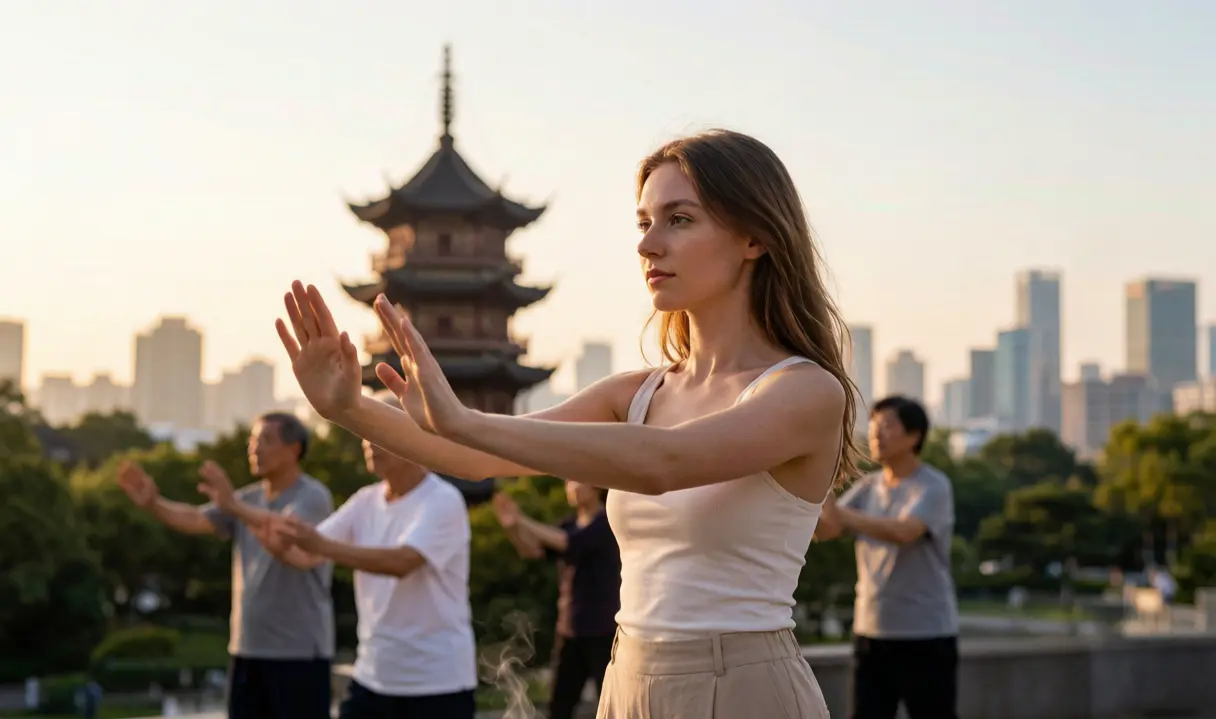
Morning park qigong. Show up to any major city park before 8 a.m. — People’s Park in Shanghai, Temple of Heaven in Beijing, Lianhuashan in Shenzhen — and you’ll find groups practicing tai chi and Baduanjin. In my experience, most regulars are friendly and happy to let visitors follow along at the back. No booking needed. No English required. Just join the edge of the circle and copy the movements.
A TCM consultation. If you’re curious about how practitioners actually assess things, many Chinese hospitals and clinics offer TCM consultations where a practitioner takes your pulse, looks at your tongue, and asks about sleep, digestion, and energy levels. It’s a fascinating cultural experience, and it can be a genuinely informative conversation about how your body’s coping. Treat it as what it is: a consultation in a different medical tradition. It is not a replacement for evidence-based care, and you should never stop or change prescribed treatment based on a single consultation.
High-speed rail and village walks. Half the “China Travel” content that feeds chinamaxxing is about the 350 km/h rail network and the slow, rural side of the country. Ten days under the 240-hour policy is enough for a two- or three-city arc: Beijing → Shanghai by train, or Hong Kong → Shenzhen → Guangzhou. The contrast — ultra-modern cities, then a small town where the day still moves on the sun — is the thing vloggers can’t stop filming.
Eat like the content, not like the tourist. Congee for breakfast, hot tea instead of soda, soup with meals. This isn’t a wellness prescription; it’s just what people actually eat. And it’s one of the cheapest ways to feel like you’re “living there” instead of visiting.
That’s the chinamaxxing experience in its purest form: not a checklist, but an immersion.
A complete maxx journey includes a health checkup
Here’s the part most travel guides won’t tell you. A big chunk of what makes chinamaxxing compelling is the health framing — the idea that you’re doing something good for your body, not just your feed. Hot water, qigong, early nights: they’re all low-cost self-management habits. And if you’re already in China, there’s a more direct way to apply that same “let’s take care of the body” mindset: a full health checkup.
It sounds unusual if you’ve never considered it, but hear me out. Medical screening in China has quietly become one of the country’s most practical offerings for international visitors. The same countries that dominate the chinamaxxing trend — the US, UK, Australia, Canada, most of Europe — are the ones where a comprehensive self-pay checkup can cost $2,000–2,500 and involve weeks of appointments. In China, the equivalent at a top-tier hospital typically runs from around $399–899, is completed in one morning, and — at the centers that serve international patients — comes with English-speaking coordination and an English report.
So the logic writes itself: you’re already traveling for the experience, you’re already thinking about your health, and you can knock out a full-body screening in a single fasted morning. That’s arguably the most literal chinamaxxing there is — investing in your own baseline, Chinese-style.
Health checkup during a China trip: what you need to know
If you’re thinking about a medical checkup for tourists in China — or just wondering whether a health check during a China trip is even practical — here’s the straight picture, policy facts first, because that’s the part that confuses everyone.
Can you do a checkup under the 240-hour visa-free policy?
Yes, in practical terms — with a caveat. The 240-hour visa-free transit policy lets nationals of 55 countries stay up to 10 days while transiting to a third country, and permitted activities include tourism and visiting. A preventive health screening as part of a tourist stay falls within the normal scope of that stay. But two things matter:
- You need an onward ticket to a third country/region — that’s the core requirement of transit visa-free entry. A “return home” flight usually counts if it’s to a different country than where you came from, but rules vary by port and your exact itinerary. Don’t wing it: confirm your route qualifies before you book.
- Check the current policy before you fly. Visa rules change, and the fine print (which countries, which ports, what counts as “transit”) is updated by the National Immigration Administration. We keep a walkthrough here: How to get a China 240-hour visa-free medical checkup in 2026.
If you’re not on the visa-free list, or your itinerary doesn’t fit the transit rules, a standard tourist visa also works — the checkup itself doesn’t require any special permit.
Where can you go?
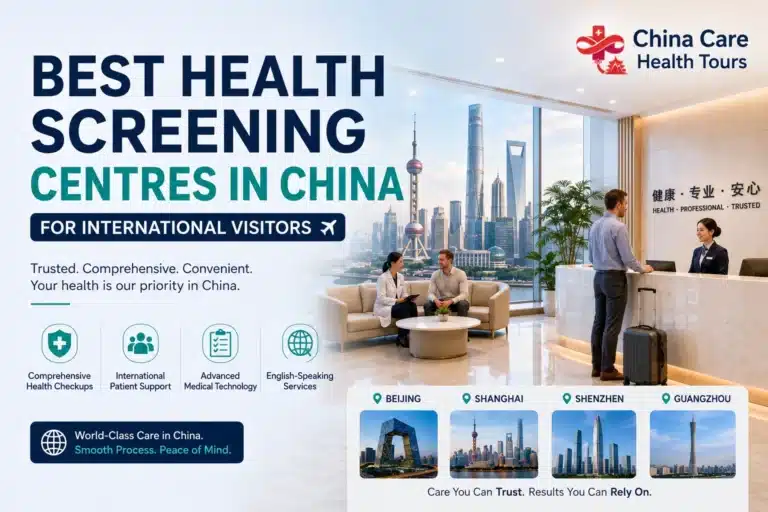
The international-friendly screening market is concentrated in a few cities with strong English infrastructure:
- Shenzhen — the de facto hub for travelers coming from Hong Kong. It’s reachable from HK in about 20–30 minutes via Lok Ma Chau or Lo Wu to Futian, no domestic flight needed. Most major centers accept foreign nationals by passport. See the Shenzhen guide for foreigners.
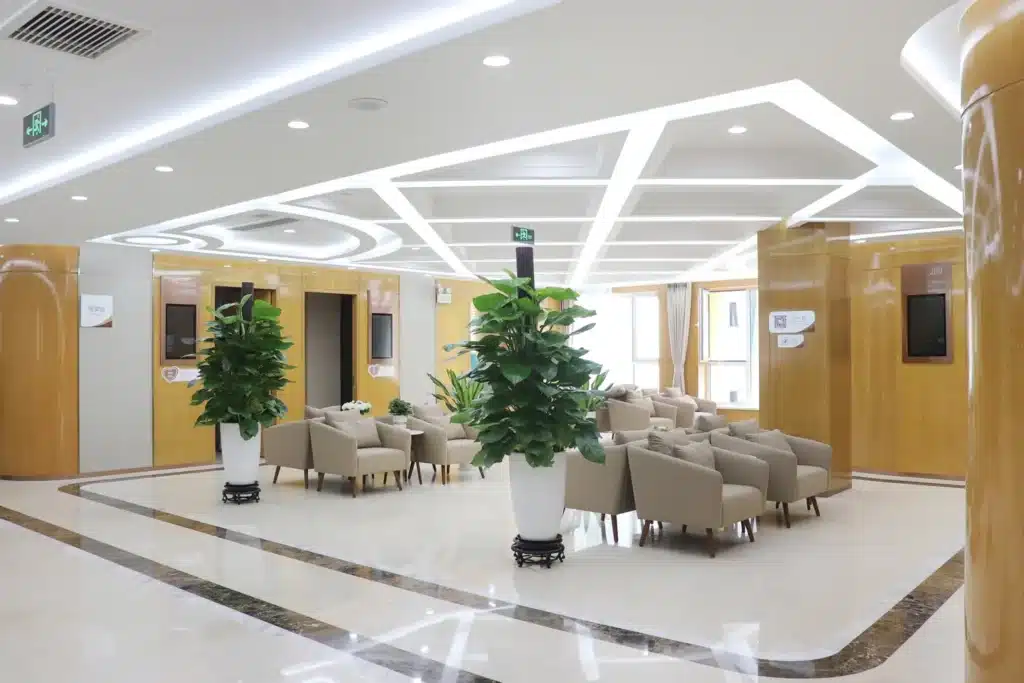
- Beijing, Shanghai, Guangzhou — the big-city standard, with Grade 3A hospitals (China’s top tier) and premium private centers like Meinian Onehealth, which runs 600+ centers across 200+ cities and screens roughly 30 million people a year (listed on the Shenzhen Stock Exchange, SZSE: 002044). The national screening hub covers these options.
What does the process look like?
A full-body screening is a single-morning affair, typically:
- Book in advance (usually 2–5 days out) through a coordinator who can confirm English support and lock a slot.
- Arrive fasted — no breakfast, no coffee — around 7:30–8:00 a.m.
- Work through the station circuit: blood draw, ECG, ultrasound, chest imaging, physical exam, physician consultation. Most people finish in 3–4 hours.
- Get results digitally, usually within 3–7 working days, as an English PDF you can share with your home doctor.
What does it cost?
It varies by center, city, and how deep you want to go — that’s the honest answer. Indicative 2026 numbers:
| Tier | Typical range | What it covers |
|---|---|---|
| Entry-level full-body | $399–499 | Blood, ECG, ultrasound, chest imaging, physical exam |
| Comprehensive | $599–899 | + cardiac/vascular imaging, tumor markers |
| Premium executive | $1,000+ | + Brain MRI, extended panels, VIP suite (flagship centers) |
Across the board, the same breadth of screening typically costs 30–80% less than equivalent private care in Hong Kong, Singapore, the US, or the UK. Compare executive health screening options or confirm the exact package contents and price before you book — “full-body” means different things at different centers.
The fine print we need to say out loud
- We coordinate; we don’t treat. We help you find a licensed hospital, book the appointment, arrange English support, and get your results explained. All clinical care is delivered by the hospital’s own licensed physicians. We’re a referral and coordination service, not a healthcare provider.
- Screening is not diagnosis. A checkup looks for red flags; it doesn’t give you a clean bill of health, and it shouldn’t replace care you’re already receiving. If a result comes back abnormal, follow up with a qualified doctor.
- No one should promise you outcomes. Anyone claiming a screening or a TCM ritual “guarantees” something is selling you something. Treat both with appropriate skepticism.
One traveler’s version: a Hong Kong layover, a Shenzhen morning
Last spring, a 31-year-old product manager from Melbourne — let’s call her Priya — had a two-day gap between business meetings in Hong Kong and a flight home. She’d seen the chinamaxxing videos and was half-joking about the “hot water life,” but she had a nagging family-history question she’d been putting off for two years.
She crossed into Shenzhen on a Tuesday morning, fasted, did a comprehensive screen at a center in Futian, and was back across the border before lunch. The part that surprised her wasn’t the cost — it was the whole thing being done by 11 a.m., with a coordinator walking her through every step in English. Her results arrived as a PDF three days later; one marker was slightly off, and she followed up with a doctor at home who told her it was likely a benign blip and worth rechecking in a year. Nothing dramatic. But she says the trip was worth it for the peace of mind alone: “It was the one thing I’d been avoiding, and I did it between two meetings.”
That’s the realistic version of this story. Not a miracle. Just a useful checkup that cost less and took less time than she expected, slotted into a trip she was already taking.
Is chinamaxxing worth the trip?
Let’s land the plane. Chinamaxxing is, at heart, a very Gen Z idea: that the good life is something you can systematically optimize, and that some of the best ingredients for that optimization happen to be cheap, ancient, and Chinese. Hot water, congee, qigong, early nights — these aren’t magic. They’re habits. And habits are free to start anywhere, which is why the trend spread so fast.
But there’s a difference between recreating the vibe in your kitchen and experiencing it where it actually lives. If the trend has you curious, the trip is worth it — not because it will “fix” anything, but because context matters. Doing Baduanjin with a group of retirees in a Beijing park at sunrise is a different thing than following a filtered tutorial in your bedroom. That’s the real upgrade.
And if you’re going to invest in your wellness anyway — which, let’s be honest, is half the point of this whole trend — then a health checkup while you’re in China is the most direct way to act on that intention. One fasted morning, English support, a report you can actually use.
Planning a chinamaxxing trip and thinking about adding a checkup? That’s exactly what we help with. We’re a coordination service for international visitors in China — we connect you with licensed hospitals and English-speaking coordinators, handle the booking, arrange translated reports, and make sure the paperwork (including visa questions) is sorted. No medical advice, no markup on your package, no pressure: just a fixed coordination fee and someone who’s done this dozens of times.
Start with the 240-hour visa-free checkup walkthrough, see which cities and centers make sense for your route, or message us directly and we’ll help you figure out the rest.
The hot water can wait until you’re on the plane. The planning shouldn’t.
Sources: National Immigration Administration (H1 2026 statistics, July 2026); CCTV Finance & Sina News (chinamaxxing / China Travel view counts, August 2026); Zhejiang News profile of Sherry Zhu (March 2026); New York Post, “TikTokkers are ‘Chinamaxxing’ their health” (March 2026); The Conversation (2026); Hainan Provincial Government & Shanghai Municipal Government policy pages for the 240-hour visa-free transit policy; SinoCareLink and China Care Health Tours pricing guides (2026).