
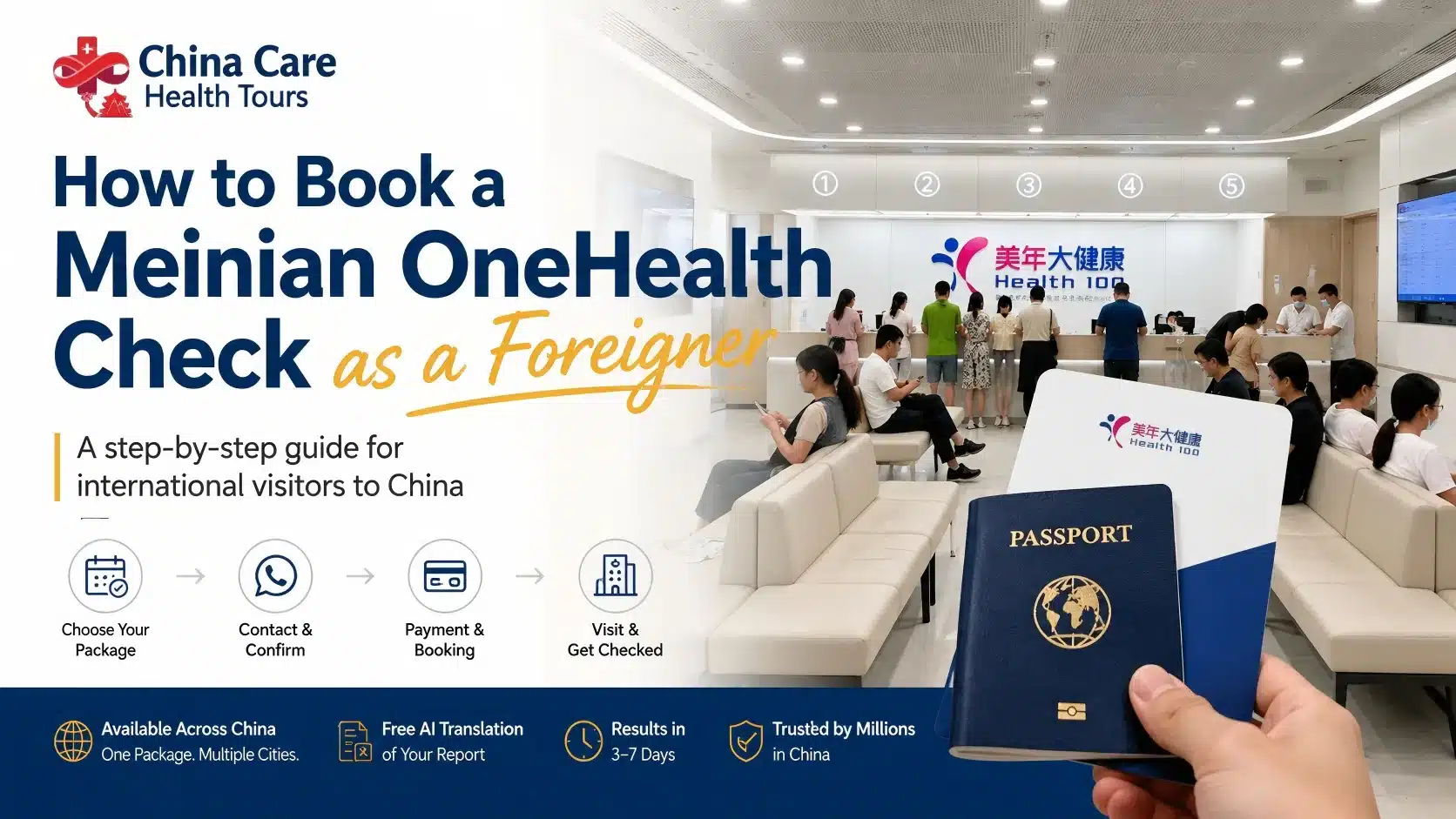
Meinian Onehealth is China’s largest private health screening network — 500+ locations across 200+ cities — but its booking system, staff communication, and reports are almost entirely in Chinese. This guide covers whether foreigners can actually use Meinian, what English support looks like in practice, current pricing, report translation, and how to book without a Chinese mobile number or Alipay/WeChat Pay.
Key Facts
- Meinian Onehealth operates 500+ locations across 200+ cities in China, making it the country’s largest private health screening network.
- Beijing centres publish fixed entry-tier pricing from ¥499 (approx. USD 70); other cities, including Shanghai, Guangzhou, and Shenzhen, run different product lines and require direct enquiry for current pricing.
- Digital screening results with AI-assisted English translation are typically delivered within 3–7 working days.
- Meinian’s appointment system normally requires a Chinese mainland mobile number for SMS booking confirmation — a common obstacle for first-time foreign visitors.
Table of Contents
Can Foreigners Use Meinian Health?
Yes. Meinian Onehealth accepts international patients using a passport as their primary identification document — you do not need a Chinese ID card to register for an appointment. This is the first question most people ask, and the honest answer is that the access is not the hard part. The process is.
Meinian was built for the domestic Chinese market: over 500 locations serving primarily Chinese nationals who book, pay, and communicate through Chinese-language apps and a Chinese mobile number. Nothing in the system is designed around a foreign passport holder walking in without WeChat, Alipay, or a +86 phone number. That doesn’t mean it’s closed to you — it means the friction is real, and knowing where it appears in advance saves you a wasted trip.
The three points where foreign patients most often get stuck are:
- Registration — the online and in-app booking flow is entirely in Chinese and expects a Chinese mobile number for SMS verification.
- Communication on the day — English-speaking staff availability varies significantly by branch and city.
- The report — results are issued in Chinese by default, with no automatic English translation.
None of these are dealbreakers. They’re exactly the gaps that China Care exists to close for international visitors who want to use Meinian without navigating all three in Chinese, alone, on their first visit to the country.
 Featured
 Heart & Vascular Screening
Heart & Vascular Screening at Meinian Onehealth Screening Centre, 1,499 RMB. Nationwide package, coordinated in English by China Care.
- Pay in full to reserve
- Flexible scheduling
If you’re weighing Meinian against China’s other major screening networks, our comparison of executive health screening vs. a regular health check is a useful starting point for understanding what tier of programme actually matches your risk profile before you commit to a specific centre.
Meinian Onehealth Locations
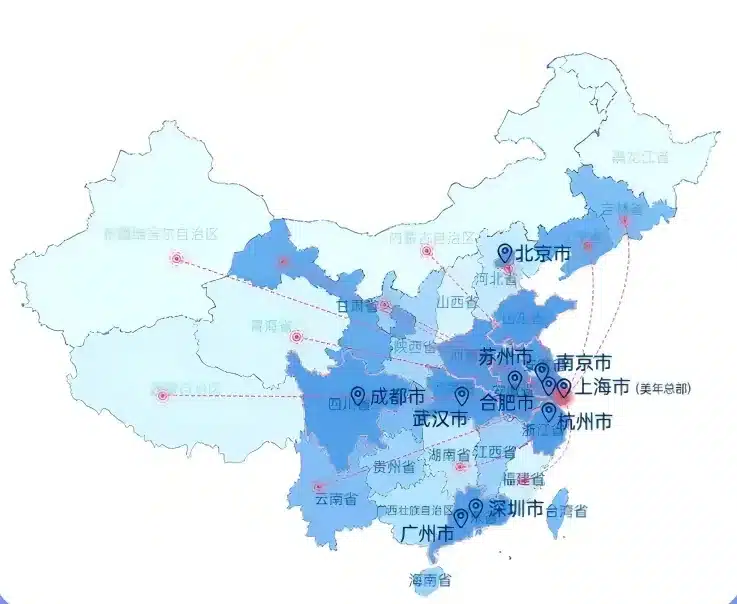
Meinian Onehealth’s defining advantage is scale. With 500+ centres across more than 200 cities, it is by a wide margin the largest private health screening operator in China — larger than either JD Health or Ruici Health by location count, though both of those networks run more concentrated, flagship-style operations in major cities.
For international visitors, this scale matters in a specific way: if your itinerary touches more than one Chinese city, Meinian is the only network of the three where you can realistically book the same programme in, say, Beijing and then Shanghai on a later trip, under a consistent product structure.
Where Meinian has flagship, international-patient-facing branches:
- Beijing — multiple centres with published entry-level pricing tiers; see our health screening in Beijing guide for the branch details most relevant to foreign visitors.
- Shanghai — several central-district locations; product lines and pricing differ from Beijing. Our health screening in Shanghai guide covers the centres most set up for English-speaking patients.
- Guangzhou — centres concentrated in the central business districts; see health screening in Guangzhou.
- Shenzhen — an important exception. Shenzhen branches do not sell the nationally advertised entry-level tiers. Instead, Shenzhen’s product line runs exclusively through private platinum examination-room packages, starting substantially higher than Beijing’s entry pricing. See health screening in Shenzhen for specifics.
- Wuhan and 190+ other cities — Meinian’s national footprint extends well beyond the four cities above, though English-language support and international-patient familiarity are strongest at flagship branches in first-tier cities.
The practical takeaway: don’t assume the package or price you see for one city applies to another. Meinian’s pricing and product structure are set city-by-city, sometimes branch-by-branch, and this is one of the more common sources of confusion for first-time foreign patients who research online before arriving.
How to Book a Meinian OneHealth Check as a Foreigner
Here is the process, step by step, for booking a Meinian screening as an international visitor.
Step 1: Decide your city and travel dates.
Because pricing and packages vary by city, confirm where you’ll actually be during your trip before comparing programmes. If your dates are flexible, Beijing currently offers the most transparent published pricing of Meinian’s major branches.
Step 2: Get a package recommendation.
Rather than trying to interpret a Chinese-language menu of dozens of add-on tests, tell China Care your age, health concerns, family history, and budget. You’ll be matched to the Meinian tier that actually fits your risk profile — not oversold on tests you don’t need, and not underscreened on the ones that matter.

Advanced CT Screening
Advanced CT Screening at Meinian Onehealth Screening Centre, 1,399 RMB. Nationwide package, coordinated in English by China Care.
- Pay in full to reserve
- Flexible scheduling
Step 3: Submit your passport details in advance.
Meinian’s registration requires ID at check-in. For foreign patients, this means passport details need to be submitted ahead of the appointment so the booking is correctly registered under your name — this step alone resolves most of the friction that causes same-day booking failures for first-time foreign visitors.
Step 4: Confirm your appointment without a Chinese mobile number.
This is the step most guides skip. Meinian’s appointment system normally uses a Chinese mainland mobile number for booking confirmation via SMS. If you don’t have one, China Care can assist with the booking process and ensure your appointment is successfully confirmed — you don’t need to acquire a local SIM card just to book a health screening.
Step 5: Fast for at least 8 hours before your appointment.
No food or water. Blood tests and abdominal ultrasound both require an empty stomach — a standard fasting protocol consistent with guidance from the National Institutes of Health on pre-test preparation — and this is non-negotiable regardless of which tier you book.
Step 6: Attend your appointment.
Most programmes run 3–5 hours, with all tests completed in the same building on the same visit. Morning slots move faster and are recommended if you have a tight schedule — and morning slots at popular branches fill quickly, so book 3–5 days ahead where possible.
Step 7: Receive your translated report.
Digital results, with AI English translation included as part of the coordinated booking service, typically arrive within 3–7 working days.
If you’re still finalising your China itinerary and need to sort out visa logistics alongside your screening appointment, our medical visa guide for China covers the current entry requirements for 2026.
Meinian Health English Service
This is where expectations and reality diverge most for first-time foreign patients. Meinian is a domestic Chinese health screening operator first, and English-language service is not uniformly built into every branch the way it would be at a boutique international clinic.
What varies by branch:
- English-speaking front-desk staff — more likely at flagship centres in Beijing and Shanghai, less consistent elsewhere
- English signage and self-service kiosks — inconsistent even within the same city
- English-language consultation with the screening physician — not standard; most physician interactions happen in Mandarin
What China Care adds on top of Meinian’s own service:
- A bilingual check-in note prepared in advance with your appointment details, to present at arrival
- English communication support throughout the booking and pre-visit process
- A bilingual coordinator to accompany you on the day, available as a paid add-on for patients who want a translator present at every station rather than relying on the check-in note alone
- Ongoing WhatsApp support if you have questions before, during, or after your visit
The honest framing here matters: English service at Meinian is not something you can assume will be there by default, particularly outside the four largest cities. If English communication throughout the day is a hard requirement for you rather than a nice-to-have, confirm the specific branch’s language support before you book — and mention that requirement when you enquire, since it may affect which branch is recommended.
Meinian Health Price
Meinian’s pricing is not a single national price list — it is set city by city, and in some cities, branch by branch. This is the single biggest source of confusion in online research about Meinian pricing, because a price quoted for one city is frequently assumed to apply everywhere.
Beijing — published fixed-price tiers (exclusive to Beijing locations):
| Package | Scope | Price | Approx. USD |
|---|---|---|---|
| Health Basic | Physical exam, full blood count, liver/kidney/glucose, lipid panel, chest X-ray, abdominal ultrasound, urine analysis | ¥499 | ~$70 |
| Health Essentials | Everything in Health Basic, plus 12-lead ECG, thyroid ultrasound, tumour markers (basic panel), Hepatitis B surface antigen, thyroid function | ¥999 | ~$138 |
| Health Guard | Everything in Health Essentials, plus low-dose chest CT, expanded tumour markers (6-panel), carotid artery Doppler, cervical smear/PSA, bone density (DXA) | ¥1,999 | ~$275 |
Other cities: Shanghai, Guangzhou, and Wuhan operate different product lines from Beijing, at different price points. Shenzhen is the clearest exception — branches there do not sell the entry-level tiers shown above at all; Shenzhen’s product line is exclusively platinum private examination-room programmes, priced meaningfully higher. For confirmed current pricing outside Beijing, enquire directly — you pay the published package rate, with no extra fees added on top of what Meinian itself charges.
How Meinian pricing compares internationally:
| Programme tier | Hong Kong | United Kingdom | United States | Singapore | China (via Meinian) |
|---|---|---|---|---|---|
| Entry-level check | HKD 8,000–12,000 | GBP 1,200–2,000 | USD 2,000–3,500 | SGD 2,500–4,000 | ~USD 70 (Beijing) |
| Mid-tier with cancer markers | HKD 15,000–22,000 | GBP 2,500–4,000 | USD 4,000–6,000 | SGD 5,000–7,500 | ~USD 275 (Beijing) |
| Premium / platinum | HKD 30,000–50,000 | GBP 5,000–9,000 | USD 8,000–15,000 | SGD 10,000–18,000 | Enquire |
Even accounting for the narrower scope of Beijing’s entry tiers relative to a full executive physical elsewhere, the price gap is substantial. This is the core of Meinian’s value proposition — not that it’s the cheapest option available anywhere in the world at any tier, but that comparable diagnostic depth in China costs a fraction of the equivalent programme in Hong Kong, the UK, the US, or Singapore.
Meinian Health Report in English
Meinian issues its screening reports in Chinese by default. This is true across virtually every branch, regardless of city or tier. If you book directly with no translation arrangement, you will receive a Chinese-language PDF or app-based report at the end of your visit — readable by a Chinese-speaking companion, but not directly usable by a GP or specialist back home.
What’s included when you book through China Care:
AI-assisted English translation of your report is included as part of the coordinated booking service. This covers the standard structure of a screening report — test results, reference ranges, and the physician’s summary notes — translated into English and typically delivered within 3–7 working days of your appointment.
What requires an additional step:
If you need a certified or professional medical translation — for example, for an insurance claim, a formal referral, or a specialist who requires notarised documentation — this is a separate service from the standard AI-assisted translation and can be arranged at an additional cost. AI translation is well-suited to helping you and your home doctor understand the findings; it is not a substitute for certified medical translation where that is formally required.
According to the World Health Organization’s guidance on health screening, the clinical value of any screening programme depends on the results actually being interpreted and acted upon — a report you cannot read is a report you cannot act on. This is the single most practical reason foreign patients arrange translation support before their appointment rather than after.
How Payment Works Through China Care
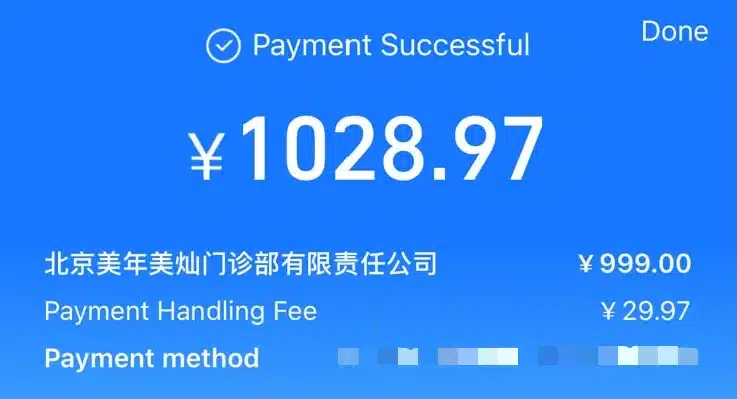
Before payment, China Care confirms the selected centre, package/version, preferred date, availability, published package rate, and booking requirements.
Once confirmed, an advance payment of the published package rate is required to secure the booking. You pay China Care directly when booking, and China Care settles the payment with the screening centre on your behalf — so you don’t need a Chinese bank card or cash on the day.
Flexible Payment Options
We’ll recommend the most convenient and secure payment method based on your situation.
- If you already use Alipay or WeChat Pay, we’ll guide you through the quickest payment option — paying China Care directly using their official payment QR code.
- If you don’t have access to Chinese payment methods, China Care also accepts international payment options for overseas visitors, including international credit or debit card, Wise, or bank transfer, so you can pay before you travel.
Is Meinian Health Worth It?
The honest answer depends on what you’re comparing it against, and what you actually need from a screening visit.
Where Meinian delivers clear value:
- Scale and accessibility. No other network in China matches 500+ locations across 200+ cities. If your travel plans are flexible or multi-city, this matters.
- Price relative to comparable programmes abroad. Beijing’s published entry tier at roughly USD 70 covers a panel that would cost several times that in Hong Kong, the UK, the US, or Singapore — see the comparison table in Section 5.
- Equipment and lab standards. Major Meinian branches use nationally regulated laboratory processes and mainstream imaging equipment (GE, Siemens-tier), not discount or unregulated providers.
- Speed. Most appointments complete in 3–5 hours in a single visit, with digital results in 3–7 working days.
Where the honest caveats sit:
- English service is inconsistent outside flagship branches. If a fully English-speaking experience without any coordination support is your baseline expectation, several Meinian branches will fall short of that.
- Reports are issued in Chinese by default. Translation is not automatic unless arranged.
- Booking logistics assume a Chinese mobile number and Chinese payment apps. Without support, this is a genuine barrier, not a minor inconvenience.
- Pricing and product depth vary meaningfully by city. The Beijing tiers above do not describe what you’ll find in Shanghai, Guangzhou, or especially Shenzhen, where the entry-level product doesn’t exist at all.
- It is not a diagnostic replacement for symptomatic care. Health screening, including at Meinian, is designed for asymptomatic preventive check-ups — not for investigating an existing symptom, which warrants a direct specialist consultation instead.
A 2022 Lancet study on cancer screening intervals found that early-stage diagnoses in screened populations produce survival outcomes two to three times better than late-stage diagnoses — the clinical case for regular screening, independent of provider, is well established. Whether Meinian specifically is worth it for you comes down to whether the practical gaps above are things you can navigate alone, or things you’d rather have coordinated on your behalf.
For most first-time foreign visitors, the answer is that Meinian’s underlying screening product is genuinely strong value — the friction is almost entirely in the booking, language, and payment layer around it, not in the clinical quality of the check-up itself.
FAQs
Can foreigners use Meinian Health?
Yes. International patients can book at Meinian centres using a passport as their primary ID — no Chinese ID card is required. The practical challenges are the Chinese-only booking system, variable English support, and Chinese-language reports, not eligibility.
Does Meinian Health offer English service?
Partially, and inconsistently by branch. Flagship centres in Beijing and Shanghai are more likely to have English-speaking staff at reception. Physician consultations are typically conducted in Mandarin. China Care provides English communication support throughout the booking process, with an on-site bilingual coordinator available as a paid add-on.
Will my Meinian Health report be in English?
Not by default — Meinian issues reports in Chinese. When you book through China Care, AI-assisted English translation is included as part of the service, typically delivered within 3–7 working days. Certified professional translation for formal use (insurance, referrals) can be arranged separately at an additional cost.
How much does Meinian Health cost?
It depends entirely on the city. Beijing has published fixed tiers from ¥499 (approx. USD 70) up to ¥1,999 (approx. USD 275). Shanghai, Guangzhou, and Wuhan run different product lines at different prices. Shenzhen does not offer the entry-level tiers at all — its product line is exclusively platinum private-room packages, priced higher.
Is Meinian Health worth it for foreigners?
For the underlying screening product, generally yes — the diagnostic scope and lab standards are strong relative to price, especially compared to equivalent programmes abroad. The caveats are almost entirely logistical: booking without a Chinese mobile number, arranging report translation, and confirming English support at your specific branch in advance.
Where are Meinian Onehealth locations?
Meinian operates 700+ locations across 200+ cities in China, making it the country’s largest private health screening network. Flagship branches with the strongest international-patient support are in Beijing, Shanghai, Guangzhou, and Shenzhen — though Shenzhen’s product line differs significantly from the other three.
Do I need a Chinese mobile number to book Meinian?
Not if you book through China Care. Meinian’s own appointment system normally requires a Chinese mainland mobile number for SMS confirmation. China Care handles the booking on your behalf and confirms your appointment directly with you over WhatsApp instead.
How is payment arranged for a Meinian partner package?
China Care first confirms the current centre, package, preferred date, availability, published rate and booking details. Booking note. Advance payment is required to secure this partner package. Availability is confirmed before payment, and China Care collects the payment directly.
Book Your Screening
Meinian Onehealth offers genuinely strong screening value at scale — the gap between “available to foreigners” and “easy for foreigners to book” is what China Care exists to close. Tell us your city, your health priorities, and your travel dates, and we’ll confirm the right package, handle the booking without a Chinese mobile number, arrange payment in whichever method suits you, and make sure your report comes back in English.
China Care confirms the centre, package, date, availability, and rate before payment. An advance payment is required to secure your booking. You pay China Care directly, and we handle payment with the screening centre on your behalf — no Chinese bank card or cash needed on the day.
Get a Free Package Recommendation →
Tell us your age, health concerns, and travel dates — we’ll match you to the right Meinian programme, free of charge.
View the Meinian Onehealth Screening Centre →
See current programmes, Beijing pricing, and how China Care coordinates your booking.
Read the Full Guide to Health Screening in China →
Everything you need to know before your appointment: logistics, language support, and what to expect on the day.