
Medical treatment in China can mean very different things: help with a serious diagnosis, a plan for a chronic condition, a preventive health check, a wellness visit, or care needed while travelling. The right next step depends on why you are coming, what records you have, and which hospital can realistically help.
A few things worth knowing first
- Foreigners can receive medical treatment in China, but not every hospital, department, insurer, or travel route will fit every case.
- If you have a serious diagnosis, the hospital needs real records — not just a short description — before it can say whether an appointment or treatment pathway makes sense.
- China does not have one universal “medical visa” for every patient. Check the current requirements with the Chinese embassy, consulate, or visa application centre responsible for where you live.
- You normally pay the hospital directly. Direct billing, deposits, accepted cards, and insurance reimbursement all need to be checked for the specific hospital and appointment.
- China Care helps foreign patients navigate the process. We do not diagnose, promise treatment, guarantee a visa or insurance approval, or replace the treating doctor.
Table of Contents
What Brings You to China for Healthcare?
People use the phrase “medical treatment in China” to mean very different things. One person may be looking for another opinion after a difficult cancer diagnosis. Another may be managing diabetes or trying to understand persistent fatigue. Someone else may be in China for a holiday and want a health check, acupuncture, or help with a non-urgent illness.
Those are not the same journey, and they should not start in the same place.
I have a serious or complex diagnosis
If you have cancer, a blood disorder, a rare disease, a complex surgical question, or another serious diagnosis, start with your medical records. A hospital needs to understand the diagnosis, tests, treatment history, and current condition before it can tell you whether it can assess the case. Do not book travel around a treatment promise that has not come from the treating hospital.
Discuss a serious or complex case with China Care | Explore cancer treatment in China | Read about CAR-T cell therapy in China
I want help with a chronic health concern
If you are managing diabetes, blood pressure, weight, metabolic risk, fatigue, sleep problems, or another long-term concern, the sensible starting point is an assessment, not a claim that anyone can “fix” the condition during one trip. A visit may involve a specialist consultation, relevant tests, a medication review, and practical support for nutrition, activity, sleep, or rehabilitation. It should still fit alongside care from your regular clinician at home.
Ask about chronic-condition and health-management support | Learn about stem cell therapy in China
I am planning a health, wellness, or preventive-care visit
You may simply want a structured health check, a TCM consultation, help with recovery and mobility, or time to focus on sleep, stress, and healthy routines. That can be useful, but it should be described honestly. A wellness visit is not a substitute for diagnosing a serious symptom, and it is not a cure for a chronic disease.
Explore executive health screening in China | See what health screening costs in China
I am already travelling in China and need care
If you need non-emergency care while visiting China, you may need a clinic or hospital that can handle your language needs, payment method, and medical records. The best option depends on your city and symptoms. If the problem is severe or life-threatening, go to the nearest emergency department or contact local emergency services straight away.
Browse hospitals in China for international patients | Read: Are Chinese hospitals safe for foreign patients?
Medical treatment in China is not one product. The right route for an international patient depends on the clinical question first, then on the hospital, city, language support, payment plan, and follow-up arrangements.
If You Have a Serious or Complex Diagnosis
When someone has just received a difficult diagnosis, it is natural to search for the best hospital, the quickest treatment, or the lowest price. But for serious care, the first question is simpler: can the right department review the case properly?
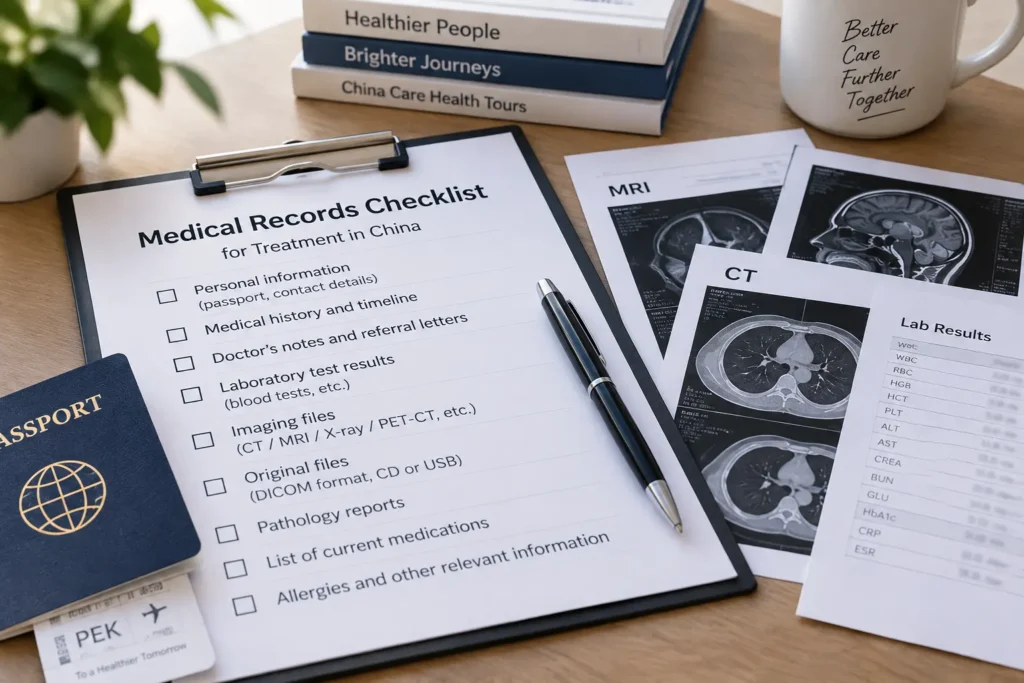
Start by gathering the documents a specialist is likely to need:
- a concise diagnosis summary;
- recent specialist letters;
- pathology and biopsy reports where relevant;
- imaging reports and original DICOM files if you have them;
- recent blood tests and other key laboratory results;
- a treatment timeline, including treatments that did not work; and
- a current medication list, allergies, and the question you want answered.
The hospital may ask for further documents, a pathology re-review, repeat tests, or an in-person assessment. That can feel slow when you are anxious, but it is better than travelling with an assumed treatment plan that later turns out not to fit.
For patients considering CAR-T therapy, a trial listing is not the same as a place on a trial. Each study has its own diagnosis, previous-treatment, timing, organ-function, and enrolment requirements. For some patients, a commercially available, NMPA-approved CAR-T product may be a more realistic route than a trial, but only the treating centre can make that judgement after reviewing the case. Standard commercial CAR-T manufacturing is commonly described as taking 7–21 days, while the wider hospital stay and recovery plan may take longer.
For cancer, complex surgery, or a blood disorder, the practical first step is a records-based enquiry. China Care can help organise those records and coordinate with an appropriate hospital pathway. The hospital, not China Care, decides whether it can accept the case and what it needs next.
Chronic Conditions and Long-Term Health Management
Chronic health concerns need a different kind of conversation. You may be living with diabetes, high blood pressure, weight-related health issues, cardiovascular risk, chronic pain, reduced mobility, poor sleep, or persistent fatigue. A short trip can be useful for getting a clearer assessment or starting a structured programme, but it does not replace long-term medical follow-up at home.
For diabetes and other metabolic conditions, a hospital may look at your current medications, HbA1c and other lab results, blood pressure, weight, kidney function, cardiovascular risk, diet, activity, and any complications. The goal should be a practical, clinician-led plan — not a promise to reverse or cure diabetes. If you already have a treating doctor at home, that doctor should remain part of the picture.
For weight management, look for a medical assessment rather than a cosmetic promise. The most useful questions are usually about metabolic health, nutrition, sleep, activity, medications, and what is sustainable after you leave China. Be cautious around any programme that promises effortless weight loss, “detox,” or permanent results without a clinical assessment.
For fatigue, stress, poor sleep, or what some people call “sub-health,” it is worth being specific about the symptoms and how long they have been present. These are not formal diagnoses on their own. They can have many causes, and a health check may be appropriate, but serious or worsening symptoms need clinician-led investigation rather than a wellness-only answer.
A private hospital can be a practical place to start when you want a coordinated consultation, testing, and recovery-oriented support. Foshan Chancheng Hospital lists cardiovascular medicine, rehabilitation, and health screening among its strengths, with international-patient coordination. Confirm the right department and the service scope before arranging travel.
For chronic conditions, the useful question is not “Can China cure this?” It is “Can this hospital help me understand and manage this safely, alongside my ongoing care at home?”
Health Screening, TCM, and Wellness Visits
Not every healthcare visit begins with an illness. Some visitors come to China for a focused annual health check, a second look at health risks, a TCM consultation, rehabilitation, or simply a more deliberate approach to sleep, stress, mobility, and prevention.
Executive screening can be a practical choice when you have no urgent symptoms and want several tests arranged in a structured visit. Packages vary widely. Before booking, check what is included, how much preparation is required, which tests need a clinician’s referral, and when results will be available. Digital results are commonly delivered within 3–7 working days, depending on the package and the tests included.
A health-screening programme is not the right place to investigate a serious symptom that has not been diagnosed. If you have unexplained weight loss, persistent chest pain, new neurological symptoms, heavy bleeding, severe shortness of breath, or a concerning scan result, seek proper medical assessment instead of trying to fit the issue into a routine wellness package.
Traditional Chinese Medicine can include acupuncture, herbal medicine, tuina, and other approaches. Some people use these alongside conventional care for comfort, rehabilitation, sleep, or wellbeing. They should not replace evidence-based treatment for a serious illness. Tell the clinician responsible for your care about every herb, supplement, or complementary therapy you take, because interactions can matter.
For a screening or rehabilitation-focused private-hospital pathway, see Foshan Chancheng Hospital. For published screening packages, see Executive Health Screening and Health Screening in China for Foreigners.
Medical Care While You Are Travelling in China
If you are already in China, you do not need to turn every health concern into a medical-tourism project. You may simply need a clinician for a minor illness, a prescription question, an injury, a routine check, or an outpatient test.
For a non-urgent problem, confirm three things before you go: whether the hospital can see you in the relevant department, whether language support is available for that appointment, and how payment works. Bring your passport, insurance details if you have them, a list of medications, and any useful reports from home. Ask how you will receive a visit summary, test result, prescription, or imaging report before you leave.
For visitors arriving through Hong Kong or staying in Shenzhen, CM Lippo Prince Bay Hospital offers a private international-medical-centre pathway. Its public hospital information lists multilingual support and cross-border insurance settlement. These services still need to be confirmed for your exact appointment, clinician, insurance policy, and payment method.
For a more planned outpatient or inpatient pathway in Guangzhou, Guangzhou Fosun Fuxing Chancheng Hospital can review a structured enquiry through its international team before you travel. A review is not a treatment guarantee; it is a way to understand whether the hospital can offer a realistic next step.
If you have a life-threatening emergency or feel seriously unwell, do not wait for an online enquiry or an interpreter arrangement. Go to the nearest emergency department or contact local emergency services.
Where Treatment Happens: Shenzhen, Guangzhou and Foshan
China Care’s current hospital coordination work is concentrated in the Greater Bay Area. Shenzhen is directly north of Hong Kong. Guangzhou and Foshan are also part of the region, but they need their own travel and onward-transport planning. Hong Kong can make arrival easier for some people, but it should not be the reason you choose a hospital.
Shenzhen — If you are coming from Hong Kong or are already in Shenzhen, CM Lippo Prince Bay Hospital may be a practical private option to explore. It is in Shekou and has an international medical centre. Confirm the department, clinician, language support, insurance settlement, and payment arrangements before you go. You can also browse the Shenzhen Hospital Directory.
Guangzhou — Guangzhou is a large medical city with rail and road connections to Hong Kong. Guangzhou Fosun Fuxing Chancheng Hospital is a private tertiary general hospital with outpatient and inpatient care. China Care can coordinate a records-based Hospital Access enquiry with the hospital’s international team before travel. The hospital still needs to assess the individual case before confirming whether it can help. Browse the Guangzhou Hospital Directory for wider context.
Foshan — Foshan is west of Guangzhou and may make sense where a hospital’s confirmed service is the right clinical and practical fit. Foshan Chancheng Hospital is a private Grade 3A hospital that lists international-patient coordination, cardiovascular medicine, rehabilitation, and health screening among its services. Confirm language support, direct-billing eligibility, appointments, and onward travel before committing to a plan. Browse the Foshan Hospital Directory.
The best hospital is not necessarily the closest one. It is the hospital with the relevant department, a workable patient pathway, and a realistic plan for what happens after the appointment.
Records, Language Support, and Hospital Access
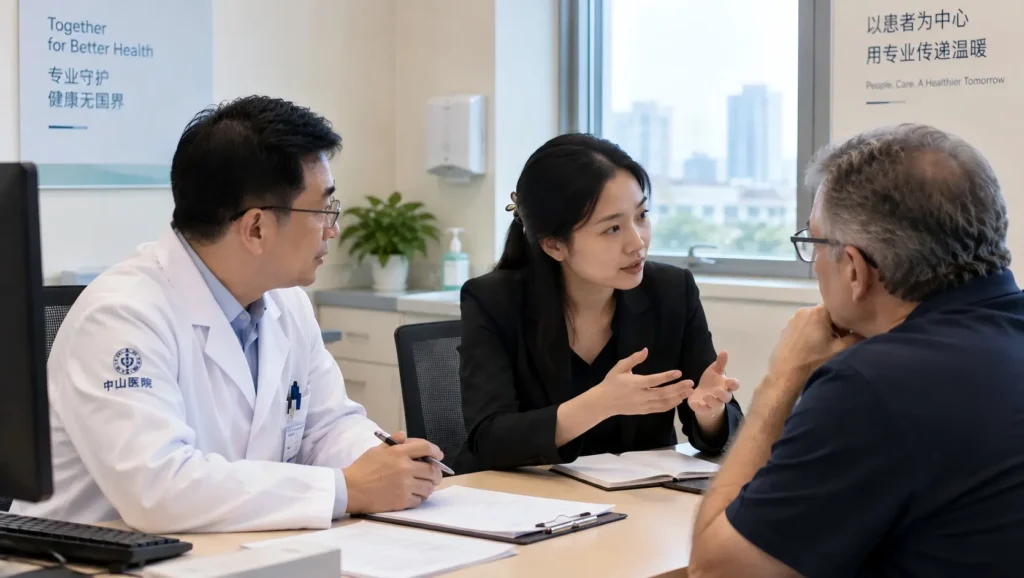
Good medical care depends on clear information. If you are travelling for treatment, do not assume an English-speaking website means every clinical conversation, consent form, report, or ward round will happen in English.
Before an appointment, ask:
- Will the treating clinician consult in English, or is an interpreter needed?
- Can an interpreter be present for the consultation, consent discussion, tests, and inpatient rounds if needed?
- Which records need translation before the appointment?
- Will the hospital give you a discharge summary, imaging report, pathology result, and medication list you can use at home?
- Who will explain any follow-up instructions before you leave China?
A translation app is fine for taxis, menus, and basic logistics. It is not a good substitute for medical interpretation during a surgical consent discussion, medication change, oncology consultation, or discharge conversation. If an interpreter is involved, ask for drug names, doses, dates, and decisions to be written down clearly.
China Care can help organise records, coordinate hospital communication, and arrange support where available. We cannot interpret a scan, tell you which treatment you need, or make a clinical decision for the hospital.
For practical planning, see How to Hire a Medical Translator in China and the China Care Hospital Directory.
Visa, Payment, and Insurance
These are the parts people often leave until late in the process. It is better to sort them out before you buy flights.
Visa and entry planning
China does not have one universal medical-visa category for all foreign patients. Your correct entry documents depend on nationality, place of residence, trip purpose, expected length of stay, and current immigration requirements. Some travellers may qualify for visa-free or transit arrangements, but those rules have conditions and can change.
For planned treatment, check with the Chinese embassy, consulate, or visa application centre responsible for your place of residence. A hospital may provide appointment or admission documents where appropriate, but it does not decide visa eligibility. China Care cannot issue visa invitation letters or make visa decisions.
Read the China medical-visa planning guide and the separate guide to medical treatment in China during visa-free travel. Then verify the current requirements with the relevant official authority before booking.
Payment and insurance
Foreign patients normally pay the hospital directly unless their insurer has confirmed direct billing for the specific hospital, department, service, and policy. Even at a hospital that works with an insurer, a particular treatment may need pre-authorisation or may not be covered.
Before travel, ask your insurer:
- Is this exact hospital and department in my direct-billing network?
- Is the consultation, test, procedure, or admission covered?
- Does the insurer need pre-authorisation, and who submits it?
- What deposit or co-payment might I need to pay myself?
- Which reports, receipts, and translations will be needed for a claim?
- What happens if I need to stay longer or change hospitals?
Also confirm payment methods with the hospital. Card acceptance, cash, transfers, Alipay, WeChat Pay, deposits, and billing procedures can differ between hospitals and between outpatient and inpatient care.
China Care’s coordination fee, when one applies, is separate from the hospital’s treatment cost. We never add to, inflate, or mark up the hospital’s quoted treatment cost.
Before You Travel: When You Need Clinical Clearance First
Do not arrange international travel solely because a website or coordinator has suggested that a hospital might be suitable. Speak with your current treating team and the receiving hospital first if you:
- are medically unstable or have new, worsening, or severe symptoms;
- have recently had major surgery, intensive chemotherapy, or a treatment that could make a long flight unsafe;
- need oxygen, dialysis, blood products, complex wound care, or close monitoring;
- have a serious infection or are at high risk of one; or
- do not have a realistic plan for follow-up once you return home.
This is not about making travel harder. It is about avoiding a situation where the journey itself creates a problem. A sensible medical-travel plan leaves room for changed appointment dates, unexpected tests, a longer stay, and a patient who may not be fit to fly home on the original date.
Costs: What Can Be Confirmed in Advance?
The cost of medical treatment in China depends on the hospital, city, diagnosis, department, tests, treatment plan, length of stay, complications, and follow-up needs. Anyone offering one all-purpose price for “treatment in China” is leaving out important details.
| Cost category | Usually possible to confirm before travel | Often only clear after clinical review |
|---|---|---|
| Consultation or health screening | Published package rate or appointment fee, where available | Extra tests recommended after the visit |
| Hospital deposit | Deposit policy and accepted payment methods | Final inpatient balance |
| Surgery, cancer care, or other complex treatment | A preliminary estimate after records review | Final plan, consumables, complications, length of stay, and further treatment |
| Interpretation and logistics | Agreed scope and coordination fee | Extra visits, hours, or changed plans |
| Insurance reimbursement | Policy terms and pre-authorisation requirements | Final insurer decision on the claim |
For executive screening, China Care works with published package rates: you pay the published package rate — no extra fees added on top. For complex care, treatment costs are quoted by the hospital and paid directly to the hospital. Ask for a written estimate before you make a non-refundable travel commitment, and ask what is included, excluded, or likely to change.
Frequently Asked Questions
Can foreigners receive medical treatment in China?
Yes. Foreigners can receive care in China, including treatment for a serious diagnosis, chronic-condition management, preventive screening, and outpatient care during a visit. The right route depends on the condition, the hospital department, language support, payment arrangements, travel documentation, and whether it is safe for the patient to travel.
Do I need a medical visa for China?
There is no single answer for every patient. Requirements depend on nationality, residence, travel purpose, length of stay, and current immigration policy. For planned treatment, check with the Chinese embassy, consulate, or visa application centre responsible for where you live before booking travel.
Are there English-speaking hospitals and doctors in China?
Some hospitals and departments offer English or multilingual support, especially through international patient services, but it varies. Confirm exactly who will support your consultation, tests, admission, and discharge. For important clinical decisions, use qualified medical interpretation rather than relying on an app.
Can I use international health insurance in China?
Possibly. Coverage depends on the policy, hospital, department, treatment, and pre-authorisation rules. Some private hospitals may offer direct billing for selected policies, while other appointments require direct payment and a later claim. Confirm the details with the insurer before travel.
How do foreign patients pay hospital bills in China?
Payment is usually made directly to the hospital. You may need to pay a deposit before non-emergency services. Confirm accepted payment methods and keep all medical reports and receipts for your insurer.
Can I come to China for diabetes or weight management?
A visit may be useful for an endocrinology or metabolic-health assessment, testing, medication review, nutrition support, rehabilitation, or a structured health-management plan. It should not be presented as a cure, and it should work alongside ongoing care from your clinician at home.
Can tourists get a health check or acupuncture in China?
Yes, many visitors book preventive screening or complementary-care services. Check the provider, package, preparation requirements, language support, payment method, and results-delivery process in advance. A health check or wellness visit is not a substitute for investigating a serious symptom.
Can international patients join a CAR-T clinical trial in China?
A clinical trial is not a default treatment route. The treating centre must assess diagnosis, previous treatment, current condition, organ function, timing, and the study’s enrolment criteria. Some patients may be better suited to a commercial CAR-T pathway, subject to hospital assessment.
What can China Care do for me?
China Care can help organise records, identify relevant private-hospital pathways, coordinate appointments and practical support, and explain the administrative process. We cannot diagnose, recommend a treatment, guarantee hospital acceptance, provide a visa decision, approve insurance, or replace your treating clinicians.
References and Further Reading
- China National Immigration Administration: English information portal
- ClinicalTrials.gov: CAR-T studies in China search
- China Care Health Tours: Hospital Directory
- China Care Health Tours: Cancer Treatment in China
- China Care Health Tours: CAR-T Cell Therapy in China
- China Care Health Tours: Executive Health Screening
- China Care Health Tours: Health Screening in China for Foreigners
- China Care Health Tours: How to Hire a Medical Translator in China
- China Care Health Tours: China Medical-Visa Planning Guide
- China Care Health Tours: CM Lippo Prince Bay Hospital, Shenzhen
- China Care Health Tours: Guangzhou Fosun Fuxing Chancheng Hospital
- China Care Health Tours: Foshan Chancheng Hospital