
China Care Health Tours outlines how international patients can use China’s 240-Hour Visa-Free Transit policy for medical tourism in 2026. Travelers from 55 eligible countries — including the US, UK, Canada, Australia, and most of the EU — can enter through any of 65 open ports across 24 provinces and stay up to 10 days for comprehensive health screenings, without obtaining a formal medical visa, provided they hold an onward ticket to a third country or region. Shenzhen, Guangzhou, and Beijing are the three most practical entry points for a screening-focused trip, each with its own dedicated international patient screening centres. This is separate from China’s 24-Hour Visa-Free Transit policy, which applies to all nationalities but confines travelers to the port’s limited transit area.
Key Facts
- The 240-Hour Visa-Free Transit policy covers citizens of 55 countries and allows entry through 65 open ports across 24 provinces, municipalities, and regions — including dedicated entry points at Beijing Capital, Beijing Daxing, Guangzhou Baiyun, and Shenzhen Bao’an airports.
- Guangdong Province is the only region where travelers may exit through any open port in the province and travel anywhere within it — making Guangzhou Baiyun and Shenzhen Bao’an practical entry points for a Guangdong-wide medical trip. Beijing’s activity area is limited to Beijing Municipality itself.
- Comprehensive executive health screenings in Shenzhen, Guangzhou, and Beijing cost $800–$1,600 compared to $3,500–$5,500+ in the United States.
- Wait times for health screenings are 1–3 days in China versus 2–4 weeks in the US.
- Medical appointments must be booked at least 7 days in advance of arrival.
Table of Contents
24-Hour Transit (Not Relevant for Medical Travel)
All of China’s open border ports offer a 24-Hour Visa-Free Transit policy to travelers of any nationality. Foreign nationals holding a valid international travel document and a confirmed connecting ticket on an international flight, ship, or train — travelling through China to a third country or region — may transit visa-free provided they stay no more than 24 hours and do not leave the port’s designated transit area. Travelers who need to leave that area must apply for a temporary entry permit from the port’s border inspection authority.
This policy is not practical for a health screening trip: 24 hours confined to an airport transit zone leaves no time to reach a hospital or screening centre. It is included here only to distinguish it clearly from the 240-Hour policy below, which is the relevant one for medical travelers.
240-Hour Visa-Free Transit (The Policy for Medical Travelers)
China currently grants a 240-Hour (10-day) Visa-Free Transit policy to citizens of 55 countries, including the United States, Russia, and the United Kingdom. Eligible travelers holding a valid international travel document and a dated, confirmed connecting itinerary to a third country or region may enter visa-free through any of 65 open ports across 24 provinces, municipalities, and autonomous regions, and stay in the designated activity area for up to 10 days. During this window, travelers may engage in tourism, business, visits, and family visits; activities requiring prior approval — work, study, journalism — still require a separate visa.
The 55 Eligible Countries
Europe (40): Austria, Belgium, Czechia, Denmark, Estonia, Finland, France, Germany, Greece, Hungary, Iceland, Italy, Latvia, Lithuania, Luxembourg, Malta, Netherlands, Poland, Portugal, Slovakia, Slovenia, Spain, Sweden, Switzerland, Monaco, Russia, United Kingdom, Ireland, Cyprus, Bulgaria, Romania, Ukraine, Serbia, Croatia, Bosnia and Herzegovina, Montenegro, North Macedonia, Albania, Belarus, Norway
Americas (6): United States, Canada, Brazil, Mexico, Argentina, Chile
Oceania (2): Australia, New Zealand
Asia (7): South Korea, Japan, Singapore, Brunei, United Arab Emirates, Qatar, Indonesia
Ports of Entry and Permitted Activity Areas
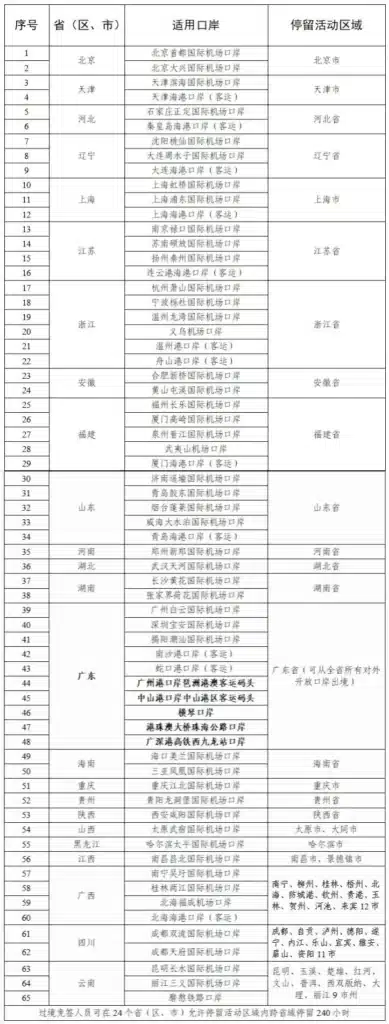
The table below highlights the entries most relevant to medical travelers; the image above shows the complete official list.
| Province / Region | Ports of Entry | Permitted Activity Area |
|---|---|---|
| Beijing | Beijing Capital Int’l Airport; Beijing Daxing Int’l Airport | Beijing Municipality |
| Shanghai | Shanghai Hongqiao Int’l Airport; Shanghai Pudong Int’l Airport; Shanghai Seaport (passenger) | Shanghai Municipality |
| Guangdong | Guangzhou Baiyun Int’l Airport; Shenzhen Bao’an Int’l Airport; Jieyang Chaoshan Int’l Airport; Nansha Port; Shekou Port; Hengqin Port; Hong Kong–Zhuhai–Macao Bridge (Zhuhai); Guangshen–HK High-Speed Rail West Kowloon Station | Guangdong Province — may exit through any open port in the province |
| Hainan | Haikou Meilan Int’l Airport; Sanya Phoenix Int’l Airport | Hainan Province |
| Sichuan | Chengdu Shuangliu Int’l Airport; Chengdu Tianfu Int’l Airport | 11 cities incl. Chengdu |
| Hubei | Wuhan Tianhe Int’l Airport | Hubei Province |
Guangdong is the only province on the full list where travelers may exit through any open port in the province, not just the one they entered through. In practice, this means a traveler who enters at Shenzhen Bao’an can visit hospitals or screening centres in Guangzhou, or vice versa, and depart from either city. Beijing’s activity area is more contained — travelers entering at Beijing Capital or Beijing Daxing must stay within Beijing Municipality for the duration of their visit, but this is not a limitation for a screening trip, since Beijing’s screening centres and international hospitals are concentrated within the city itself. Full details, including all 65 ports, are published by the National Immigration Administration, the authoritative source for eligibility and entry-point updates.
Why Shenzhen, Guangzhou, and Beijing
These three cities offer whole-body AI-augmented screenings completed in 4–6 hours, with advanced diagnostics such as liquid biopsy and Total Body PET-CT. Costs are $800–$1,600 in China versus $3,500–$5,500+ in the United States, and wait times are 1–3 days versus 2–4 weeks in the US. The World Bank’s health expenditure data confirms that China’s per-capita health spending remains substantially lower than in the US, underpinning this cost differential. The NCI notes that early cancer detection through regular screening significantly improves treatment outcomes — making the accessibility of affordable, timely screenings in China a meaningful clinical advantage.
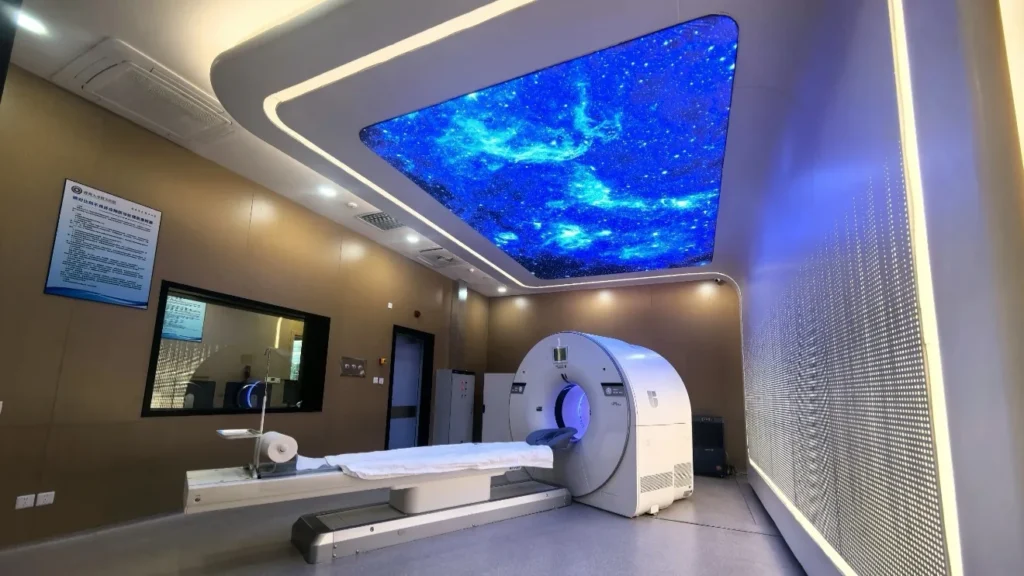
Shenzhen and Guangzhou share the practical advantage of Guangdong’s province-wide exit rule described above. Beijing operates differently: its screening infrastructure is built around JD Health’s flagship centre, which runs the same digital-first screening protocols in both Beijing and Shenzhen, and Meinian’s Beijing locations, which offer fixed, published package pricing not available at Meinian’s other city locations. For a traveler who is already routing through Beijing Capital or Beijing Daxing on a connecting itinerary, the 240-hour policy makes it possible to fit in a full screening without a separate trip to Guangdong.
Who This Guide Is For
The 240-hour policy tends to suit three kinds of travelers:
- Business travelers passing through China who want to add a full-body checkup to an existing itinerary without extending their trip by more than a few days.
- Travelers transiting to a third country — for example, someone flying from the US to Southeast Asia or Australia — who can build in a 5–10 day stop in Shenzhen, Guangzhou, or Beijing specifically for a screening.
- Cautious first-time patients who want to test the experience of Chinese healthcare with a low-commitment screening trip before considering treatment for an existing condition.
It is not designed for patients who already have a confirmed diagnosis requiring surgery, CAR-T therapy, or multi-week treatment — those cases need a S2 medical visa rather than a transit exemption. See How to Get a Medical Visa for China for that pathway, including when a 30-day visa exemption may apply instead.
Recommended 10-Day Timeline
- Day 1: Airport entry at Shenzhen Bao’an, Guangzhou Baiyun, or Beijing Capital/Daxing via transit permit counter
- Day 2: Comprehensive health screening at partner hospital or screening centre
- Days 3–5: Lab result processing and regional exploration
- Day 6: Specialist consultation reviewing results
- Days 7–10: Leisure activities before onward departure
This timeline applies equally to a Beijing-based trip, with one caveat: unlike Guangdong, Beijing’s activity area does not extend to neighboring provinces, so any side trips during Days 3–5 and 7–10 should stay within Beijing Municipality.
Top Hospitals for International Patients
Shenzhen and Guangzhou:
- University of Hong Kong–Shenzhen Hospital (IMC)
- Peking University Shenzhen Hospital (VIP Wing)
- Guangzhou United Family Hospital
Beijing:
- Peking Union Medical College Hospital (VIP International Medical Service)
- Beijing United Family Hospital
Beyond individual hospitals, Shenzhen, Guangzhou, and Beijing also host several dedicated executive health screening centres built specifically for this kind of short-stay visit. JD Health Screening Centre operates purpose-built facilities in both Beijing and Shenzhen with fully digital records and results within 3–7 working days. Meinian Onehealth Screening Centre offers fixed, published package pricing exclusively at its Beijing locations, while Ruici Health Screening Centre offers a smaller, more private setting with a presence in Shanghai and Guangzhou. If you’re deciding between providers, our Meinian vs JD Health screening comparison breaks down the differences in packages, pricing, and patient experience.
What Happens If Screening Finds Something?
A comprehensive screening occasionally turns up a finding that needs further evaluation — a nodule on imaging, an abnormal biomarker, an irregularity on a scan. This is, in a real sense, the point of screening: catching something early enough that it can still be addressed straightforwardly. But it also means it’s worth knowing, before you travel, what your options are if it happens to you.
Within your 10-day transit window, most screening centres can arrange a same-trip specialist consultation to review an abnormal result and outline what a follow-up work-up would involve. If the finding requires a full diagnostic evaluation or treatment — a biopsy, a specialist procedure, or ongoing oncology care — that generally exceeds both the 10-day stay and the scope of a transit-exempt entry, and you would need to plan a separate trip on an S2 medical visa.
This is where a coordination service becomes useful rather than optional. China Care Health Tours can arrange a specialist referral, translate and forward your screening results to the relevant oncology or specialist team, and outline next steps and cost estimates in English before you decide anything. Coordination fees are fixed and agreed in advance — there is no charge for the initial case review. For context on what more advanced treatment pathways look like, see our guides to cancer treatment in China and CAR-T cell therapy in China.
Practical Requirements
- Medical appointments must be booked at least 7 days in advance
- Download mobile payment apps (Alipay or WeChat Pay) before arrival
- Carry onward flight confirmation to a third country or region
- Review the CDC’s China travel health guidance for pre-travel vaccinations and health advisories
- For a fuller overview of what to expect — packages, pricing tiers, and how English-language reporting works — see our complete guide to executive health screening in China
FAQs
How do I actually apply for the 240-hour visa-free transit at the airport?
There is no advance application. You simply arrive at an eligible port — such as Guangzhou Baiyun, Shenzhen Bao’an, or Beijing Capital/Daxing — holding your passport and a confirmed onward ticket to a third country or region, and request the transit stamp at the border checkpoint. Some airports have a dedicated 24/240-hour transit counter separate from the regular immigration queue; ask an airport staff member if it isn’t clearly signed.
Can I go to Hong Kong and come back to mainland China without restarting my 10 days?
No. Hong Kong and Macau are separate customs and immigration territories from mainland China. Leaving mainland China for Hong Kong ends your transit stay, and re-entry would require going through the immigration process again, which may not be possible under the same transit exemption. Plan your Hong Kong side trips, if any, either before entering mainland China or after your transit window ends.
How long does it take to get my screening results, and are they in English?
Most comprehensive screening packages in Shenzhen, Guangzhou, and Beijing return results within 1–3 days, with a physician debrief covering key findings. English-language reporting is standard at the international patient departments of the hospitals and screening centres listed above; confirm this specifically when booking if you’re using a facility for the first time.
What if I need more time than my 10-day transit window allows?
The 240-hour transit period cannot be extended. If your screening uncovers something requiring further evaluation, or you simply need more time, you would need to depart as planned and return separately on an appropriate visa — either the 30-day visa exemption (if your nationality qualifies) or an S2 medical visa for extended treatment. See our medical visa guide for details.
What’s the difference between the 240-hour transit policy and the 30-day visa exemption?
The 240-hour transit policy requires proof of onward travel to a third country or region and caps your stay at 10 days, but is available to 55 specific nationalities through designated ports. The 30-day visa exemption, covering 77+ countries, has no onward-travel requirement and allows a longer stay, but is a distinct policy administered separately. Check which applies to your passport before booking travel.
Can my spouse or a family member accompany me under the same transit exemption?
Yes, provided they independently meet the same requirements — a valid passport from an eligible country and a confirmed onward ticket to a third country or region. Each traveler is assessed individually at the border; there is no dependent or accompanying-family provision within the transit policy itself.
Do I need travel insurance for a screening trip under this policy?
It isn’t a legal requirement for entry, but is strongly recommended. Travel medical insurance that explicitly covers care received in mainland China is worth confirming before departure, since many standard travel policies exclude treatment-seeking trips or limit coverage for pre-existing conditions.
Is this policy the same as a tourist visa exemption?
No. The 240-hour policy is a transit exemption tied to onward international travel, not a general tourist visa waiver. If your primary purpose is tourism without an onward international connection, a different entry category applies. Confirm your specific situation against the National Immigration Administration’s official policy page before booking.
Ready to Plan Your Screening Trip?
China Care Health Tours coordinates the full process — from confirming your eligibility for the 240-hour transit policy, to booking your screening package, to arranging specialist follow-up if anything needs a closer look.
Get a Free Case Review →
Browse Health Screening Packages →
Read the Full Medical Visa Guide →
References
- National Immigration Administration of China — 240-Hour Visa-Free Transit Policy: Eligible Countries, Ports of Entry, and Permitted Activity Areas — https://www.nia.gov.cn/n741440/n741577/c1731205/content.html
- China Care Health Tours — HKU-Shenzhen Hospital Profile — https://chinacarehealthtours.com/hospitals/shenzhen/hku-shenzhen-hospital/
- China Care Health Tours — Peking University Shenzhen Hospital Profile — https://chinacarehealthtours.com/hospitals/shenzhen/peking-university-sz-hospital/
- China Care Health Tours — Peking Union Medical College Hospital (PUMCH) Profile — https://chinacarehealthtours.com/hospitals/beijing/pumch/
- China Care Health Tours — Beijing United Family Hospital Profile — https://chinacarehealthtours.com/hospitals/beijing/beijing-united-family-hospital-review-top-international-healthcare-in-beijing/
- China Care Health Tours — Executive Health Screening — https://chinacarehealthtours.com/executive-health-screening/
- China Care Health Tours — Executive Health Screening in China (Complete Guide) — https://chinacarehealthtours.com/executive-health-screening-in-china/
- China Care Health Tours — Meinian Onehealth Screening Centre — https://chinacarehealthtours.com/executive-health-screening/meinian-onehealth-screening-centre/
- China Care Health Tours — JD Health Screening Centre — https://chinacarehealthtours.com/executive-health-screening/jd-health-screening-centre/
- China Care Health Tours — Ruici Health Screening Centre — https://chinacarehealthtours.com/executive-health-screening/ruici-health-screening-centre/
- China Care Health Tours — Meinian vs JD Health Screening Comparison — https://chinacarehealthtours.com/meinian-vs-jd-health-screening/
- China Care Health Tours — Can I Get Medical Treatment in China Visa-Free? — https://chinacarehealthtours.com/can-i-get-medical-treatment-in-china-visa-free/
- China Care Health Tours — How to Get a Medical Visa for China: A Complete 2026 Guide — https://chinacarehealthtours.com/how-to-get-a-medical-visa-for-china-a-complete-2026-guide/
- China Care Health Tours — Cancer Treatment in China — https://chinacarehealthtours.com/cancer-treatment-in-china/
- China Care Health Tours — CAR-T Cell Therapy in China — https://chinacarehealthtours.com/car-t-cell-therapy-in-china/
- China Care Health Tours — Shenzhen Medical Guide — https://chinacarehealthtours.com/destinations/shenzhen-medical-guide/
- China Care Health Tours — Executive Health Screening Packages — https://chinacarehealthtours.com/executive-health-screening/packages/
- China Care Health Tours — Contact Us — https://chinacarehealthtours.com/contact-us/